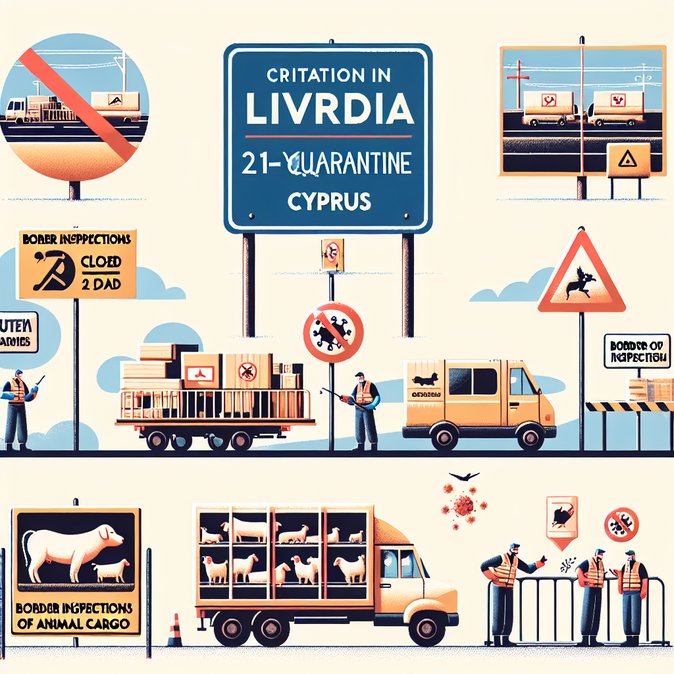
Veterinary authorities confirmed on 20 February that five cattle in Livadia, Larnaca district, tested positive for foot-and-mouth disease (FMD)—the first case in the Republic-controlled south. All 260 animals on the farm will be culled and a 3-km protection zone has been locked down, with roads closed and vehicle disinfection required. Police have erected roadblocks and banned the movement of livestock and related products without permits.(thestar.com.my)
Bio-security has also been tightened at Green-Line checkpoints after reports that a parallel outbreak hit north-controlled farms earlier this year. Trucks carrying animal feed or meat now face additional inspections and possible delays of up to two hours, officials told local media. The European Commission has offered technical support and earlier sent 500,000 vaccine doses to the north.
![Foot-and-mouth outbreak triggers movement bans and Green-Line bio-security checks]()
For travellers and companies needing to arrange short-notice entry paperwork amid these evolving measures, VisaHQ’s Cyprus specialists (https://www.visahq.com/cyprus/) can expedite visas, work permits and other documentation while providing real-time guidance on any additional bio-security declarations the government may introduce.
While human travel remains unaffected, the restrictions have knock-on effects for supply chains. Cyprus’ dairy industry relies on daily transfers of milk to processing plants, many near the buffer zone. Exporters of halloumi cheese, a major jurisdictional GI product, worry that prolonged controls could jeopardise EU-bound shipments if cold-chain timing slips.
Global-mobility teams relocating agri-sector staff should be aware that site visits to farms in the Larnaca quarantine area require advance authorisation and protective clothing. Logistics managers are advised to re-route time-sensitive goods via unaffected ports or schedule additional lead time until authorities declare the zone disease-free—earliest 14 March, assuming no further cases emerge.
Bio-security has also been tightened at Green-Line checkpoints after reports that a parallel outbreak hit north-controlled farms earlier this year. Trucks carrying animal feed or meat now face additional inspections and possible delays of up to two hours, officials told local media. The European Commission has offered technical support and earlier sent 500,000 vaccine doses to the north.

For travellers and companies needing to arrange short-notice entry paperwork amid these evolving measures, VisaHQ’s Cyprus specialists (https://www.visahq.com/cyprus/) can expedite visas, work permits and other documentation while providing real-time guidance on any additional bio-security declarations the government may introduce.
While human travel remains unaffected, the restrictions have knock-on effects for supply chains. Cyprus’ dairy industry relies on daily transfers of milk to processing plants, many near the buffer zone. Exporters of halloumi cheese, a major jurisdictional GI product, worry that prolonged controls could jeopardise EU-bound shipments if cold-chain timing slips.
Global-mobility teams relocating agri-sector staff should be aware that site visits to farms in the Larnaca quarantine area require advance authorisation and protective clothing. Logistics managers are advised to re-route time-sensitive goods via unaffected ports or schedule additional lead time until authorities declare the zone disease-free—earliest 14 March, assuming no further cases emerge.