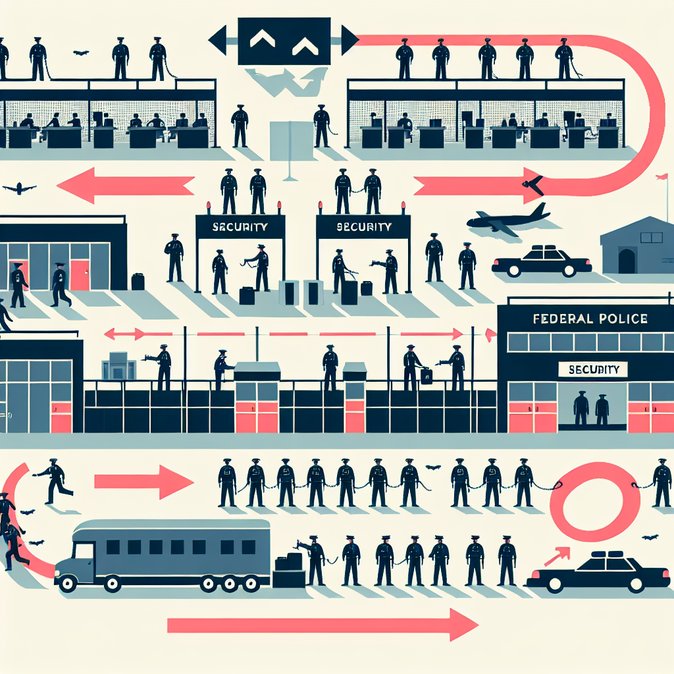
Hours after the Interior Ministry confirmed the prolongation of internal border controls, the Police Union (GdP) issued an unusual public statement: "The manpower currently deployed at the German-Polish frontier is no longer proportionate," said Andreas Broska, GdP chair for Bundespolizei operations in Berlin-Brandenburg. The union points to a steady decline in irregular-entry detections since late 2025 and argues that officers are urgently needed at rail hubs and airports instead. (zeit.de)
According to GdP figures, daily “apprehensions” along the Oder–Neisse corridor have dropped from 240 last October to fewer than 60 in February. Yet more than 1,800 federal officers remain assigned to road and motorway checkpoints. Broska warns that this "static deployment" leaves gaps in anti-terror patrols at Berlin Hauptbahnhof and understaffs passport control lanes at Frankfurt and Munich just weeks before the EU Entry/Exit System goes fully live.
The Interior Ministry has not commented on redeployment but maintains that fixed controls are still needed to deter smugglers who have shifted to smaller crossing points and forest tracks. A Bundestag oversight committee will debate the resource allocation next week.
![Police union calls for fewer officers at German-Polish border as migration numbers fall]()
For businesses and travelers navigating these shifting requirements, VisaHQ offers a practical safety net. The company’s online platform (https://www.visahq.com/germany/) provides real-time updates on German visa rules, guidance on the new EES procedures, and streamlined processing for everything from Schengen visas to work permits—helping firms keep staff movements on track even as border policies evolve.
For mobility planners the dispute matters: a reduction in border manpower could ease traffic bottlenecks on the A12 and A15, cutting transit times for company vehicles and freight. Conversely, additional officers at airports could help mitigate EES-related queues for non-EU staff arriving on assignment.
Companies with frequent cross-border operations into Poland should monitor local police advisories; spot checks may become more mobile and unpredictable even if overall staffing is reduced.
According to GdP figures, daily “apprehensions” along the Oder–Neisse corridor have dropped from 240 last October to fewer than 60 in February. Yet more than 1,800 federal officers remain assigned to road and motorway checkpoints. Broska warns that this "static deployment" leaves gaps in anti-terror patrols at Berlin Hauptbahnhof and understaffs passport control lanes at Frankfurt and Munich just weeks before the EU Entry/Exit System goes fully live.
The Interior Ministry has not commented on redeployment but maintains that fixed controls are still needed to deter smugglers who have shifted to smaller crossing points and forest tracks. A Bundestag oversight committee will debate the resource allocation next week.
For businesses and travelers navigating these shifting requirements, VisaHQ offers a practical safety net. The company’s online platform (https://www.visahq.com/germany/) provides real-time updates on German visa rules, guidance on the new EES procedures, and streamlined processing for everything from Schengen visas to work permits—helping firms keep staff movements on track even as border policies evolve.
For mobility planners the dispute matters: a reduction in border manpower could ease traffic bottlenecks on the A12 and A15, cutting transit times for company vehicles and freight. Conversely, additional officers at airports could help mitigate EES-related queues for non-EU staff arriving on assignment.
Companies with frequent cross-border operations into Poland should monitor local police advisories; spot checks may become more mobile and unpredictable even if overall staffing is reduced.