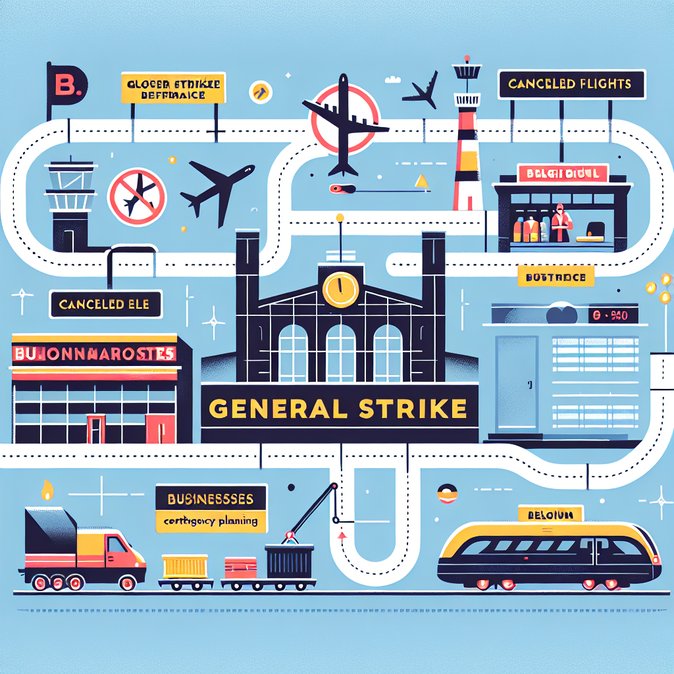
Belgium’s three main union federations – ACV/CSC, ABVV/FGTB and ACLVB – have formally notified the federal mediation service of a 24-hour general strike on Thursday 12 March. While wage-indexation disputes have been brewing for months, the immediate trigger was the government’s draft pension reform, which unions say will raise statutory retirement ages and erode early-exit schemes in high-stress sectors such as ground handling and security screening.
Aviation will bear the brunt. Brussels Airport Company warns that with ground staff, security agents and air-traffic controllers all covered by the strike notice, “little to no departures” will be possible. Airlines have begun proactive cancellations and are offering free rebooking or refunds. Long-haul carriers whose aircraft would otherwise night-stop in Zaventem are diverting to Amsterdam, Paris or Frankfurt to avoid crews and equipment being stranded in Belgium.
The industrial action coincides with the end of many European school holidays, raising the spectre of tens of thousands of stranded business travellers and holiday-makers. Corporate travel managers are re-routing personnel through neighbouring airports, while logistics firms are shifting time-critical shipments to Liège Cargo or Luxembourg Findel for the 48-hour window around the strike.
![Nation-wide 12 March strike set to paralyse Brussels Airport and rail links]()
Amid such uncertainty, travellers who need to adjust itineraries or secure alternative transit visas can lean on VisaHQ’s fast-turnaround online service. Whether you suddenly require a Schengen visa for a rerouted connection or documentation for a last-minute diversion via Paris or Amsterdam, VisaHQ’s platform (https://www.visahq.com/belgium/) streamlines applications, provides real-time status updates and expert guidance, helping you stay compliant and keep your journey on track despite the strike.
Public transport will also be disrupted: national rail operator SNCB expects only a “minimum service”, and Brussels public-transport company STIB anticipates metro headways of up to 20 minutes. Ride-hailing platforms and taxi associations report a four-fold surge in advance bookings, prompting authorities to allow temporary access to bus lanes for licensed taxis.
For mobility managers, the key recommendations are to 1) avoid itineraries touching Belgium on 11-13 March, 2) secure hotel contingencies for employees who cannot be rerouted, and 3) remind travellers that EU261 compensation does not apply to ‘extraordinary circumstances’ such as strikes. Companies with posted-worker obligations should document any assignment delays to remain compliant with Belgian wage-norm filing deadlines.
Aviation will bear the brunt. Brussels Airport Company warns that with ground staff, security agents and air-traffic controllers all covered by the strike notice, “little to no departures” will be possible. Airlines have begun proactive cancellations and are offering free rebooking or refunds. Long-haul carriers whose aircraft would otherwise night-stop in Zaventem are diverting to Amsterdam, Paris or Frankfurt to avoid crews and equipment being stranded in Belgium.
The industrial action coincides with the end of many European school holidays, raising the spectre of tens of thousands of stranded business travellers and holiday-makers. Corporate travel managers are re-routing personnel through neighbouring airports, while logistics firms are shifting time-critical shipments to Liège Cargo or Luxembourg Findel for the 48-hour window around the strike.
Amid such uncertainty, travellers who need to adjust itineraries or secure alternative transit visas can lean on VisaHQ’s fast-turnaround online service. Whether you suddenly require a Schengen visa for a rerouted connection or documentation for a last-minute diversion via Paris or Amsterdam, VisaHQ’s platform (https://www.visahq.com/belgium/) streamlines applications, provides real-time status updates and expert guidance, helping you stay compliant and keep your journey on track despite the strike.
Public transport will also be disrupted: national rail operator SNCB expects only a “minimum service”, and Brussels public-transport company STIB anticipates metro headways of up to 20 minutes. Ride-hailing platforms and taxi associations report a four-fold surge in advance bookings, prompting authorities to allow temporary access to bus lanes for licensed taxis.
For mobility managers, the key recommendations are to 1) avoid itineraries touching Belgium on 11-13 March, 2) secure hotel contingencies for employees who cannot be rerouted, and 3) remind travellers that EU261 compensation does not apply to ‘extraordinary circumstances’ such as strikes. Companies with posted-worker obligations should document any assignment delays to remain compliant with Belgian wage-norm filing deadlines.