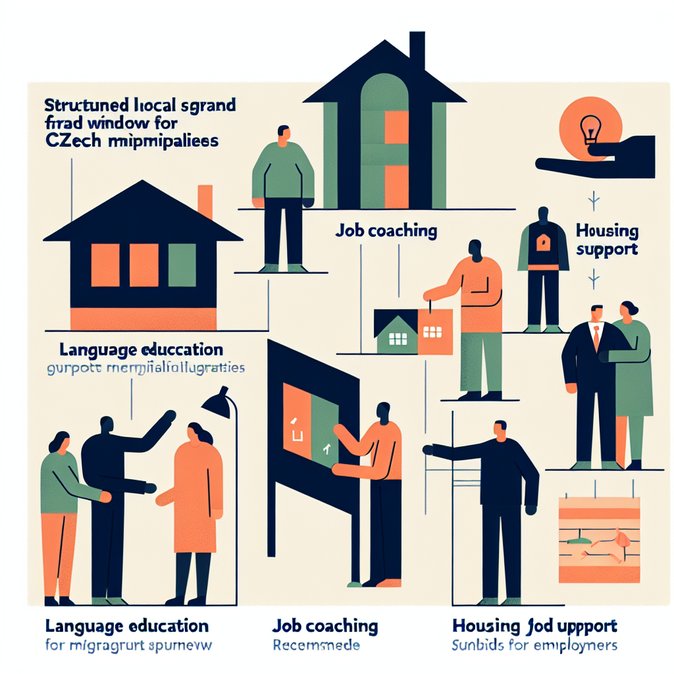
A new funding window opened late on 16 February will allow Czech municipalities, city districts and voluntary associations to claim up to 90 percent reimbursement for projects that help foreigners—chiefly Ukrainian temporary-protection holders—settle, learn Czech and enter the labour market. The measure, unveiled by the Interior Ministry and highlighted by the European Commission’s Migration and Home Affairs Directorate, is part of Prague’s 2026 integration strategy.
Eligible activities include language classes, career counselling, childcare support and salaries for local coordinators who liaise between NGOs, schools and employers. Applications are due by 17 February, and all money must be spent before 31 December 2026, a tight timeline the ministry says will "keep projects concrete and measurable". Municipalities must co-finance just 10 percent, lowering the barrier for smaller towns that have seen sudden population jumps.
For foreign residents and companies bringing talent to the Czech Republic, VisaHQ offers streamlined visa and residence-permit support that dovetails neatly with these integration efforts. From guidance on documentation and appointment scheduling to real-time status tracking, VisaHQ (https://www.visahq.com/czech-republic/) helps newcomers secure the correct legal status quickly, allowing them to focus on language courses, job searches and other municipality-funded programmes.
![EU and Czech Interior Ministry launch fast-track municipal grants to integrate protection holders]()
The grant scheme dovetails with two other policy moves: memoranda signed this month that channel €225 million in EEA and Norway Grants towards Czech integration projects, and the newly adopted Housing Support Act, which from mid-2026 will give foreign permanent residents access to rental guarantees and counselling on the same terms as Czech citizens.
For employers the municipal grants could prove valuable. Towns hosting large industrial parks may now subsidise on-site Czech lessons and job-matching services, making it easier for companies to recruit refugees into full-time roles. Relocation managers should watch local announcements and consider co-designing proposals with city halls; projects that involve corporate sponsorship often score higher in EU evaluations.
In broader context, the funding push signals Prague’s shift from emergency humanitarian aid to long-term integration. With protection status across the EU likely to run until March 2027, Czech authorities are trying to build sustainable support structures before that date. Global mobility teams should map where key suppliers or offices overlap with funded municipalities; synergies could unlock language support or childcare places for expatriate families as well.
Eligible activities include language classes, career counselling, childcare support and salaries for local coordinators who liaise between NGOs, schools and employers. Applications are due by 17 February, and all money must be spent before 31 December 2026, a tight timeline the ministry says will "keep projects concrete and measurable". Municipalities must co-finance just 10 percent, lowering the barrier for smaller towns that have seen sudden population jumps.
For foreign residents and companies bringing talent to the Czech Republic, VisaHQ offers streamlined visa and residence-permit support that dovetails neatly with these integration efforts. From guidance on documentation and appointment scheduling to real-time status tracking, VisaHQ (https://www.visahq.com/czech-republic/) helps newcomers secure the correct legal status quickly, allowing them to focus on language courses, job searches and other municipality-funded programmes.

The grant scheme dovetails with two other policy moves: memoranda signed this month that channel €225 million in EEA and Norway Grants towards Czech integration projects, and the newly adopted Housing Support Act, which from mid-2026 will give foreign permanent residents access to rental guarantees and counselling on the same terms as Czech citizens.
For employers the municipal grants could prove valuable. Towns hosting large industrial parks may now subsidise on-site Czech lessons and job-matching services, making it easier for companies to recruit refugees into full-time roles. Relocation managers should watch local announcements and consider co-designing proposals with city halls; projects that involve corporate sponsorship often score higher in EU evaluations.
In broader context, the funding push signals Prague’s shift from emergency humanitarian aid to long-term integration. With protection status across the EU likely to run until March 2027, Czech authorities are trying to build sustainable support structures before that date. Global mobility teams should map where key suppliers or offices overlap with funded municipalities; synergies could unlock language support or childcare places for expatriate families as well.