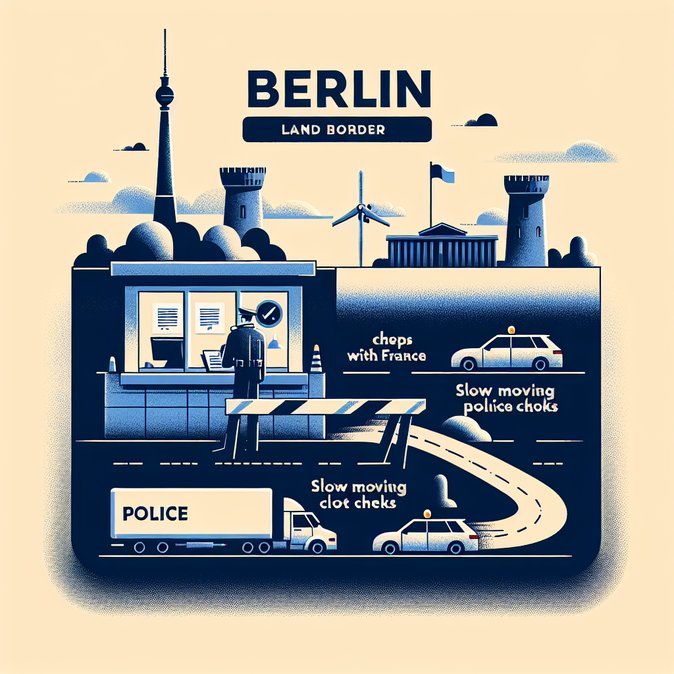
Germany’s Interior Ministry confirmed on February 17 that the temporary police controls it re-introduced on its land borders with all nine neighbouring Schengen states – including France – will remain in force for at least another six months, through September 15 2026.
The Schengen Borders Code normally guarantees passport-free travel, but allows short-term checks when a member state cites “serious threats” to public order or internal security. Berlin first invoked the clause in September 2024 amid a sharp rise in irregular entries, especially along the Czech, Polish and French frontiers. According to the ministry, officers have carried out 2.3 million spot checks and turned back 46,000 people deemed not to meet entry conditions since then.
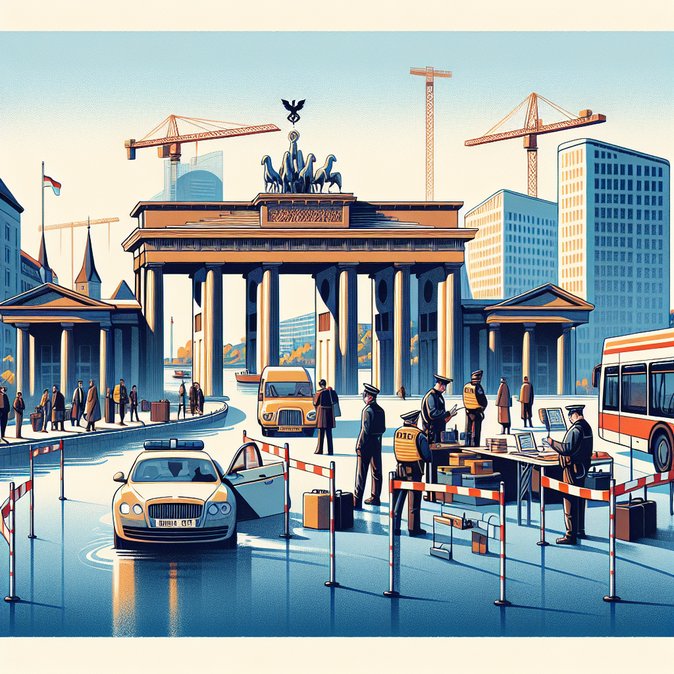
For French residents and businesses the extension means continued possibility of identity checks, vehicle searches and queueing at busy crossings such as Strasbourg–Kehl, Lauterbourg–Wörth and the A35/A5 motorway bridge near Mulhouse. Coach and rail services on the Paris–Frankfurt and Strasbourg–Stuttgart axes may also face sporadic delays while border police board to verify documents.
![Germany Extends Border Checks With France Until September 2026]()
If you are unsure what paperwork border officers might now request, VisaHQ’s online platform can guide you through the latest Schengen and residency requirements, confirm whether extra documentation is advisable, and even handle visa or permit applications on your behalf. Find more details at https://www.visahq.com/france/
Although the German government insists the measure is “targeted and flexible”, French haulage federations argue that even short hold-ups add cost to cross-border supply chains, while Eurodistrict authorities on both sides of the Rhine warn the controls undermine 30 years of labour-market integration for some 70,000 daily frontier workers.
The Commission in Brussels has urged Germany to return to “fully free movement” but acknowledged that member states retain discretion for renewable six-month periods provided the threat assessment is updated. Companies operating shuttles or staff assignments between France and Germany should continue to advise travellers to carry passports or national ID cards and, for third-country nationals, valid residence permits or Schengen visas.
The Schengen Borders Code normally guarantees passport-free travel, but allows short-term checks when a member state cites “serious threats” to public order or internal security. Berlin first invoked the clause in September 2024 amid a sharp rise in irregular entries, especially along the Czech, Polish and French frontiers. According to the ministry, officers have carried out 2.3 million spot checks and turned back 46,000 people deemed not to meet entry conditions since then.
For French residents and businesses the extension means continued possibility of identity checks, vehicle searches and queueing at busy crossings such as Strasbourg–Kehl, Lauterbourg–Wörth and the A35/A5 motorway bridge near Mulhouse. Coach and rail services on the Paris–Frankfurt and Strasbourg–Stuttgart axes may also face sporadic delays while border police board to verify documents.
If you are unsure what paperwork border officers might now request, VisaHQ’s online platform can guide you through the latest Schengen and residency requirements, confirm whether extra documentation is advisable, and even handle visa or permit applications on your behalf. Find more details at https://www.visahq.com/france/
Although the German government insists the measure is “targeted and flexible”, French haulage federations argue that even short hold-ups add cost to cross-border supply chains, while Eurodistrict authorities on both sides of the Rhine warn the controls undermine 30 years of labour-market integration for some 70,000 daily frontier workers.
The Commission in Brussels has urged Germany to return to “fully free movement” but acknowledged that member states retain discretion for renewable six-month periods provided the threat assessment is updated. Companies operating shuttles or staff assignments between France and Germany should continue to advise travellers to carry passports or national ID cards and, for third-country nationals, valid residence permits or Schengen visas.