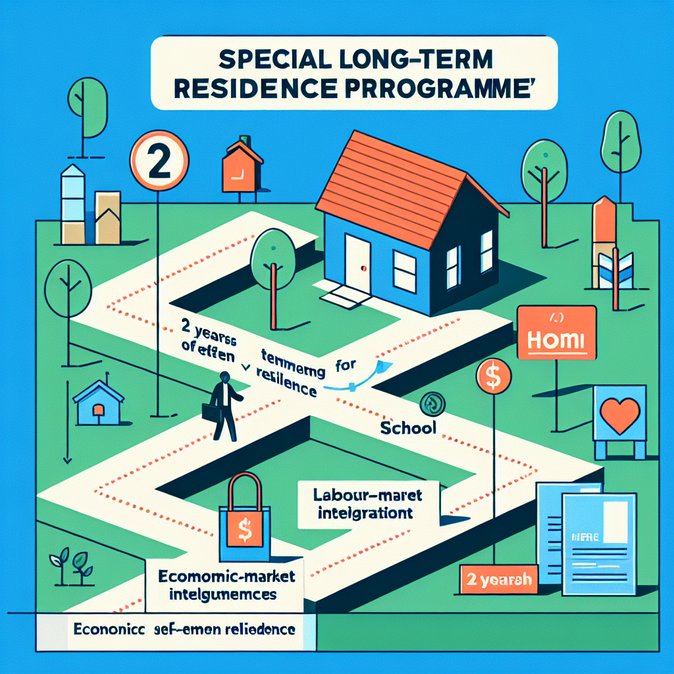
Less than 24 hours after municipalities received fresh integration cash, the Czech Cabinet approved a decree that fundamentally rewrites the route from emergency protection to durable residence for Ukrainians. Announced on 17 February by Interior Minister Lubomír Metnar, the ‘Special Long-Term Residence Programme’ will filter the roughly 390,000 Ukrainians currently under temporary protection and reward only those who are fully self-sufficient.
To qualify, applicants must have spent at least two years under temporary protection, pass security vetting, have children enrolled in Czech schools, and reach a combined gross household income of CZK 440,000 (≈€17,600) without drawing any welfare benefits. Tax arrears or unpaid health-insurance premiums are automatic deal-breakers. The message is blunt: humanitarian aid is ending and economic integration is now the ticket to stay.
According to ministry data, just 17,000 of 80,000 Ukrainians who applied for conventional long-term status last year met comparable criteria. Officials predict a similar acceptance rate under the new programme, arguing that labour-market absorption—not blanket protection—is what the economy needs. Employers facing critical shortages in manufacturing, logistics and health care broadly welcome the clarity but warn that income thresholds may exclude part-time workers and single-earner families.
![Prague tightens path from temporary protection to long-term residence for Ukrainians]()
Whether you’re an HR professional shepherding assignees through the new hurdles or a Ukrainian resident preparing a personal application, services like VisaHQ can streamline the process. The company’s Czech portal (https://www.visahq.com/czech-republic/) centralises up-to-date requirements, forms and booking tools and offers individual support that helps applicants avoid costly missteps while meeting tight government deadlines.
Politically, the decree is a compromise inside a governing coalition that includes the anti-migration Freedom and Direct Democracy (SPD) party. By setting strict conditions across the board, Metnar hopes to blunt SPD claims of "special treatment" for Ukrainians while still giving integrated refugees a path to permanence. A draft amendment to the Aliens Residence Act, due in May, will embed the programme in primary legislation.
For global-mobility teams the immediate task is compliance auditing. Ukrainian assignees and their dependants holding temporary protection must be screened for income, benefit status and school enrolment. Companies may need to top up salaries, settle insurance arrears or shift contractors onto full employment contracts to meet the CZK 440,000 threshold. Those who fail to qualify will revert to temporary protection, which the government has signalled it does not intend to renew indefinitely.
To qualify, applicants must have spent at least two years under temporary protection, pass security vetting, have children enrolled in Czech schools, and reach a combined gross household income of CZK 440,000 (≈€17,600) without drawing any welfare benefits. Tax arrears or unpaid health-insurance premiums are automatic deal-breakers. The message is blunt: humanitarian aid is ending and economic integration is now the ticket to stay.
According to ministry data, just 17,000 of 80,000 Ukrainians who applied for conventional long-term status last year met comparable criteria. Officials predict a similar acceptance rate under the new programme, arguing that labour-market absorption—not blanket protection—is what the economy needs. Employers facing critical shortages in manufacturing, logistics and health care broadly welcome the clarity but warn that income thresholds may exclude part-time workers and single-earner families.

Whether you’re an HR professional shepherding assignees through the new hurdles or a Ukrainian resident preparing a personal application, services like VisaHQ can streamline the process. The company’s Czech portal (https://www.visahq.com/czech-republic/) centralises up-to-date requirements, forms and booking tools and offers individual support that helps applicants avoid costly missteps while meeting tight government deadlines.
Politically, the decree is a compromise inside a governing coalition that includes the anti-migration Freedom and Direct Democracy (SPD) party. By setting strict conditions across the board, Metnar hopes to blunt SPD claims of "special treatment" for Ukrainians while still giving integrated refugees a path to permanence. A draft amendment to the Aliens Residence Act, due in May, will embed the programme in primary legislation.
For global-mobility teams the immediate task is compliance auditing. Ukrainian assignees and their dependants holding temporary protection must be screened for income, benefit status and school enrolment. Companies may need to top up salaries, settle insurance arrears or shift contractors onto full employment contracts to meet the CZK 440,000 threshold. Those who fail to qualify will revert to temporary protection, which the government has signalled it does not intend to renew indefinitely.