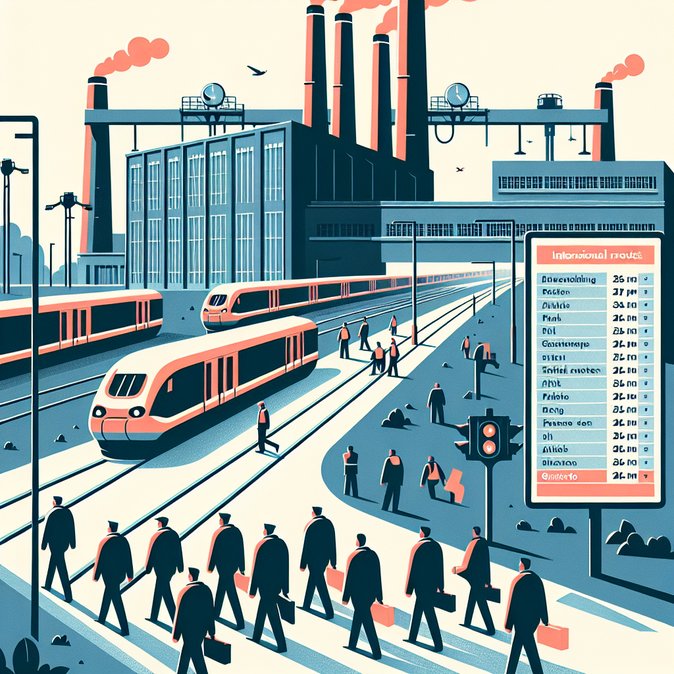
Engineers and technicians at Alstom’s Charleroi site—the company’s main Belgian facility for signalling equipment and train assembly—downed tools for a second day on 17 February. The dispute centres on flexibilisation demands and the absence of a sector-wide metal-industry labour accord, forcing each company to negotiate individually.
Although passenger services are not immediately affected, Alstom’s Charleroi plant is responsible for retrofitting ETCS signalling on SNCB locomotives and producing components for high-speed Thalys and Eurostar sets. A prolonged stoppage could delay hand-overs scheduled for Q3 2026, potentially compromising reliability targets ahead of the busy summer season.
For corporate mobility teams, any knock-on slippage in rolling-stock availability may trigger timetable changes on key international business routes such as Brussels–Paris and Brussels–Amsterdam. Advance-purchase rail passes used for assignee travel budgets could lose value if trains are rescheduled or replaced by buses.
![Strike at Alstom Charleroi Plant Raises Concerns Over Future Rolling-Stock Deliveries]()
For mobility coordinators juggling visa renewals alongside shifting transport timetables, VisaHQ’s Belgium portal (https://www.visahq.com/belgium/) streamlines Schengen and work-permit paperwork, offers real-time application tracking, and arranges secure courier pick-up of passports—helping travellers stay compliant even if rail disruptions force last-minute itinerary changes.
Union leader Romeo Bordenga of FGTB said talks remain "at a stand-still", while Alstom management claims it has already offered above-inflation wage adjustments. The dispute is further complicated by EU supply-chain rules that incentivise local content, giving unions leverage.
Observers note that Belgium’s fragmented collective-bargaining landscape often spills into industrial action that catches travellers off-guard. Mobility managers should monitor the negotiations and build flexibility into rail-dependent travel plans, especially for cross-border commuters.
Although passenger services are not immediately affected, Alstom’s Charleroi plant is responsible for retrofitting ETCS signalling on SNCB locomotives and producing components for high-speed Thalys and Eurostar sets. A prolonged stoppage could delay hand-overs scheduled for Q3 2026, potentially compromising reliability targets ahead of the busy summer season.
For corporate mobility teams, any knock-on slippage in rolling-stock availability may trigger timetable changes on key international business routes such as Brussels–Paris and Brussels–Amsterdam. Advance-purchase rail passes used for assignee travel budgets could lose value if trains are rescheduled or replaced by buses.

For mobility coordinators juggling visa renewals alongside shifting transport timetables, VisaHQ’s Belgium portal (https://www.visahq.com/belgium/) streamlines Schengen and work-permit paperwork, offers real-time application tracking, and arranges secure courier pick-up of passports—helping travellers stay compliant even if rail disruptions force last-minute itinerary changes.
Union leader Romeo Bordenga of FGTB said talks remain "at a stand-still", while Alstom management claims it has already offered above-inflation wage adjustments. The dispute is further complicated by EU supply-chain rules that incentivise local content, giving unions leverage.
Observers note that Belgium’s fragmented collective-bargaining landscape often spills into industrial action that catches travellers off-guard. Mobility managers should monitor the negotiations and build flexibility into rail-dependent travel plans, especially for cross-border commuters.