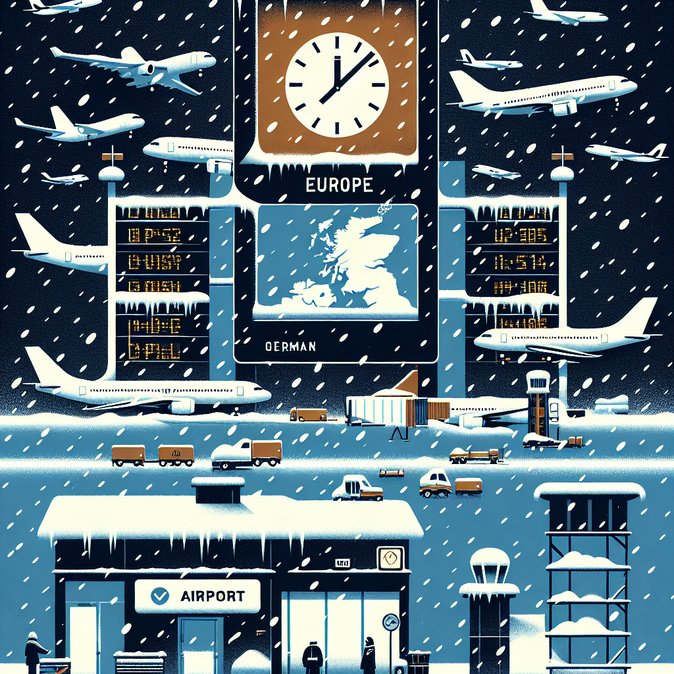
A brutal combination of heavy snow sweeping across Western and Central Europe and a 24-hour Lufthansa pilot-and-cabin-crew strike grounded or delayed more than 700 flights and disrupted another 5 000 on 15–16 February, according to Eurocontrol data compiled by multiple outlets. While Amsterdam, Paris and the German hubs bore the brunt, knock-on effects spilled into Vienna, Zurich and Budapest as aircraft rotations collapsed.(evrimagaci.org)
Vienna International Airport reported “moderate but manageable” disruption, with 34 departures delayed and five Lufthansa-group flights cancelled by mid-afternoon on Monday. Austrian Airlines drafted in reserve crews and rerouted passengers via Zurich, but warned corporate travel managers that residual delays could persist through the evening wave as snow continued in southern Germany.
For business travellers, the timing is awkward: many Austrian companies are moving staff to trade fairs in Munich and Frankfurt this week. Travel-risk consultancies advise booking longer layovers, using rail alternatives on the Linz–Munich and Vienna–Frankfurt high-speed services, and retaining boarding passes and receipts in case EC 261 compensation becomes claimable.
![Snowstorms and Lufthansa strike ripple into Vienna schedules as Europe’s air network buckles]()
Travellers scrambling for alternative routings may also need to verify that their travel documents remain valid for any newly added stopovers. VisaHQ’s Austria platform (https://www.visahq.com/austria/) can arrange same-day passport photos, express renewals and short-notice visa applications, smoothing last-minute itinerary changes when airlines rebook passengers via third-country hubs.
Freight forwarders are also feeling the squeeze. With roughly 40 % of Austria’s non-EU air cargo usually moving in passenger-plane bellies, the lost capacity on German routes has prompted express shippers to shift urgent consignments to freighters out of Bratislava or Liège, pushing up short-haul rates. Supply-chain managers in the electronics and pharma sectors are monitoring temperature-sensitive shipments closely.
Looking ahead, union leaders hinted at further industrial action if wage talks stall, while meteorologists expect another Atlantic low to reach the Alps by the weekend. Mobility teams should therefore build extra slack into flight routings and remind travellers to pre-enrol biometric data for the upcoming Schengen Entry/Exit System to speed re-checks during irregular operations.
Vienna International Airport reported “moderate but manageable” disruption, with 34 departures delayed and five Lufthansa-group flights cancelled by mid-afternoon on Monday. Austrian Airlines drafted in reserve crews and rerouted passengers via Zurich, but warned corporate travel managers that residual delays could persist through the evening wave as snow continued in southern Germany.
For business travellers, the timing is awkward: many Austrian companies are moving staff to trade fairs in Munich and Frankfurt this week. Travel-risk consultancies advise booking longer layovers, using rail alternatives on the Linz–Munich and Vienna–Frankfurt high-speed services, and retaining boarding passes and receipts in case EC 261 compensation becomes claimable.

Travellers scrambling for alternative routings may also need to verify that their travel documents remain valid for any newly added stopovers. VisaHQ’s Austria platform (https://www.visahq.com/austria/) can arrange same-day passport photos, express renewals and short-notice visa applications, smoothing last-minute itinerary changes when airlines rebook passengers via third-country hubs.
Freight forwarders are also feeling the squeeze. With roughly 40 % of Austria’s non-EU air cargo usually moving in passenger-plane bellies, the lost capacity on German routes has prompted express shippers to shift urgent consignments to freighters out of Bratislava or Liège, pushing up short-haul rates. Supply-chain managers in the electronics and pharma sectors are monitoring temperature-sensitive shipments closely.
Looking ahead, union leaders hinted at further industrial action if wage talks stall, while meteorologists expect another Atlantic low to reach the Alps by the weekend. Mobility teams should therefore build extra slack into flight routings and remind travellers to pre-enrol biometric data for the upcoming Schengen Entry/Exit System to speed re-checks during irregular operations.
More From Austria
View all
Germany extends Salzburg–Bavaria border checks until September 2026, putting fresh strain on Austrian commuters
Vienna and Interior Ministry clash over who pays for asylum-family reunifications under EU migration pact