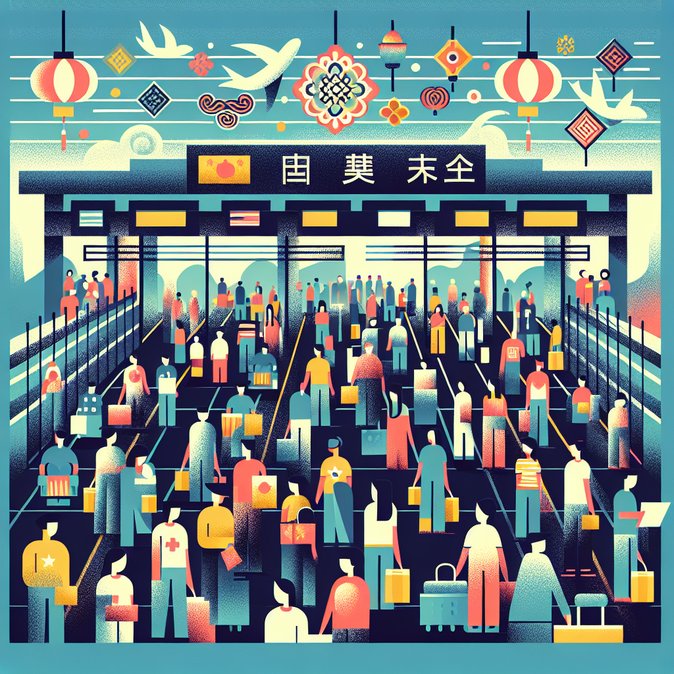
Hong Kong’s border checkpoints were at full throttle on Sunday, 15 February 2026, the first day of the mainland’s nine-day Lunar New Year holiday. Radio Television Hong Kong (RTHK) reported that immigration counters had already processed more than 240,000 arrivals by 4 p.m., nearly half of them—about 113,000—travellers from across the boundary. Arrivals surged at the West Kowloon high-speed-rail terminus and the Lo Wu, Lok Ma Chau and Shenzhen Bay land crossings, while Hong Kong International Airport (HKIA) handled the bulk of long-haul visitors.(news.rthk.hk)
The influx is the first real stress test of the city’s border infrastructure since pandemic-era restrictions were fully lifted last year. Immigration officers have been redeployed to front-line counters, and extra e-Channels have been opened to keep queues below 30 minutes. Tour groups from Guangdong, Guangxi and as far afield as Xinjiang told reporters they cleared formalities in 15–20 minutes—half the time they used to allow.(news.rthk.hk)
For individual tourists and corporate road-warriors alike, online visa facilitators such as VisaHQ can streamline pre-trip paperwork, securing Hong Kong entry visas, mainland China visas and permits for other regional hubs through one simple dashboard. Their dedicated Hong Kong page (https://www.visahq.com/hong-kong/) lists the latest requirements, fees and turnaround times, helping travellers avoid surprises at the checkpoint and focus on making the most of their Lunar New Year break.
![Mainland tourists pour into Hong Kong as nine-day Lunar New Year ‘Golden Week’ begins]()
For Hong Kong’s hospitality and retail sectors, the mainland “Golden Week” is worth billions. The Travel Industry Council expects about 2,600 organised tour groups and 1.4 million individual visitors during the period. Hoteliers say room rates around Victoria Harbour have jumped 30 per cent for the nights of the New Year’s Eve parade and fireworks, while shops in Tsim Sha Tsui and Causeway Bay have extended opening hours until midnight. The Tourism Board is distributing “Hong Kong Goodies” e-coupons worth HK$100 each at major control points to encourage spending.
Business-travel managers should note that peak arrival times at land checkpoints are forecast between 10 a.m. and 2 p.m., and again after 6 p.m. when tour coaches return from day trips. Companies with expatriates flying in this week are advising staff to allow at least an extra hour for ground transport from the airport as traffic control measures will close certain harbour-front roads before the 18 February fireworks show. Travellers connecting onward to the Greater Bay Area have been told to pre-book cross-border buses as many departures are already sold out.
The smooth first-day operations are a strategic win for Hong Kong, which is pitching itself as the “events capital” of Asia. If crowd management holds up through 23 February, officials believe it will strengthen the case for hosting even larger MICE events and mega-festivals later in the year, supporting the government’s broader “Hello Hong Kong 2.0” revival campaign.
The influx is the first real stress test of the city’s border infrastructure since pandemic-era restrictions were fully lifted last year. Immigration officers have been redeployed to front-line counters, and extra e-Channels have been opened to keep queues below 30 minutes. Tour groups from Guangdong, Guangxi and as far afield as Xinjiang told reporters they cleared formalities in 15–20 minutes—half the time they used to allow.(news.rthk.hk)
For individual tourists and corporate road-warriors alike, online visa facilitators such as VisaHQ can streamline pre-trip paperwork, securing Hong Kong entry visas, mainland China visas and permits for other regional hubs through one simple dashboard. Their dedicated Hong Kong page (https://www.visahq.com/hong-kong/) lists the latest requirements, fees and turnaround times, helping travellers avoid surprises at the checkpoint and focus on making the most of their Lunar New Year break.

For Hong Kong’s hospitality and retail sectors, the mainland “Golden Week” is worth billions. The Travel Industry Council expects about 2,600 organised tour groups and 1.4 million individual visitors during the period. Hoteliers say room rates around Victoria Harbour have jumped 30 per cent for the nights of the New Year’s Eve parade and fireworks, while shops in Tsim Sha Tsui and Causeway Bay have extended opening hours until midnight. The Tourism Board is distributing “Hong Kong Goodies” e-coupons worth HK$100 each at major control points to encourage spending.
Business-travel managers should note that peak arrival times at land checkpoints are forecast between 10 a.m. and 2 p.m., and again after 6 p.m. when tour coaches return from day trips. Companies with expatriates flying in this week are advising staff to allow at least an extra hour for ground transport from the airport as traffic control measures will close certain harbour-front roads before the 18 February fireworks show. Travellers connecting onward to the Greater Bay Area have been told to pre-book cross-border buses as many departures are already sold out.
The smooth first-day operations are a strategic win for Hong Kong, which is pitching itself as the “events capital” of Asia. If crowd management holds up through 23 February, officials believe it will strengthen the case for hosting even larger MICE events and mega-festivals later in the year, supporting the government’s broader “Hello Hong Kong 2.0” revival campaign.