The Airport Authority Hong Kong released its monthly traffic bulletin on 15 February 2026, showing Hong Kong International Airport (HKIA) handled 5.51 million passengers and 34,445 flight movements in January—year-on-year increases of 4.5 per cent and 2.4 per cent respectively. Cargo throughput also climbed 5.4 per cent to 415,000 tonnes, driven by an 18 per cent jump in trans-shipment volumes.(hongkongairport.com)
Transfer and transit traffic was the star segment, recording double-digit growth as more travellers resumed using HKIA as a hub between the Chinese mainland, Southeast Asia and North America. Airlines restored frequencies on the Taipei, Bangkok and Tokyo routes, while new fifth-freedom flights by a Middle Eastern carrier added capacity on the Asia–US corridor.
Whether you’re a corporate road warrior or a leisure traveller, making sure you have the correct entry documentation is essential before passing through Hong Kong. VisaHQ’s Hong Kong portal (https://www.visahq.com/hong-kong/) provides an easy way to check visa requirements for over 200 jurisdictions, complete applications online and track approvals in real time—saving travellers and travel managers valuable time ahead of their flights via HKIA.
![Hong Kong International Airport posts 5.5 million passengers in January, braces for 210,000-passenger peak days over holiday]()
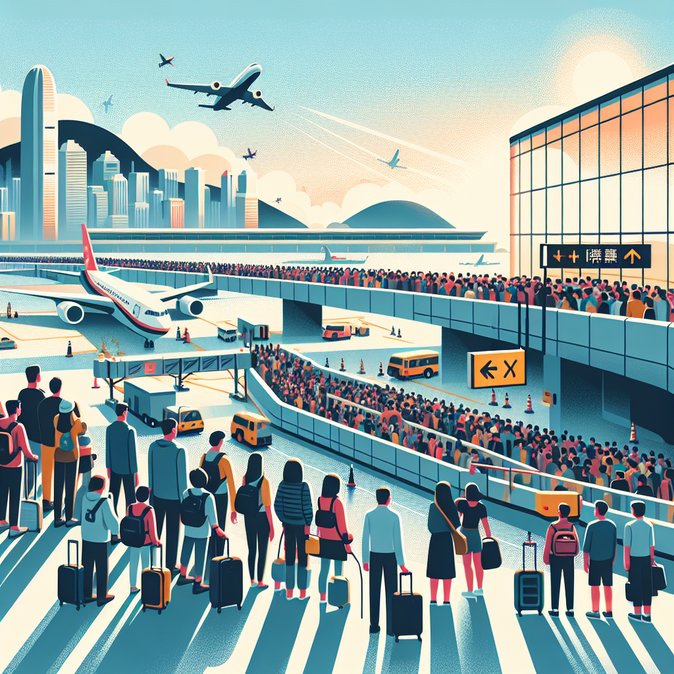
Looking ahead, the Airport Authority expects daily passenger throughput to hit 210,000 on peak days during the 15–23 February Lunar New Year period. Contingency plans include deploying 500 extra seasonal staff, opening all 300 check-in desks during morning peaks, and working with Immigration to ensure all e-Channel gates are manned. Travellers are advised to arrive three hours before departure and use the “HKIA Journey” mobile app to pre-book security-fast-track slots.
For corporate travel managers, the figures confirm that Hong Kong’s aviation recovery remains on track. January’s 13 per cent rolling-12-month passenger growth suggests the airport could surpass 70 million passengers in 2026—closing in on its pre-Covid record of 75 million. Airlines continue to cite strong premium-cabin demand, a positive sign for the city’s role as a regional headquarters hub.
The robust cargo rebound is also significant for multinationals that rely on time-critical shipments. With the third runway now operating and the logistics park in Dongguan feeding air-sea trans-shipment, HKIA is positioning itself as the gateway of choice for high-value electronics and e-commerce goods moving between mainland factories and global markets.
Transfer and transit traffic was the star segment, recording double-digit growth as more travellers resumed using HKIA as a hub between the Chinese mainland, Southeast Asia and North America. Airlines restored frequencies on the Taipei, Bangkok and Tokyo routes, while new fifth-freedom flights by a Middle Eastern carrier added capacity on the Asia–US corridor.
Whether you’re a corporate road warrior or a leisure traveller, making sure you have the correct entry documentation is essential before passing through Hong Kong. VisaHQ’s Hong Kong portal (https://www.visahq.com/hong-kong/) provides an easy way to check visa requirements for over 200 jurisdictions, complete applications online and track approvals in real time—saving travellers and travel managers valuable time ahead of their flights via HKIA.

Looking ahead, the Airport Authority expects daily passenger throughput to hit 210,000 on peak days during the 15–23 February Lunar New Year period. Contingency plans include deploying 500 extra seasonal staff, opening all 300 check-in desks during morning peaks, and working with Immigration to ensure all e-Channel gates are manned. Travellers are advised to arrive three hours before departure and use the “HKIA Journey” mobile app to pre-book security-fast-track slots.
For corporate travel managers, the figures confirm that Hong Kong’s aviation recovery remains on track. January’s 13 per cent rolling-12-month passenger growth suggests the airport could surpass 70 million passengers in 2026—closing in on its pre-Covid record of 75 million. Airlines continue to cite strong premium-cabin demand, a positive sign for the city’s role as a regional headquarters hub.
The robust cargo rebound is also significant for multinationals that rely on time-critical shipments. With the third runway now operating and the logistics park in Dongguan feeding air-sea trans-shipment, HKIA is positioning itself as the gateway of choice for high-value electronics and e-commerce goods moving between mainland factories and global markets.