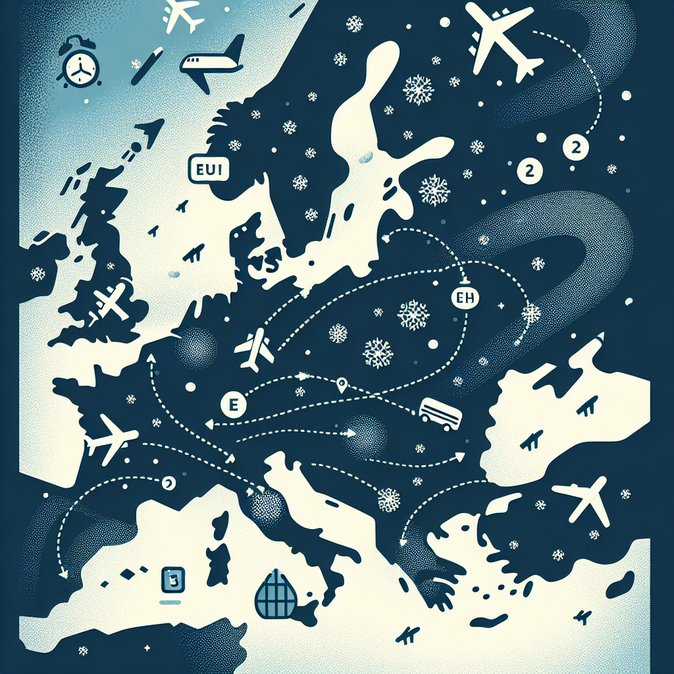
The same Arctic front that paralysed Paris spread across north-western Europe throughout 15 February, wiping out 733 flights and delaying more than 5,000 others, according to FlightAware data compiled by industry portal Travel and Tour World. France bore a sizeable share: 129 cancellations at Charles-de-Gaulle, 15 at Orly and a further 52 across Toulouse, Lyon, Bordeaux, Nice and Marseille, plus 371 delays system-wide.
Air France and Transavia together axed 289 departures, while easyJet, British Airways and KLM trimmed intra-European rotations to keep long-haul schedules intact. The snowband moved eastward during the afternoon, snarling Amsterdam-Schiphol, Brussels and Frankfurt, and forcing Eurocontrol to meter traffic. In Paris, Roissy’s de-icing backlog peaked at 60 aircraft waiting for treatment, inflating taxi-out times to an average 50 minutes versus the normal 18.
![Europe-wide snow chaos: 196 French flights scrapped, 371 delayed]()
For travellers whose itineraries are being reshuffled by the snowstorm—and who might suddenly need to route through non-Schengen hubs or extend a stay—VisaHQ can streamline the paperwork. Its France portal (https://www.visahq.com/france/) provides an easy way to check entry rules, secure transit or short-stay visas online, and receive status alerts, ensuring that unexpected weather changes don’t also turn into documentation headaches.
Business travellers should build extra buffer time into connections this week: residual crew rotations and positioning flights are expected to knock on into Monday. Companies with travel-risk programmes are urging employees to register itineraries and use the ‘duty-of-care’ channels provided by TMCs for rapid rebooking.
The disruption starkly illustrates why French airports and carriers are racing to complete biometric Entry/Exit System (EES) kiosks before the April deadline; officials say automated gates should reduce queuing once the storm-related backlog clears, although only 35 % of EES stations are currently live.
Air France and Transavia together axed 289 departures, while easyJet, British Airways and KLM trimmed intra-European rotations to keep long-haul schedules intact. The snowband moved eastward during the afternoon, snarling Amsterdam-Schiphol, Brussels and Frankfurt, and forcing Eurocontrol to meter traffic. In Paris, Roissy’s de-icing backlog peaked at 60 aircraft waiting for treatment, inflating taxi-out times to an average 50 minutes versus the normal 18.

For travellers whose itineraries are being reshuffled by the snowstorm—and who might suddenly need to route through non-Schengen hubs or extend a stay—VisaHQ can streamline the paperwork. Its France portal (https://www.visahq.com/france/) provides an easy way to check entry rules, secure transit or short-stay visas online, and receive status alerts, ensuring that unexpected weather changes don’t also turn into documentation headaches.
Business travellers should build extra buffer time into connections this week: residual crew rotations and positioning flights are expected to knock on into Monday. Companies with travel-risk programmes are urging employees to register itineraries and use the ‘duty-of-care’ channels provided by TMCs for rapid rebooking.
The disruption starkly illustrates why French airports and carriers are racing to complete biometric Entry/Exit System (EES) kiosks before the April deadline; officials say automated gates should reduce queuing once the storm-related backlog clears, although only 35 % of EES stations are currently live.