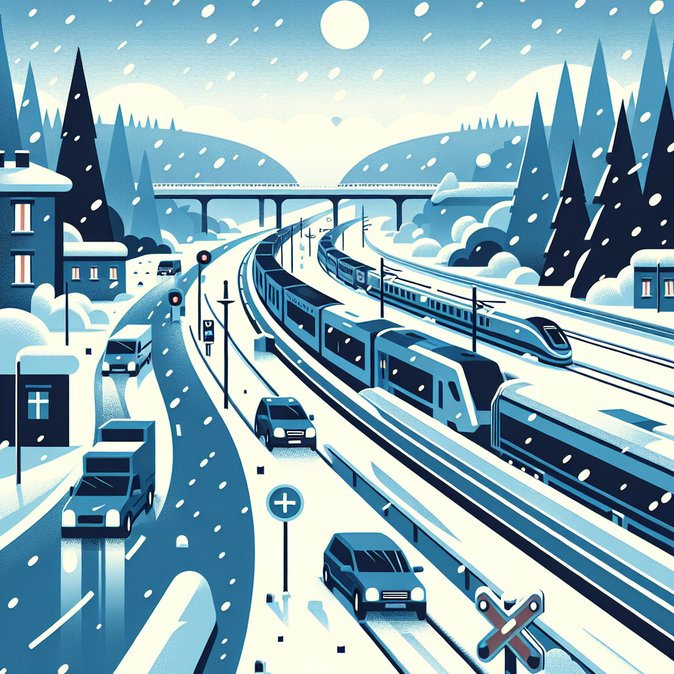
A sharp cold front moving across Central Europe dumped up to 15 centimetres of fresh snow on parts of Czechia overnight, throwing the country’s transport network into disarray on Sunday, 15 February 2026.
Meteorologists at the Czech Hydrometeorological Institute (ČHMÚ) issued an orange-level warning late Saturday, cautioning drivers and rail operators to expect treacherous conditions, drifting snow and patches of black ice. By dawn, the Moravian-Silesian Region was hardest hit: police reported dozens of accidents on the D1, D48 and major first-class roads, while a municipal gritter overturned near Klatovy in South Bohemia.
Passenger rail services also felt the impact. Long-distance Pendolino and InterCity trains on the Bohumín–Prague corridor were running 20–60 minutes late after speed restrictions were imposed; regional services in Opava and Frýdek-Místek faced partial cancellations as track switches froze. Infrastructure manager Správa železnic deployed emergency crews with heating units to keep key junctions operational and warned that knock-on delays could persist throughout the afternoon.
![Heavy Snowfall Triggers Nationwide Travel Advisory, Disrupting Road and Rail Links in Czechia]()
Although Prague itself saw only light snow, the capital’s ring road became congested as motorists avoided hilly secondary routes. Airport operations at Václav Havel Airport remained largely stable, but handling agents advised passengers to arrive earlier, anticipating slowed road access and possible de-icing queues during peak departure banks.
Should the weather force a last-minute reroute abroad, travellers can streamline any visa or travel-document updates through VisaHQ, whose Czech portal (https://www.visahq.com/czech-republic/) consolidates real-time entry requirements, passport-validity rules and embassy processing times for more than 200 destinations.
For corporate mobility managers the timing is awkward: Sunday evenings are traditionally a high-volume departure window for weekly commuters and assignees returning to client sites abroad. Companies have been urged to activate contingency plans—allowing remote start-of-week work where feasible, rerouting employees to Monday-morning flights, and briefing logistics teams about potential delivery slippages. Car-rental providers in Ostrava and Brno have reported a surge in last-minute winter-tyre requests, while relocation firms say household-goods shipments scheduled for Monday may need to be reslotted.
ČHMÚ forecasts show snow tapering off by late Sunday, but sub-zero temperatures will keep ice on untreated surfaces through Tuesday. Truckers heading towards Germany and Slovakia should expect rolling lane closures as road authorities clear drifts and re-grit priority arteries. The Ministry of Transport reiterated that drivers must carry full winter equipment—including chains—until conditions normalise. Travellers can monitor live updates on the DopravniInfo portal and the Správa železnic “Můj vlak” app.
Meteorologists at the Czech Hydrometeorological Institute (ČHMÚ) issued an orange-level warning late Saturday, cautioning drivers and rail operators to expect treacherous conditions, drifting snow and patches of black ice. By dawn, the Moravian-Silesian Region was hardest hit: police reported dozens of accidents on the D1, D48 and major first-class roads, while a municipal gritter overturned near Klatovy in South Bohemia.
Passenger rail services also felt the impact. Long-distance Pendolino and InterCity trains on the Bohumín–Prague corridor were running 20–60 minutes late after speed restrictions were imposed; regional services in Opava and Frýdek-Místek faced partial cancellations as track switches froze. Infrastructure manager Správa železnic deployed emergency crews with heating units to keep key junctions operational and warned that knock-on delays could persist throughout the afternoon.

Although Prague itself saw only light snow, the capital’s ring road became congested as motorists avoided hilly secondary routes. Airport operations at Václav Havel Airport remained largely stable, but handling agents advised passengers to arrive earlier, anticipating slowed road access and possible de-icing queues during peak departure banks.
Should the weather force a last-minute reroute abroad, travellers can streamline any visa or travel-document updates through VisaHQ, whose Czech portal (https://www.visahq.com/czech-republic/) consolidates real-time entry requirements, passport-validity rules and embassy processing times for more than 200 destinations.
For corporate mobility managers the timing is awkward: Sunday evenings are traditionally a high-volume departure window for weekly commuters and assignees returning to client sites abroad. Companies have been urged to activate contingency plans—allowing remote start-of-week work where feasible, rerouting employees to Monday-morning flights, and briefing logistics teams about potential delivery slippages. Car-rental providers in Ostrava and Brno have reported a surge in last-minute winter-tyre requests, while relocation firms say household-goods shipments scheduled for Monday may need to be reslotted.
ČHMÚ forecasts show snow tapering off by late Sunday, but sub-zero temperatures will keep ice on untreated surfaces through Tuesday. Truckers heading towards Germany and Slovakia should expect rolling lane closures as road authorities clear drifts and re-grit priority arteries. The Ministry of Transport reiterated that drivers must carry full winter equipment—including chains—until conditions normalise. Travellers can monitor live updates on the DopravniInfo portal and the Správa železnic “Můj vlak” app.