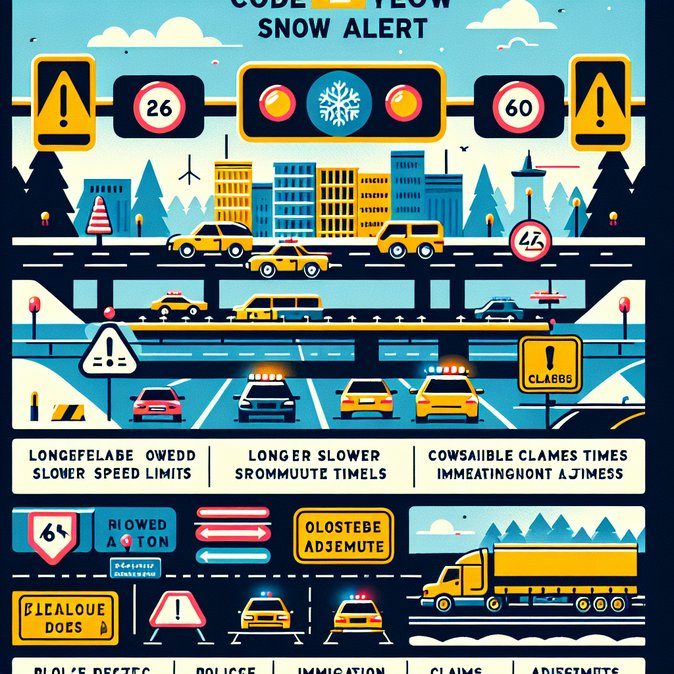
The Royal Meteorological Institute (IRM) placed much of Belgium under a code-yellow warning on Sunday as a polar trough brought widespread snow and sub-zero wind-chill. Forecasts called for 2-to-7 cm of accumulation, with the heaviest bands expected over Wallonia and the Brabant regions. The alert runs through 03:00 on Monday and empowers local authorities to activate winter-service plans.
Belgium’s Federal Police responded by deploying additional patrols on the E40, E19 and A201 airport spur, warning of “treacherous surfaces and zero visibility at times.” Temporary speed limits of 70 km/h were introduced on key arterial roads feeding Brussels Airport. Officers also mounted spot-checks at motorway service areas popular with cross-border coach operators, part of ongoing “mobile entry” inspections targeting undocumented migration.
![Belgian Meteorological Institute Issues Code-Yellow Snow Alert; Federal Police Step Up Road and Border Checks]()
For international assignees still finalising travel documentation, VisaHQ can smooth the process by expediting Belgian work permits, Schengen visas or even emergency passport renewals. Mobility teams can monitor each case through the firm’s online dashboard—accessible at https://www.visahq.com/belgium/—ensuring paperwork won’t compound weather-related delays.
For global-mobility teams the snow alert has practical consequences beyond commuter safety. Under Belgium’s ‘journey-time’ rules, employees who spend more than three hours travelling between home and temporary workplace may claim tax-free allowances—costs that escalate when road speeds tumble. Companies housing short-term assignees in Ghent, Leuven or Liège should verify shuttle arrangements and consider remote-work alternatives on Monday.
The IRM emphasised that conditions will deteriorate after dusk, with wet snow turning to ice as temperatures plunge to –4 °C inland. It urged employers to brief international staff unfamiliar with Belgian winter driving—particularly those using pool cars with summer tyres. The institute’s own app now sends geofenced push notifications in English, French, Dutch and German, a feature HR can highlight in welcome packs.
Belgium’s Federal Police responded by deploying additional patrols on the E40, E19 and A201 airport spur, warning of “treacherous surfaces and zero visibility at times.” Temporary speed limits of 70 km/h were introduced on key arterial roads feeding Brussels Airport. Officers also mounted spot-checks at motorway service areas popular with cross-border coach operators, part of ongoing “mobile entry” inspections targeting undocumented migration.

For international assignees still finalising travel documentation, VisaHQ can smooth the process by expediting Belgian work permits, Schengen visas or even emergency passport renewals. Mobility teams can monitor each case through the firm’s online dashboard—accessible at https://www.visahq.com/belgium/—ensuring paperwork won’t compound weather-related delays.
For global-mobility teams the snow alert has practical consequences beyond commuter safety. Under Belgium’s ‘journey-time’ rules, employees who spend more than three hours travelling between home and temporary workplace may claim tax-free allowances—costs that escalate when road speeds tumble. Companies housing short-term assignees in Ghent, Leuven or Liège should verify shuttle arrangements and consider remote-work alternatives on Monday.
The IRM emphasised that conditions will deteriorate after dusk, with wet snow turning to ice as temperatures plunge to –4 °C inland. It urged employers to brief international staff unfamiliar with Belgian winter driving—particularly those using pool cars with summer tyres. The institute’s own app now sends geofenced push notifications in English, French, Dutch and German, a feature HR can highlight in welcome packs.
More From Belgium
View all
Snowstorm Grounds Scores of Flights at Brussels Airport, Forcing Mobility Teams into Crisis Mode

Eurostar Warns of Lengthy Delays Between Brussels-Midi and Paris Gare du Nord After Track Problems and Weather Hit Benelux Corridor