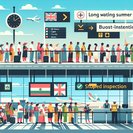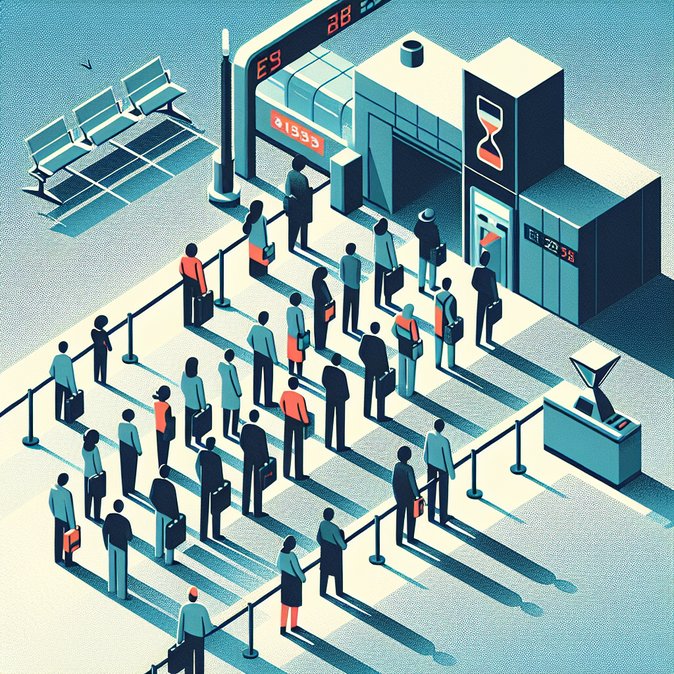
Europe’s long-delayed Entry/Exit System (EES) moves to its **mandatory** phase in April, but British travellers are already feeling the pinch. According to aviation sources quoted by *The Independent*, biometric registration of non-EU nationals is still taking up to two minutes *per person* at pilot airports—far slower than planners expected. With only 35 percent of arrivals currently being processed, peak-summer modelling shows queues could stretch to four hours unless Brussels allows member-states to throttle the system.
Airports Council International (ACI Europe), Airlines for Europe (A4E) and IATA have written jointly to the European Commission urging a temporary waiver or partial suspension between July and September. They cite a lack of self-service kiosks, software delays to the promised pre-registration app and staffing shortages at passport booths. Palma-de-Mallorca, Lisbon and Prague have already recorded three-hour waits; Lanzarote saw two-hour tailbacks over Christmas.
For UK corporates the risk is twofold: employee productivity lost to border delays and potential missed connections that trigger duty-of-care headaches. Travel managers should start briefing staff to allow extra buffer time—particularly on Monday-morning rotations and Thursday-evening returns—and capture the cost impact in travel-risk assessments.
![Travel industry warns of four-hour queues for UK passengers as EU biometric border fully rolls out]()
VisaHQ’s UK-based platform can help companies and individual travellers navigate these developments by securing the right Schengen documentation in advance, providing real-time border updates and offering expert support when itineraries change at short notice. Learn more at https://www.visahq.com/united-kingdom/
Eurostar and the Port of Dover face a unique pinch-point because French border checks happen on UK soil; both are still waiting for final software from Paris to integrate EES kiosks with existing e-gates.
If no political solution emerges, airlines may be forced to *slip* flight schedules or cap passenger loads, a scenario that could send summer fares sharply higher. Companies running tight project timelines in the EU should therefore consider advance visa-support outsourcing and alternative routings via Dublin or Belfast—still outside Schengen—where existing pre-clearance models could shave hours off door-to-door journey times.
While Brussels insists the digital border will ultimately make travel smoother and more secure, the next eight weeks will determine whether that vision lands smoothly—or whether the first major test ends in scenes reminiscent of last year’s e-gate meltdown at UK airports.
Airports Council International (ACI Europe), Airlines for Europe (A4E) and IATA have written jointly to the European Commission urging a temporary waiver or partial suspension between July and September. They cite a lack of self-service kiosks, software delays to the promised pre-registration app and staffing shortages at passport booths. Palma-de-Mallorca, Lisbon and Prague have already recorded three-hour waits; Lanzarote saw two-hour tailbacks over Christmas.
For UK corporates the risk is twofold: employee productivity lost to border delays and potential missed connections that trigger duty-of-care headaches. Travel managers should start briefing staff to allow extra buffer time—particularly on Monday-morning rotations and Thursday-evening returns—and capture the cost impact in travel-risk assessments.

VisaHQ’s UK-based platform can help companies and individual travellers navigate these developments by securing the right Schengen documentation in advance, providing real-time border updates and offering expert support when itineraries change at short notice. Learn more at https://www.visahq.com/united-kingdom/
Eurostar and the Port of Dover face a unique pinch-point because French border checks happen on UK soil; both are still waiting for final software from Paris to integrate EES kiosks with existing e-gates.
If no political solution emerges, airlines may be forced to *slip* flight schedules or cap passenger loads, a scenario that could send summer fares sharply higher. Companies running tight project timelines in the EU should therefore consider advance visa-support outsourcing and alternative routings via Dublin or Belfast—still outside Schengen—where existing pre-clearance models could shave hours off door-to-door journey times.
While Brussels insists the digital border will ultimately make travel smoother and more secure, the next eight weeks will determine whether that vision lands smoothly—or whether the first major test ends in scenes reminiscent of last year’s e-gate meltdown at UK airports.