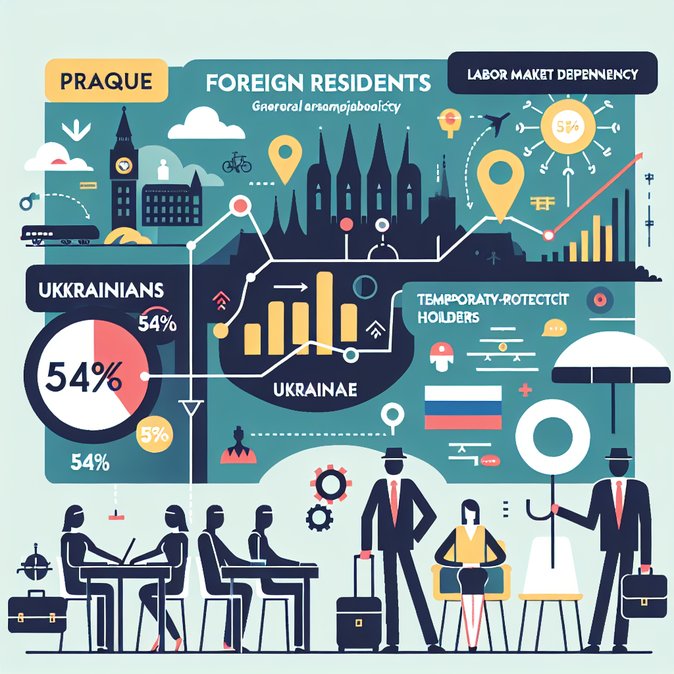
Fresh statistics released on 10 February reveal how dramatically Russia’s invasion of Ukraine has redrawn Czechia’s demographic map. According to the Ministry of the Interior, the country hosted 1.13 million legally resident foreigners at the end of 2025 – 10.4 % of the total population and an all-time high. Ukrainians account for 613,000 of that figure, meaning one out of every 18 people living in Czechia today is a Ukrainian national. (eadaily.com)
Most arrived under the special ‘temporary protection’ regime, dubbed Lex Ukraine, which grants access to health insurance, the labour market and public schools. More than 393,000 people still held that status on 31 December 2025. The Interior Ministry attributes last year’s net foreign-population growth of 37,000 almost entirely to continued inflows from Ukraine, even as new arrivals slowed compared with 2022-23.
The concentration is most visible in Prague, where city authorities estimate that upwards of 15 % of residents are now foreign citizens. Employers in construction, IT and hospitality say the Ukrainian workforce has become indispensable, filling vacancies that would otherwise hobble growth. On the flip side, the education ministry is scrambling to add Ukrainian-language teaching assistants, while housing demand has driven rents in some Prague districts up by double digits.
![Ukrainians now make up more than half of Czechia’s foreign-resident population, Interior Ministry data show]()
For companies and individuals who need help manoeuvring through Czech immigration requirements, VisaHQ’s online platform offers up-to-date visa guidance, document checklists and end-to-end application support for the Czech Republic (https://www.visahq.com/czech-republic/). The service can simplify life for multinational HR teams coordinating multiple permits as well as for Ukrainian nationals who may soon have to switch from temporary protection to standard residency pathways.
Politically, the numbers will weigh on a pending amendment to Lex Ukraine. Coalition MPs want tougher rules for beneficiaries convicted of repeated offences, while opposition parties argue for stricter time limits on temporary protection. Any change will ripple through corporate mobility programmes: revoking protection could push tens of thousands of Ukrainians into standard work-permit channels that are already oversubscribed.
For global companies, the data underline Czechia’s reliance on foreign talent and the importance of tracking policy shifts that could affect workforce planning, social integration initiatives and CSR budgets aimed at refugee support.
Most arrived under the special ‘temporary protection’ regime, dubbed Lex Ukraine, which grants access to health insurance, the labour market and public schools. More than 393,000 people still held that status on 31 December 2025. The Interior Ministry attributes last year’s net foreign-population growth of 37,000 almost entirely to continued inflows from Ukraine, even as new arrivals slowed compared with 2022-23.
The concentration is most visible in Prague, where city authorities estimate that upwards of 15 % of residents are now foreign citizens. Employers in construction, IT and hospitality say the Ukrainian workforce has become indispensable, filling vacancies that would otherwise hobble growth. On the flip side, the education ministry is scrambling to add Ukrainian-language teaching assistants, while housing demand has driven rents in some Prague districts up by double digits.

For companies and individuals who need help manoeuvring through Czech immigration requirements, VisaHQ’s online platform offers up-to-date visa guidance, document checklists and end-to-end application support for the Czech Republic (https://www.visahq.com/czech-republic/). The service can simplify life for multinational HR teams coordinating multiple permits as well as for Ukrainian nationals who may soon have to switch from temporary protection to standard residency pathways.
Politically, the numbers will weigh on a pending amendment to Lex Ukraine. Coalition MPs want tougher rules for beneficiaries convicted of repeated offences, while opposition parties argue for stricter time limits on temporary protection. Any change will ripple through corporate mobility programmes: revoking protection could push tens of thousands of Ukrainians into standard work-permit channels that are already oversubscribed.
For global companies, the data underline Czechia’s reliance on foreign talent and the importance of tracking policy shifts that could affect workforce planning, social integration initiatives and CSR budgets aimed at refugee support.