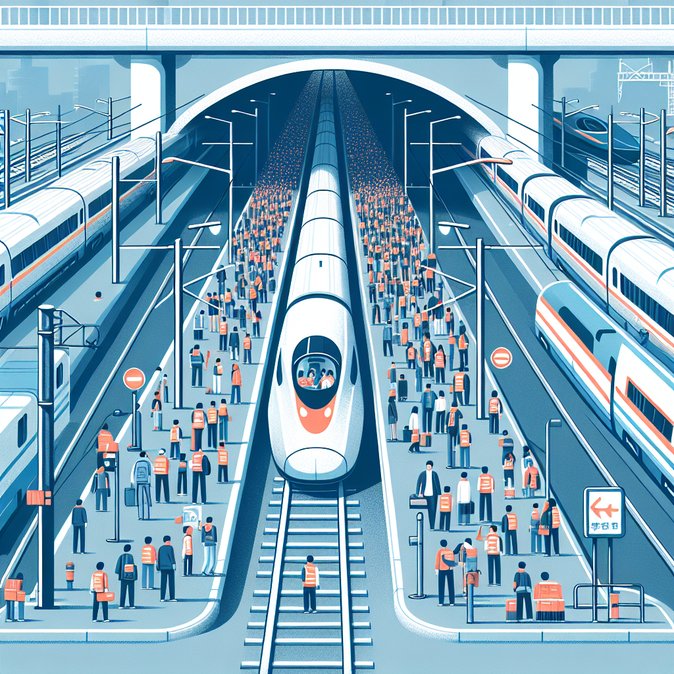
Less than 24 hours after bookings opened for 16 newly added high-speed rail stops, seats on trains from Hong Kong West Kowloon station to 14 of those destinations were completely sold out for the peak getaway window of 14-15 February.
The South China Morning Post reported on the evening of 8 February that Nanjing South, Wuxi East, Hefei South and 11 other cities showed zero availability across all three classes on China Railway’s 12306 app. Only limited inventory remained for Taizhou and Yancheng. Fares for the seven-hour Hong Kong–Nanjing journey range from HK$1,028 (second class) to HK$3,168 (business class), yet demand from holidaymakers and short-stay business travellers vastly out-stripped supply.
Amid this surge in cross-border demand, VisaHQ can help travellers cut through one more bottleneck: visas. Through its Hong Kong portal (https://www.visahq.com/hong-kong/), individuals and corporate travel managers can arrange mainland China visas online, track applications in real time and receive updates on the latest entry requirements, ensuring that travel plans remain on schedule even when train tickets are scarce.
![High-speed rail tickets from Hong Kong to 14 new mainland cities sell out days before holiday exodus]()
Travel-management companies say the sell-out underscores Hong Kong’s renewed role as a Greater Bay Area rail hub after the December 2025 network expansion that connected the city to a total of 77 mainland stations. Corporates with regional staff rotations now have direct rail access to Jiangsu and Anhui manufacturing belts, cutting door-to-door travel times by 30–40 per cent compared with flying via Shanghai.
However, the brisk sales also expose capacity constraints. Only one through-train to Nanjing operates daily, and existing rolling stock cannot be lengthened because West Kowloon’s platforms are fixed at 16 carriages. The MTR Corporation says it is negotiating with China Railway to add duplicate services during the holiday-return rush (22-24 February), but security-screening slots and pathing on the Guangzhou-Shenzhen section are limited.
Global-mobility specialists should advise assignees to book return legs immediately, consider flying to nearby airports such as Nanjing Lukou or Hefei Xinqiao, and build contingency time into project schedules in case of rail overflows.
The South China Morning Post reported on the evening of 8 February that Nanjing South, Wuxi East, Hefei South and 11 other cities showed zero availability across all three classes on China Railway’s 12306 app. Only limited inventory remained for Taizhou and Yancheng. Fares for the seven-hour Hong Kong–Nanjing journey range from HK$1,028 (second class) to HK$3,168 (business class), yet demand from holidaymakers and short-stay business travellers vastly out-stripped supply.
Amid this surge in cross-border demand, VisaHQ can help travellers cut through one more bottleneck: visas. Through its Hong Kong portal (https://www.visahq.com/hong-kong/), individuals and corporate travel managers can arrange mainland China visas online, track applications in real time and receive updates on the latest entry requirements, ensuring that travel plans remain on schedule even when train tickets are scarce.

Travel-management companies say the sell-out underscores Hong Kong’s renewed role as a Greater Bay Area rail hub after the December 2025 network expansion that connected the city to a total of 77 mainland stations. Corporates with regional staff rotations now have direct rail access to Jiangsu and Anhui manufacturing belts, cutting door-to-door travel times by 30–40 per cent compared with flying via Shanghai.
However, the brisk sales also expose capacity constraints. Only one through-train to Nanjing operates daily, and existing rolling stock cannot be lengthened because West Kowloon’s platforms are fixed at 16 carriages. The MTR Corporation says it is negotiating with China Railway to add duplicate services during the holiday-return rush (22-24 February), but security-screening slots and pathing on the Guangzhou-Shenzhen section are limited.
Global-mobility specialists should advise assignees to book return legs immediately, consider flying to nearby airports such as Nanjing Lukou or Hefei Xinqiao, and build contingency time into project schedules in case of rail overflows.
More From Hong Kong
View all
Border agencies seize 23 illegal orchid shipments as Hong Kong steps up holiday inspections

Hong Kong tightens crowd-control rules at popular nature sites ahead of expected 1.43 million mainland visitors