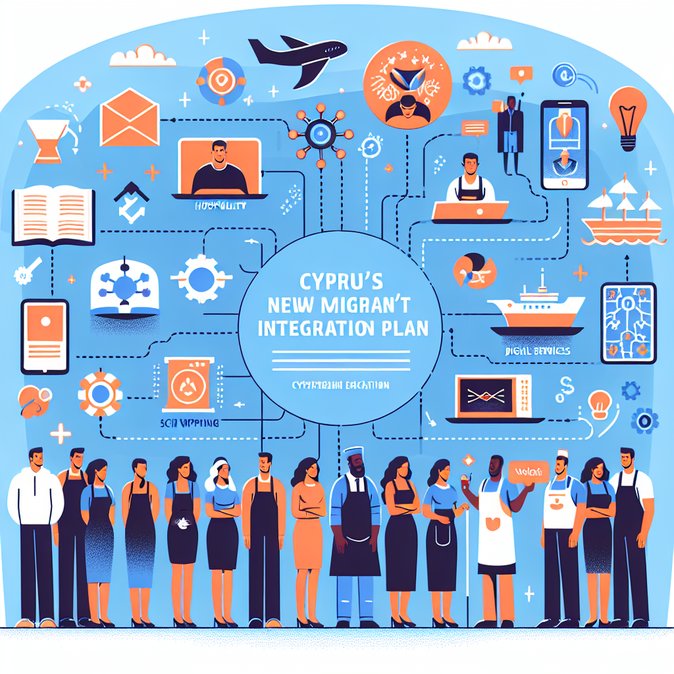
In a landmark decision that will shape the country’s labour market for the rest of the decade, the Cypriot Cabinet has endorsed the National Strategy for Migrant Integration 2026-2029. Drafted by the fledgling Deputy Ministry of Migration and International Protection, the four-year blueprint is the first time Nicosia has set measurable targets for bringing the island’s 150 000-plus legally-resident third-country nationals into the economic and social mainstream. (cna.org.cy)
Key pillars include mandatory Greek-language courses subsidised by the EU’s Asylum, Migration & Integration Fund; fast-track recognition of foreign vocational qualifications; and an online “one-stop shop” to streamline residence-permit renewals and employer notifications.
Officials say roughly €60 million in EU and national funds will be channelled into programmes ranging from digital-skills boot camps for Ukrainian IT workers in Limassol to cross-cultural community mediators in rural Paphos.
![Cabinet Adopts Cyprus’s First National Strategy for Migrant Integration 2026-2029]()
For employers—from shipping companies and hotel chains to fintech start-ups—the strategy promises more predictable processing times for work-permit renewals and clearer pathways to permanent residence for high-performing staff. The plan also pledges to clamp down on exploitation by requiring labour inspectors to audit recruitment agencies and construction sites more frequently.
Prospective employees and employers alike can simplify the visa and residence-permit paperwork by turning to VisaHQ, whose Cyprus portal (https://www.visahq.com/cyprus/) provides up-to-date guidance, document checklists, and online application management for everything from short-term business visas to multi-year work permits. By taking the bureaucratic heavy lifting off their shoulders, companies can focus on onboarding talent while migrants gain clarity on their status—an efficient complement to the government’s new integration drive.
Cyprus’s integration push comes after a dramatic drop—86 percent—in irregular arrivals since 2022, allowing the government to pivot from emergency border control to long-term inclusion. The Deputy Ministry aims to have 70 percent of legal migrants attain at least A2-level Greek proficiency and 55 percent participating in employer-funded social insurance by the end of 2029.
Businesses are being urged to partner with vocational institutes to design tailor-made up-skilling courses, while municipalities will receive grants to open intercultural centres. Observers say success will hinge on adequate staffing at migration offices and the political will to enforce anti-discrimination statutes.
Key pillars include mandatory Greek-language courses subsidised by the EU’s Asylum, Migration & Integration Fund; fast-track recognition of foreign vocational qualifications; and an online “one-stop shop” to streamline residence-permit renewals and employer notifications.
Officials say roughly €60 million in EU and national funds will be channelled into programmes ranging from digital-skills boot camps for Ukrainian IT workers in Limassol to cross-cultural community mediators in rural Paphos.

For employers—from shipping companies and hotel chains to fintech start-ups—the strategy promises more predictable processing times for work-permit renewals and clearer pathways to permanent residence for high-performing staff. The plan also pledges to clamp down on exploitation by requiring labour inspectors to audit recruitment agencies and construction sites more frequently.
Prospective employees and employers alike can simplify the visa and residence-permit paperwork by turning to VisaHQ, whose Cyprus portal (https://www.visahq.com/cyprus/) provides up-to-date guidance, document checklists, and online application management for everything from short-term business visas to multi-year work permits. By taking the bureaucratic heavy lifting off their shoulders, companies can focus on onboarding talent while migrants gain clarity on their status—an efficient complement to the government’s new integration drive.
Cyprus’s integration push comes after a dramatic drop—86 percent—in irregular arrivals since 2022, allowing the government to pivot from emergency border control to long-term inclusion. The Deputy Ministry aims to have 70 percent of legal migrants attain at least A2-level Greek proficiency and 55 percent participating in employer-funded social insurance by the end of 2029.
Businesses are being urged to partner with vocational institutes to design tailor-made up-skilling courses, while municipalities will receive grants to open intercultural centres. Observers say success will hinge on adequate staffing at migration offices and the political will to enforce anti-discrimination statutes.
More From Cyprus
View all
Cyprus Presses Washington to Admit Island into U.S. Visa Waiver Program

EU Sets Deadline: Cypriot Travellers Must Replace Old ID Cards by 3 August 2026 or Risk Domestic-Schengen Travel Ban