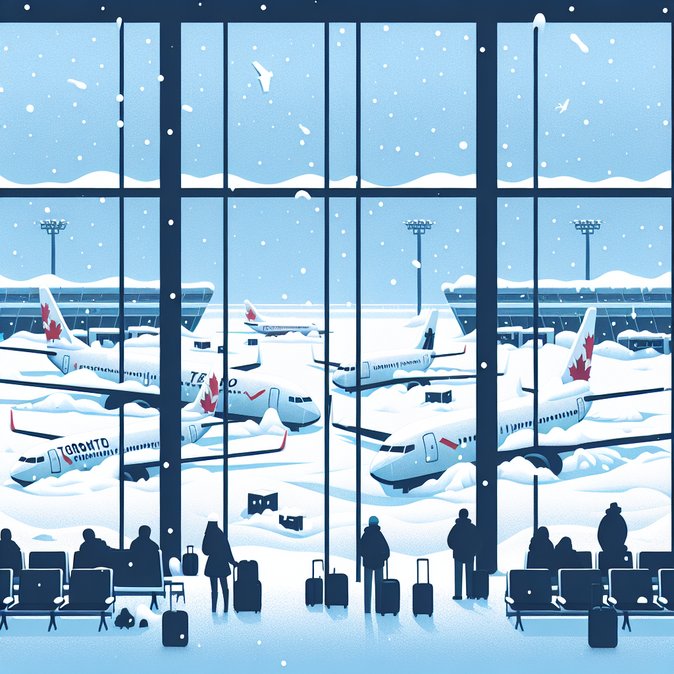
A powerful winter storm that swept through southern Ontario between 7 and 8 February dumped heavy snow and brought low visibility to Toronto Pearson International Airport, forcing airlines to delay more than 300 flights and cancel nearly 40. Air Canada alone scrubbed 20 services and posted more than 140 delays, while WestJet, Delta, American, British Airways and Air China all reported cascading network knock-ons. (travelandtourworld.com)
With runways intermittently closed for ploughing and de-icing queues stretching beyond available gates, the disruption rippled across North America and trans-Atlantic schedules. One high-profile incident involved Air Canada flight AC858 to London, diverted to St John’s after an unruly passenger, then returned to Toronto, illustrating how operational stress amplifies irregular events. (travelandtourworld.com)
![Snowstorm Paralyses Toronto Pearson, Stranding Thousands and Disrupting Global Itineraries]()
Travellers suddenly faced with rerouting or extended layovers should also verify whether their visas or electronic travel authorizations will still be valid for the new dates and any unexpected transit points. VisaHQ’s Canada portal (https://www.visahq.com/canada/) can fast-track renewals or new applications online, coordinating with consulates worldwide and alerting users as soon as approvals are issued—an invaluable safety net when winter weather upends plans.
Airport hotels around Pearson hit capacity by Saturday afternoon, prompting price spikes and leaving some travellers to sleep in terminals. Local tourism businesses, however, saw an unexpected surge in emergency bookings. Travel insurers reminded policy-holders that weather-related delays are covered only if policies were purchased before Environment Canada issued its storm warning.
For business-mobility managers, the episode underscores the need for robust contingency planning during Canada’s peak snow season (January-March). Experts recommend building at least a six-hour buffer into itineraries that connect through YYZ in winter, purchasing fully flexible fares, and reminding assignees of their carrier’s rebooking rules before travel. Airlines have issued change-fee waivers valid through 12 February, but seat availability on alternate flights remains tight.
With runways intermittently closed for ploughing and de-icing queues stretching beyond available gates, the disruption rippled across North America and trans-Atlantic schedules. One high-profile incident involved Air Canada flight AC858 to London, diverted to St John’s after an unruly passenger, then returned to Toronto, illustrating how operational stress amplifies irregular events. (travelandtourworld.com)

Travellers suddenly faced with rerouting or extended layovers should also verify whether their visas or electronic travel authorizations will still be valid for the new dates and any unexpected transit points. VisaHQ’s Canada portal (https://www.visahq.com/canada/) can fast-track renewals or new applications online, coordinating with consulates worldwide and alerting users as soon as approvals are issued—an invaluable safety net when winter weather upends plans.
Airport hotels around Pearson hit capacity by Saturday afternoon, prompting price spikes and leaving some travellers to sleep in terminals. Local tourism businesses, however, saw an unexpected surge in emergency bookings. Travel insurers reminded policy-holders that weather-related delays are covered only if policies were purchased before Environment Canada issued its storm warning.
For business-mobility managers, the episode underscores the need for robust contingency planning during Canada’s peak snow season (January-March). Experts recommend building at least a six-hour buffer into itineraries that connect through YYZ in winter, purchasing fully flexible fares, and reminding assignees of their carrier’s rebooking rules before travel. Airlines have issued change-fee waivers valid through 12 February, but seat availability on alternate flights remains tight.