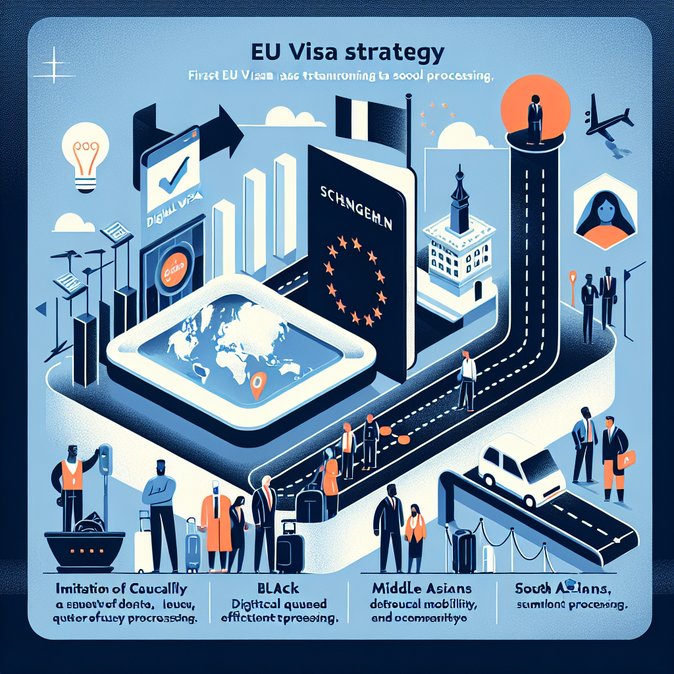
The European Commission has adopted its first comprehensive EU Visa Strategy, promising to overhaul how Schengen visas are issued and managed and, crucially for Italy, to give member-state consulates the resources and digital tools they have long requested.
Under the plan—published on 7 February 2026—the Commission proposes three pillars. The first is tighter border security: a new framework for granting or suspending visa-free status, closer monitoring of existing waivers and reinforced scrutiny of travel documents. Pillar two focuses on competitiveness, committing every Schengen state to roll out 100 per cent digital short-stay visa processing by 2028 and to offer longer-validity multiple-entry visas to “trusted travellers”, including frequent business visitors. The final pillar targets global talent attraction: Brussels urges capitals to create single-window “Legal Mobility Gateways” that help employers and highly-skilled professionals navigate long-stay visas, start-up permits and intra-EU mobility rules. Additional EU funding is earmarked for consulate staffing and IT upgrades.
For Italian companies—and the thousands of foreign workers and investors they recruit—the timing is significant. Italy’s consulates currently face the longest Schengen appointment queues in the bloc; digital filing and pooled outsourcing could ease a bottleneck that has frustrated tour operators, film productions and exporters alike. The talent component dovetails with Rome’s three-year migration quota plan by making it simpler for non-EU researchers, engineers and graduate students to move between European subsidiaries without re-applying for new residence permits.
![EU Unveils First-Ever Visa Strategy, Pledging Faster Schengen Procedures and New Talent Pathways]()
Whether you are a business traveller aiming for a longer-validity C-visa or an HR department preparing assignees for the new digital portal, VisaHQ can streamline the entire process. Through its Italy-dedicated platform (https://www.visahq.com/italy/) the company tracks consulate appointment availability in real time, pre-screens documentation to meet shifting EU rules, and securely stores biometrics so repeat applicants are ready for the one-click reuse promised by the Strategy. VisaHQ’s team also monitors pilot programmes such as extended-validity visas, alerting clients as soon as an Italian mission opts in.
Practically, travellers will feel the changes in stages. The much-delayed Entry/Exit System (EES) went live in October 2025; ETIAS will follow in late-2026. Once the Visa Strategy is enacted, Italy must transpose the digital visa code—meaning that by 2027 most applicants will upload biometric data once and reuse it for future trips. Multiple-entry visas of up to five years will become the norm for bona-fide business visitors, reducing repeat paperwork.
Corporate mobility managers should start mapping how the forthcoming ‘Legal Mobility Gateway’ will interact with Italy’s existing one-stop-shop for work permits (Sportello Unico). Early engagement with Italian consulates will be key: the Commission’s blueprint lets member states pilot longer visa validity immediately, so proactive missions could begin issuing two-year Schengen C-visas long before the formal deadline. In short, while the Strategy is EU-wide, its success will hinge on how quickly high-volume countries such as Italy embrace the digital shift and talent-friendly rules.
Under the plan—published on 7 February 2026—the Commission proposes three pillars. The first is tighter border security: a new framework for granting or suspending visa-free status, closer monitoring of existing waivers and reinforced scrutiny of travel documents. Pillar two focuses on competitiveness, committing every Schengen state to roll out 100 per cent digital short-stay visa processing by 2028 and to offer longer-validity multiple-entry visas to “trusted travellers”, including frequent business visitors. The final pillar targets global talent attraction: Brussels urges capitals to create single-window “Legal Mobility Gateways” that help employers and highly-skilled professionals navigate long-stay visas, start-up permits and intra-EU mobility rules. Additional EU funding is earmarked for consulate staffing and IT upgrades.
For Italian companies—and the thousands of foreign workers and investors they recruit—the timing is significant. Italy’s consulates currently face the longest Schengen appointment queues in the bloc; digital filing and pooled outsourcing could ease a bottleneck that has frustrated tour operators, film productions and exporters alike. The talent component dovetails with Rome’s three-year migration quota plan by making it simpler for non-EU researchers, engineers and graduate students to move between European subsidiaries without re-applying for new residence permits.

Whether you are a business traveller aiming for a longer-validity C-visa or an HR department preparing assignees for the new digital portal, VisaHQ can streamline the entire process. Through its Italy-dedicated platform (https://www.visahq.com/italy/) the company tracks consulate appointment availability in real time, pre-screens documentation to meet shifting EU rules, and securely stores biometrics so repeat applicants are ready for the one-click reuse promised by the Strategy. VisaHQ’s team also monitors pilot programmes such as extended-validity visas, alerting clients as soon as an Italian mission opts in.
Practically, travellers will feel the changes in stages. The much-delayed Entry/Exit System (EES) went live in October 2025; ETIAS will follow in late-2026. Once the Visa Strategy is enacted, Italy must transpose the digital visa code—meaning that by 2027 most applicants will upload biometric data once and reuse it for future trips. Multiple-entry visas of up to five years will become the norm for bona-fide business visitors, reducing repeat paperwork.
Corporate mobility managers should start mapping how the forthcoming ‘Legal Mobility Gateway’ will interact with Italy’s existing one-stop-shop for work permits (Sportello Unico). Early engagement with Italian consulates will be key: the Commission’s blueprint lets member states pilot longer visa validity immediately, so proactive missions could begin issuing two-year Schengen C-visas long before the formal deadline. In short, while the Strategy is EU-wide, its success will hinge on how quickly high-volume countries such as Italy embrace the digital shift and talent-friendly rules.