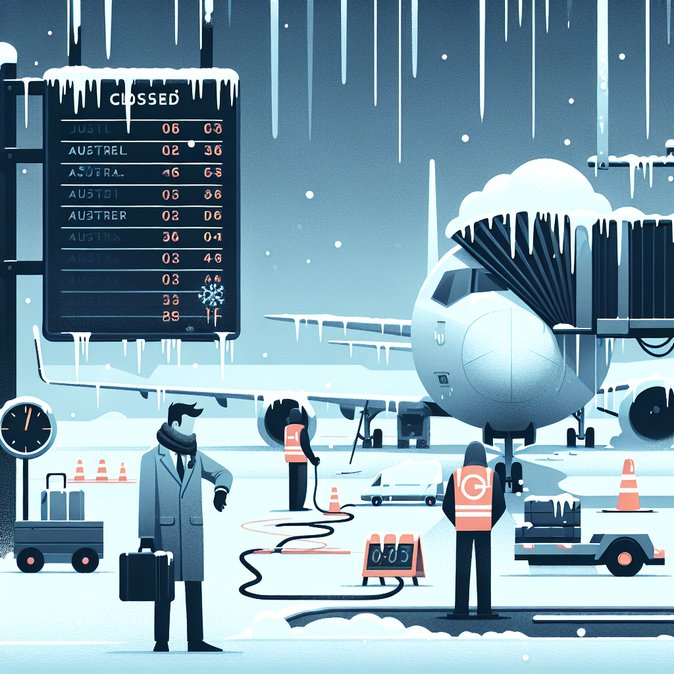
Severe freezing rain sweeping across eastern Germany forced Berlin-Brandenburg Airport (BER) to suspend all take-offs and landings for a second day on 6 February, disrupting one of Austria’s busiest short-haul business corridors. Austrian aviation outlet *Austrian Wings* reported that six daily rotations between Vienna and Berlin were on the schedule; the first outbound service (OS 231/232, planned 07:10) was cancelled outright and airlines warned that further flights might be scrubbed at short notice.
The shutdown stranded hundreds of passengers who use the 70-minute hop for government, start-up and life-science ties between the two capitals. Lufthansa Group carriers re-booked travellers via Munich or Frankfurt, while low-cost competitors offered cross-border coach transfers to Dresden and Prague. Vienna Airport advised passengers to monitor flight status and arrive later to avoid terminal crowding.
![Ice Storm Shuts Berlin BER – Vienna Flights Cancelled or at Risk]()
Meanwhile, travellers who suddenly need to detour through neighbouring countries or extend their stay can turn to VisaHQ for help securing any additional travel documents. The company’s Austria portal (https://www.visahq.com/austria/) provides rapid, step-by-step visa and transit-permit processing, easing the paperwork burden while airlines and airports work through weather disruptions.
Meteorologists said the rare large-scale "Blitzeis" episode coated runways with a centimetre-thick glaze, making de-icing ineffective. Berlin authorities expect operations to resume gradually on 7 February once temperatures rise above zero.
For mobility managers the episode is a reminder that Central Europe’s increasingly volatile winter weather can upend tight itineraries. Companies with time-critical meetings are urged to build 24-hour buffers into travel policies and verify that tickets qualify for EU261 compensation or lounge access when force-majeure closures hit.
The shutdown stranded hundreds of passengers who use the 70-minute hop for government, start-up and life-science ties between the two capitals. Lufthansa Group carriers re-booked travellers via Munich or Frankfurt, while low-cost competitors offered cross-border coach transfers to Dresden and Prague. Vienna Airport advised passengers to monitor flight status and arrive later to avoid terminal crowding.

Meanwhile, travellers who suddenly need to detour through neighbouring countries or extend their stay can turn to VisaHQ for help securing any additional travel documents. The company’s Austria portal (https://www.visahq.com/austria/) provides rapid, step-by-step visa and transit-permit processing, easing the paperwork burden while airlines and airports work through weather disruptions.
Meteorologists said the rare large-scale "Blitzeis" episode coated runways with a centimetre-thick glaze, making de-icing ineffective. Berlin authorities expect operations to resume gradually on 7 February once temperatures rise above zero.
For mobility managers the episode is a reminder that Central Europe’s increasingly volatile winter weather can upend tight itineraries. Companies with time-critical meetings are urged to build 24-hour buffers into travel policies and verify that tickets qualify for EU261 compensation or lounge access when force-majeure closures hit.