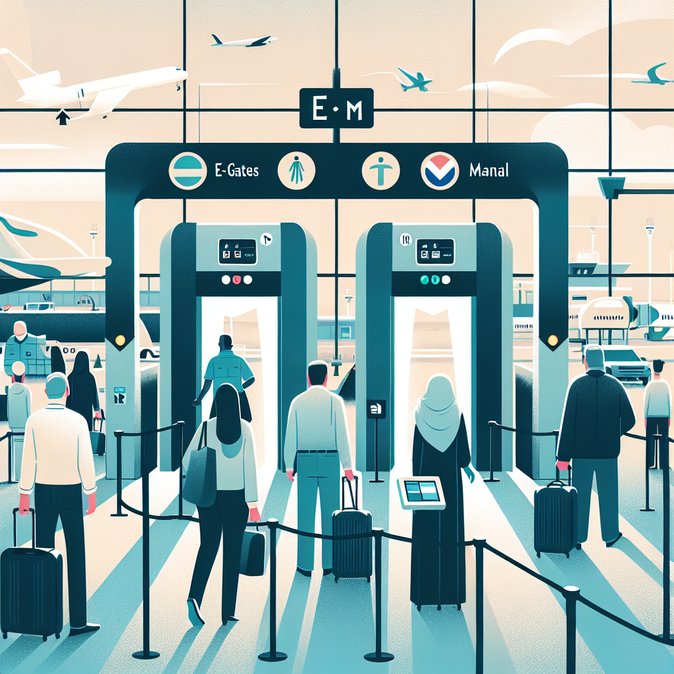
One of the hidden casualties of the EU’s digital border overhaul is France’s network of Parafe automated passport gates. Until 2025, holders of French residence cards—many of them British or American expatriates on local work contracts—could zip through Parafe e-gates alongside EU citizens. Since the phased introduction of the Entry-Exit System, the gates have been switched off for third-country nationals while software is rewritten to recognise the new EES database.
According to industry sources, integration has proved “far more complicated than expected”. The Connexion reports that British and US residents in France can no longer use e-gates at Paris-CDG, Orly, Nice or Lyon and must join the non-EU queue where full fingerprinting and facial capture are performed. Airports and the border police had hoped to restore access by February, but insiders now say the fix is unlikely before the end of March—and possibly not until the summer peak.
Travellers trying to stay ahead of these shifting requirements can save time by preparing documentation before departure. VisaHQ, the global visa and passport specialist, offers step-by-step support on French residence permits, Schengen rules and EES registration, with real-time updates on its France portal (https://www.visahq.com/france/). Companies and individuals can use the service to check eligibility, book biometric appointments and arrange courier submission—reducing surprises when they reach the border.
![French e-gate upgrade stalls: Britons and Americans living in France stuck in manual lanes]()
Why does this matter? Roughly 200,000 UK nationals and 30,000 US citizens hold French residency. Many commute weekly to EU hubs or fly long-haul for multinational employers. Losing fast-track access adds 20-40 minutes per trip and increases the risk of missed rail and domestic flight connections. For HR teams managing rotational assignees, it also raises compliance questions: staff stranded in non-EU queues may exceed the 90-day intra-Schengen limit between passport stamps if biometrics are not captured consistently.
The government notes that EU rules allow Member States to ‘partially suspend’ EES for up to six hours during extraordinary congestion, but French airports have so far been hesitant to use that flexibility. Technology suppliers Thales and Idemia are racing to certify updated gate firmware that can call the EES database in real time and display a resident’s 10-year card on the booth screen. Once operational, returning residents who have already registered biometrics will be able to clear the frontier in under a minute, bringing France in line with Spain and Portugal, where resident e-gate access was restored in December.
In the interim, multinational employers should advise UK and US staff to retain boarding passes and old passport stamps to evidence days spent outside Schengen, and to allow at least a two-hour buffer when connecting to onward EU flights. Frequent travellers may also pre-register at quieter regional airports—Toulouse and Bordeaux report average EES processing times of under ten minutes.
According to industry sources, integration has proved “far more complicated than expected”. The Connexion reports that British and US residents in France can no longer use e-gates at Paris-CDG, Orly, Nice or Lyon and must join the non-EU queue where full fingerprinting and facial capture are performed. Airports and the border police had hoped to restore access by February, but insiders now say the fix is unlikely before the end of March—and possibly not until the summer peak.
Travellers trying to stay ahead of these shifting requirements can save time by preparing documentation before departure. VisaHQ, the global visa and passport specialist, offers step-by-step support on French residence permits, Schengen rules and EES registration, with real-time updates on its France portal (https://www.visahq.com/france/). Companies and individuals can use the service to check eligibility, book biometric appointments and arrange courier submission—reducing surprises when they reach the border.

Why does this matter? Roughly 200,000 UK nationals and 30,000 US citizens hold French residency. Many commute weekly to EU hubs or fly long-haul for multinational employers. Losing fast-track access adds 20-40 minutes per trip and increases the risk of missed rail and domestic flight connections. For HR teams managing rotational assignees, it also raises compliance questions: staff stranded in non-EU queues may exceed the 90-day intra-Schengen limit between passport stamps if biometrics are not captured consistently.
The government notes that EU rules allow Member States to ‘partially suspend’ EES for up to six hours during extraordinary congestion, but French airports have so far been hesitant to use that flexibility. Technology suppliers Thales and Idemia are racing to certify updated gate firmware that can call the EES database in real time and display a resident’s 10-year card on the booth screen. Once operational, returning residents who have already registered biometrics will be able to clear the frontier in under a minute, bringing France in line with Spain and Portugal, where resident e-gate access was restored in December.
In the interim, multinational employers should advise UK and US staff to retain boarding passes and old passport stamps to evidence days spent outside Schengen, and to allow at least a two-hour buffer when connecting to onward EU flights. Frequent travellers may also pre-register at quieter regional airports—Toulouse and Bordeaux report average EES processing times of under ten minutes.