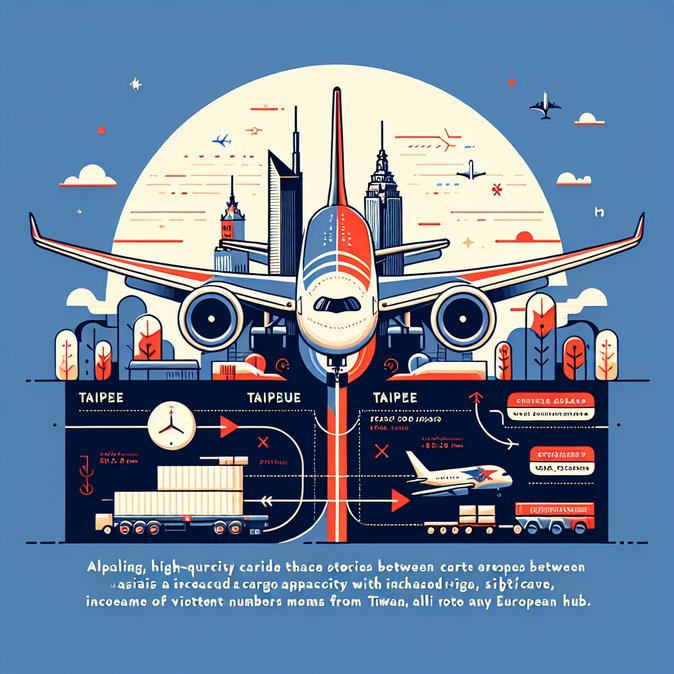
In a surprise move that underscores Prague’s growing appeal as a Central-European gateway, Taiwan’s premium carrier STARLUX Airlines announced on 5 February that it will make Václav Havel Airport its first destination on the continent. Starting 1 August 2026 the airline will operate three weekly non-stop rotations between Taipei and Prague with 306-seat Airbus A350-900s, ramping up to four flights a week in October.
For Czech business travellers the connection is a game-changer: the 10½-hour flight cuts at least four hours off the fastest one-stop itineraries via Dubai or Istanbul and eliminates the need for daylight transfers across Schengen borders. Exporters of Czech machinery and luxury glassware—two of Taiwan’s fastest-growing import categories—will benefit from 20 tonnes of belly-hold cargo capacity per flight. Meanwhile Taiwanese electronics firms already operating in Brno and Ostrava gain a direct link for technical staff rotations and high-value components.
Tourism bodies on both sides expect a noticeable uplift. CzechTourism projects 18 000 incremental Taiwanese visitors in the first year, a 35 % jump on 2025 arrivals, while Prague City Hall is working with private investors on bilingual signage and a “Little Taipei” food-and-culture trail in the Holešovice district. STARLUX will codeshare with Czech Railways to offer through-ticketing to Brno, Olomouc and Český Krumlov, aiming to disperse tourist flows beyond the capital.
![Prague lands its first Taiwan long-haul as STARLUX picks Czech capital for European debut]()
Practical implications are largely positive: Schengen-area passengers transiting in Prague en route to Taipei will remain in the common departures zone, avoiding extra border formalities, and the new schedule dovetails with early-morning connections from Ostrava and Košice. Business-class return fares launch at CZK 49 000, undercutting rivals routed via Frankfurt by around 12 %. Travellers should note that Taiwan’s 90-day visa waiver for Czech citizens remains in force, while Taiwanese passport-holders continue to enjoy 90 days in Schengen without a visa—though they will need to apply for an ETIAS travel authorisation when the EU system goes live late next year.
Whether you’re a Czech entrepreneur eyeing Taiwan’s tech hubs or a Taiwanese traveller mapping out a Central-European holiday, VisaHQ can streamline the paperwork. The service’s portal (https://www.visahq.com/czech-republic/) provides real-time guidance on Schengen and Taiwanese visa policies, the upcoming ETIAS registration, and other consular requirements, letting flyers concentrate on snagging those new STARLUX seats instead of wrestling with forms.
Analysts say the route also has geopolitical resonance: Prague has deepened cultural and economic ties with Taipei since severing its sister-city pact with Beijing in 2020. The STARLUX decision, negotiated quietly with the Czech transport ministry, signals confidence that the Czech market can withstand potential diplomatic push-back from mainland China, which still requires Czech tourists to obtain visas.
If load factors hit 80 %—the carrier’s break-even threshold—STARLUX has the option to increase frequency to daily and to open fifth-freedom tag-on services to Vienna or Warsaw, further cementing Prague’s role as a regional hub for North-East Asian traffic.
For Czech business travellers the connection is a game-changer: the 10½-hour flight cuts at least four hours off the fastest one-stop itineraries via Dubai or Istanbul and eliminates the need for daylight transfers across Schengen borders. Exporters of Czech machinery and luxury glassware—two of Taiwan’s fastest-growing import categories—will benefit from 20 tonnes of belly-hold cargo capacity per flight. Meanwhile Taiwanese electronics firms already operating in Brno and Ostrava gain a direct link for technical staff rotations and high-value components.
Tourism bodies on both sides expect a noticeable uplift. CzechTourism projects 18 000 incremental Taiwanese visitors in the first year, a 35 % jump on 2025 arrivals, while Prague City Hall is working with private investors on bilingual signage and a “Little Taipei” food-and-culture trail in the Holešovice district. STARLUX will codeshare with Czech Railways to offer through-ticketing to Brno, Olomouc and Český Krumlov, aiming to disperse tourist flows beyond the capital.

Practical implications are largely positive: Schengen-area passengers transiting in Prague en route to Taipei will remain in the common departures zone, avoiding extra border formalities, and the new schedule dovetails with early-morning connections from Ostrava and Košice. Business-class return fares launch at CZK 49 000, undercutting rivals routed via Frankfurt by around 12 %. Travellers should note that Taiwan’s 90-day visa waiver for Czech citizens remains in force, while Taiwanese passport-holders continue to enjoy 90 days in Schengen without a visa—though they will need to apply for an ETIAS travel authorisation when the EU system goes live late next year.
Whether you’re a Czech entrepreneur eyeing Taiwan’s tech hubs or a Taiwanese traveller mapping out a Central-European holiday, VisaHQ can streamline the paperwork. The service’s portal (https://www.visahq.com/czech-republic/) provides real-time guidance on Schengen and Taiwanese visa policies, the upcoming ETIAS registration, and other consular requirements, letting flyers concentrate on snagging those new STARLUX seats instead of wrestling with forms.
Analysts say the route also has geopolitical resonance: Prague has deepened cultural and economic ties with Taipei since severing its sister-city pact with Beijing in 2020. The STARLUX decision, negotiated quietly with the Czech transport ministry, signals confidence that the Czech market can withstand potential diplomatic push-back from mainland China, which still requires Czech tourists to obtain visas.
If load factors hit 80 %—the carrier’s break-even threshold—STARLUX has the option to increase frequency to daily and to open fifth-freedom tag-on services to Vienna or Warsaw, further cementing Prague’s role as a regional hub for North-East Asian traffic.