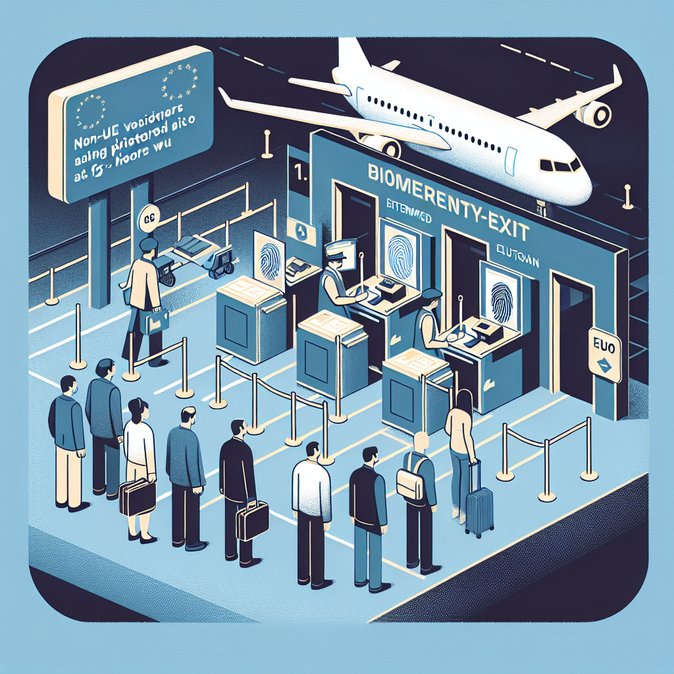
Belgium’s air, rail and motorway frontiers are bracing for the next phase of the EU Entry-Exit System (EES), the bloc-wide database that will capture the fingerprints and facial images of all visa-exempt third-country nationals every time they cross an external Schengen border. On 10 April the current “soft-launch” will end and, unless Brussels and other member states activate one of the system’s built-in derogations, border police will have to register 100 per cent of travellers instead of today’s 35 per cent.
Industry groups—among them ACI Europe, Airlines for Europe and Belgium’s own Board of Airlines Representatives—warn that the combination of Easter traffic, staffing shortages and unfamiliar biometric kiosks could see queues at Brussels Airport stretch to five hours. The Belgian National Railway Company (SNCB) and Eurostar fear similar bottlenecks in the Channel Tunnel terminals at Brussels-Midi; unlike airports, those facilities cannot easily fan passengers out to multiple kiosks.
To help companies and individual travellers stay ahead of the new biometric formalities, VisaHQ’s Belgium portal (https://www.visahq.com/belgium/) offers real-time updates, document checklists and concierge support for everything from Schengen visas to post-EES border procedures, ensuring travellers can move through Belgian borders with confidence.
![Biometric Entry-Exit System prompts calls for contingency plan at Belgian borders]()
Airports that piloted the system last autumn (Madrid, Paris-Orly and Rome) reported throughput drops of 40-60 per cent during peak waves—despite the reduced 35 per cent capture requirement and the ability to suspend EES checks altogether in case of “serious operational difficulty”. Brussels Airport has already asked the federal police to confirm that the same suspension clause will be available over the summer rush.
For business-travel managers the practical advice is clear: build extra time into itineraries for non-EU staff, warn clients that first-time registration takes longer than subsequent crossings, and encourage travellers to pre-enrol via the optional mobile app that the Belgian interior ministry plans to release in March. Companies with frequent UK visitors are also reviewing whether meetings can be shifted to the domestic Schengen area to avoid repeated biometric capture.
Belgian officials insist the technology will eventually cut fraud and speed up flows, but concede that “2026 will be a learning year”. Contingency staffing rosters have been drawn up for Brussels and Charleroi airports, yet unions say recruitment is lagging and that officers may strike if overtime becomes routine. The travel industry is therefore pressing the European Commission to issue a blanket waiver allowing member states to pause EES if processing times exceed agreed thresholds—a step that would give border guards, airlines and travellers alike a safety-valve during the transition period.
Industry groups—among them ACI Europe, Airlines for Europe and Belgium’s own Board of Airlines Representatives—warn that the combination of Easter traffic, staffing shortages and unfamiliar biometric kiosks could see queues at Brussels Airport stretch to five hours. The Belgian National Railway Company (SNCB) and Eurostar fear similar bottlenecks in the Channel Tunnel terminals at Brussels-Midi; unlike airports, those facilities cannot easily fan passengers out to multiple kiosks.
To help companies and individual travellers stay ahead of the new biometric formalities, VisaHQ’s Belgium portal (https://www.visahq.com/belgium/) offers real-time updates, document checklists and concierge support for everything from Schengen visas to post-EES border procedures, ensuring travellers can move through Belgian borders with confidence.

Airports that piloted the system last autumn (Madrid, Paris-Orly and Rome) reported throughput drops of 40-60 per cent during peak waves—despite the reduced 35 per cent capture requirement and the ability to suspend EES checks altogether in case of “serious operational difficulty”. Brussels Airport has already asked the federal police to confirm that the same suspension clause will be available over the summer rush.
For business-travel managers the practical advice is clear: build extra time into itineraries for non-EU staff, warn clients that first-time registration takes longer than subsequent crossings, and encourage travellers to pre-enrol via the optional mobile app that the Belgian interior ministry plans to release in March. Companies with frequent UK visitors are also reviewing whether meetings can be shifted to the domestic Schengen area to avoid repeated biometric capture.
Belgian officials insist the technology will eventually cut fraud and speed up flows, but concede that “2026 will be a learning year”. Contingency staffing rosters have been drawn up for Brussels and Charleroi airports, yet unions say recruitment is lagging and that officers may strike if overtime becomes routine. The travel industry is therefore pressing the European Commission to issue a blanket waiver allowing member states to pause EES if processing times exceed agreed thresholds—a step that would give border guards, airlines and travellers alike a safety-valve during the transition period.