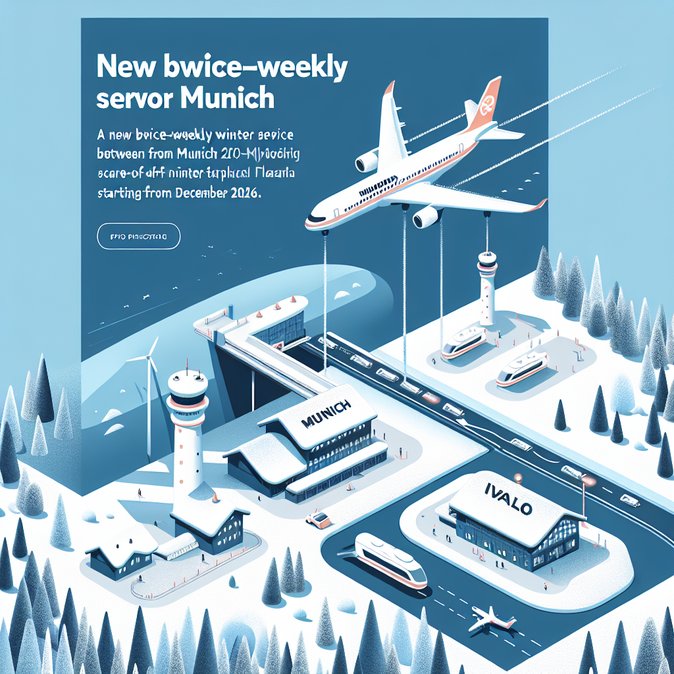
Finavia, the operator of Finland’s 20-airport network, confirmed on 2 February 2026 that German leisure carrier Bavarian Wings will open a non-stop service between Munich and Ivalo for the 2026/27 ski season. The twice-weekly flight—operating Mondays and Fridays from 14 December 2026 through 28 March 2027—marks the first direct link between Bavaria and Finnish Lapland, a region where international visitor numbers have already surpassed pre-pandemic levels.
For Finland’s tourism economy and corporate travel managers alike, the new route is more than a seasonal curiosity. Bavarian and Austrian tour operators have long routed Lapland travellers through Helsinki or via Frankfurt–Kittilä connections, adding hours and inconvenience. A direct service trims journey time by up to three hours, making weekend incentive trips and short-notice site visits far more feasible for Central European companies with operations in Northern Finland’s mining, data-centre and clean-tech clusters.
Finavia’s route-development team notes that the launch dovetails with Ivalo Airport’s €35 million terminal expansion, completed last December, which doubled Schengen-area gates and upgraded de-icing bays to accommodate wide-body charter aircraft. The airport now supports electronic Entry/Exit System (EES) kiosks as part of Finland’s phased roll-out ahead of the EU-wide go-live on 12 October 2025, ensuring smoother border checks for non-EU nationals connecting from Munich.
![Finavia Announces New Munich–Ivalo Winter Route, Boosting Lapland Connectivity]()
From a mobility-policy perspective, companies sending project teams to Lapland should revisit travel-approval matrices: the new routing via Munich could qualify for ‘most direct route’ reimbursement under many corporate travel policies and may reduce carbon footprints compared with Helsinki transfers. Travellers should still budget extra time for remote-area ground transport—road 4 from Ivalo to Inari can be slowed by winter conditions—and verify that Schengen multi-entry visas remain valid for the Germany–Finland pairing.
To make the paperwork as seamless as the new flight, travellers can turn to VisaHQ’s digital visa service, which consolidates the latest Schengen entry requirements, offers guided application steps and even provides courier support for passport handling. Corporate travel managers headed to Lapland can start the process in minutes at https://www.visahq.com/finland/ ensuring teams have the correct documentation well in advance of their departure.
The announcement also signals Finavia’s broader strategy to court point-to-point traffic that bypasses Helsinki. With Lapland airports collectively handling a record 2.4 million passengers in 2025, Finavia is leveraging extended runway opening hours and upgraded navigation aids to attract more Central European leisure and MICE charters. Mobility managers should therefore watch for additional secondary-city pairings that could reshape Finland-bound travel itineraries in the coming year.
For Finland’s tourism economy and corporate travel managers alike, the new route is more than a seasonal curiosity. Bavarian and Austrian tour operators have long routed Lapland travellers through Helsinki or via Frankfurt–Kittilä connections, adding hours and inconvenience. A direct service trims journey time by up to three hours, making weekend incentive trips and short-notice site visits far more feasible for Central European companies with operations in Northern Finland’s mining, data-centre and clean-tech clusters.
Finavia’s route-development team notes that the launch dovetails with Ivalo Airport’s €35 million terminal expansion, completed last December, which doubled Schengen-area gates and upgraded de-icing bays to accommodate wide-body charter aircraft. The airport now supports electronic Entry/Exit System (EES) kiosks as part of Finland’s phased roll-out ahead of the EU-wide go-live on 12 October 2025, ensuring smoother border checks for non-EU nationals connecting from Munich.
From a mobility-policy perspective, companies sending project teams to Lapland should revisit travel-approval matrices: the new routing via Munich could qualify for ‘most direct route’ reimbursement under many corporate travel policies and may reduce carbon footprints compared with Helsinki transfers. Travellers should still budget extra time for remote-area ground transport—road 4 from Ivalo to Inari can be slowed by winter conditions—and verify that Schengen multi-entry visas remain valid for the Germany–Finland pairing.
To make the paperwork as seamless as the new flight, travellers can turn to VisaHQ’s digital visa service, which consolidates the latest Schengen entry requirements, offers guided application steps and even provides courier support for passport handling. Corporate travel managers headed to Lapland can start the process in minutes at https://www.visahq.com/finland/ ensuring teams have the correct documentation well in advance of their departure.
The announcement also signals Finavia’s broader strategy to court point-to-point traffic that bypasses Helsinki. With Lapland airports collectively handling a record 2.4 million passengers in 2025, Finavia is leveraging extended runway opening hours and upgraded navigation aids to attract more Central European leisure and MICE charters. Mobility managers should therefore watch for additional secondary-city pairings that could reshape Finland-bound travel itineraries in the coming year.