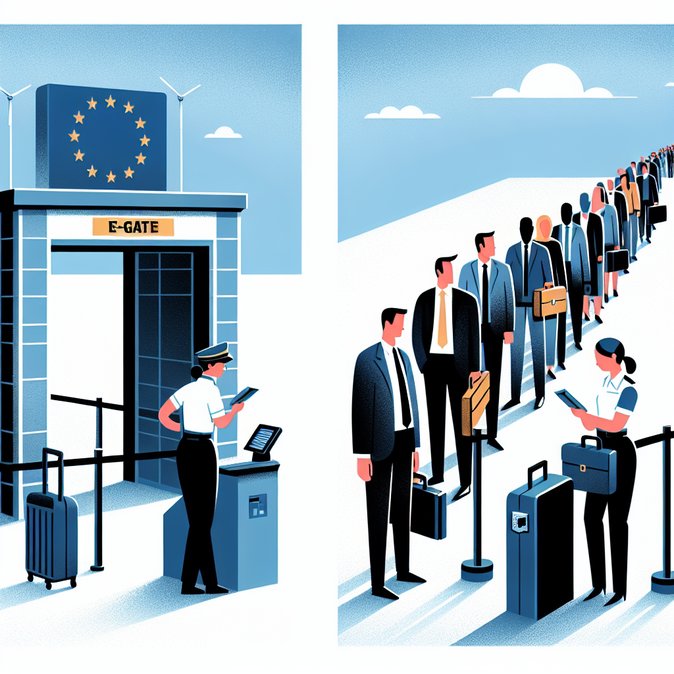
The European Commission has quietly postponed the final switch-on of the Schengen Entry/Exit System (EES) from April to September 2026 after weeks of mounting evidence that airports and ports—France’s included—are nowhere near ready for 100 % biometric processing. Euronews broke the story at 13:00 on 2 February, quoting Commission spokesman Markus Lammert: “By extending flexibility over the summer we give member states room to avoid travel chaos.” (fr.euronews.com)
EES went live in October 2025 with a modest 10 % enrolment requirement, but the threshold rose to 35 % on 9 January. French hubs such as Paris-CDG and Orly rapidly discovered that fingerprint scanners, cameras and networking software could not keep pace. Airport Council International (ACI) Europe says border-processing times at active EES checkpoints have jumped up to 70 %, with waits of three hours reported at peak periods. (fr.euronews.com)
For France the delay is a mixed blessing. On the one hand, it spares airports the impossible task of registering every eligible third-country traveller before the busy summer season and buys IT contractors five extra months to stabilise kiosks and upgrade Parafe e-gates. On the other, it prolongs an awkward transitional period in which some passengers must still undergo full biometric capture while others continue to receive passport stamps.
![EU pushes full rollout of biometric Entry/Exit System to September amid French airport bottlenecks]()
Transport operators warn that uncertainty also hurts planning. Eurostar, Brittany Ferries and airlines building summer timetables still need to factor in longer dwell times at French juxtaposed controls in Dover and St Pancras. Travel-insurance providers are already adjusting policy wording to clarify coverage for missed departures linked to border queues.
Amid this shifting landscape, travellers and corporate mobility managers can streamline paperwork by tapping VisaHQ’s expertise. The company’s France portal (https://www.visahq.com/france/) offers real-time guidance on Schengen visa rules, biometric enrolment procedures and contingency tips for navigating French border controls, helping visitors avoid surprises and reduce wait times once EES becomes fully mandatory.
Global-mobility teams should revisit travel-risk assessments: forecast staffing at French ports of entry, build contingency time into itineraries, and keep employees up to date on whether they have been successfully enrolled in EES—proof that can speed repeat crossings once the system finally goes live.
EES went live in October 2025 with a modest 10 % enrolment requirement, but the threshold rose to 35 % on 9 January. French hubs such as Paris-CDG and Orly rapidly discovered that fingerprint scanners, cameras and networking software could not keep pace. Airport Council International (ACI) Europe says border-processing times at active EES checkpoints have jumped up to 70 %, with waits of three hours reported at peak periods. (fr.euronews.com)
For France the delay is a mixed blessing. On the one hand, it spares airports the impossible task of registering every eligible third-country traveller before the busy summer season and buys IT contractors five extra months to stabilise kiosks and upgrade Parafe e-gates. On the other, it prolongs an awkward transitional period in which some passengers must still undergo full biometric capture while others continue to receive passport stamps.

Transport operators warn that uncertainty also hurts planning. Eurostar, Brittany Ferries and airlines building summer timetables still need to factor in longer dwell times at French juxtaposed controls in Dover and St Pancras. Travel-insurance providers are already adjusting policy wording to clarify coverage for missed departures linked to border queues.
Amid this shifting landscape, travellers and corporate mobility managers can streamline paperwork by tapping VisaHQ’s expertise. The company’s France portal (https://www.visahq.com/france/) offers real-time guidance on Schengen visa rules, biometric enrolment procedures and contingency tips for navigating French border controls, helping visitors avoid surprises and reduce wait times once EES becomes fully mandatory.
Global-mobility teams should revisit travel-risk assessments: forecast staffing at French ports of entry, build contingency time into itineraries, and keep employees up to date on whether they have been successfully enrolled in EES—proof that can speed repeat crossings once the system finally goes live.