In the early hours of 1 February 2026, the main French air-traffic-controller union, SNCTA, filed a formal strike notice for 07-10 October 2026. Although the stoppage is still eight months away, the timing of the announcement – made just as airlines finalise their winter schedules – immediately set alarm bells ringing in corporate travel departments.
1. What is planned?
• A nationwide, four-day walk-out covering all Area Control Centres (Reims, Paris, Brest, Bordeaux, Aix-en-Provence) and most tower services. The notice allows controllers to down tools for consecutive twenty-four-hour periods from 06:00 on 7 October until 05:59 on 11 October.
• SNCTA says “minimum-service” exemptions will apply only to emergency, military and state flights, increasing the likelihood of extensive cancellations rather than limited delays.
2. Why now?
• The union wants automatic indexation of pay scales to inflation, which has eroded real wages by roughly 9 % since 2021. It also demands accelerated recruitment to replace some 450 controllers due to retire before 2030, warning of a looming staffing gap at Paris ACC.
• Talks with the Directorate-General of Civil Aviation (DGAC) stalled last week after the Budget Ministry refused to ring-fence funds for indexation in the 2027 Finance Bill. By serving a long-horizon strike notice, the union maximises political pressure in the run-up to the parliamentary budget debate in September.
3. Projected impact on business travel and cargo flows
• Ryanair estimates it will have to cancel about 1 800 flights – not only those touching French airports but also overflights between, for example, the UK and Spain or Italy and Greece. When French upper airspace closes, hundreds of daily intra-European services must divert around the Bay of Biscay or over German airspace, adding up to 40 minutes and €2 000 in fuel per sector.
• Legacy carriers such as Air France–KLM, Lufthansa and IAG will protect key long-haul rotations but are already drafting contingency slot swaps at Amsterdam, Brussels and Milan to keep premium connections running.
• Multinational firms with pan-European mobility programmes – especially pharmaceuticals and luxury-goods groups that cluster regional meetings in Paris – are reviewing October event calendars. Travel managers are likely to trigger “Plan B” rail or videoconference options for non-critical trips.
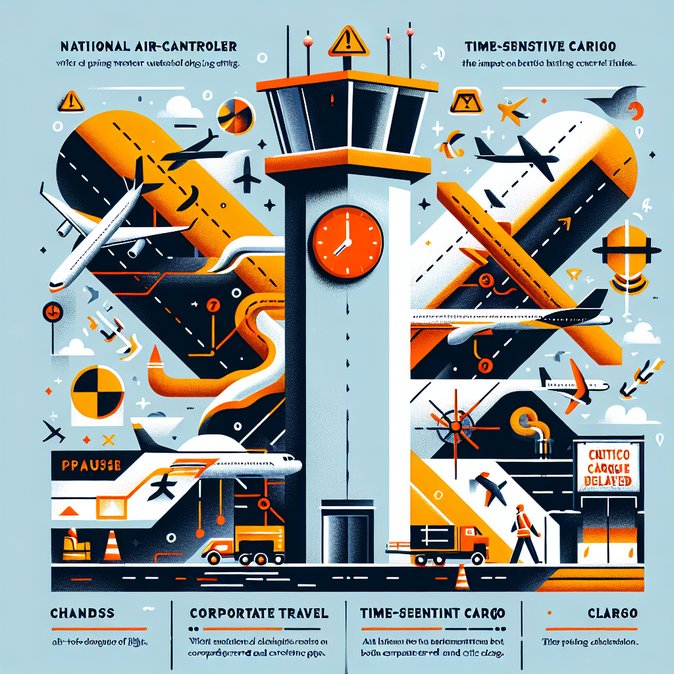
• Air-cargo forwarders warn of knock-on congestion at Charles-de-Gaulle’s cargo village and potential delays on time-critical consignments such as spare-parts and medical isotopes. Express operators (DHL, FedEx) are studying overnight reroutes via Liège and Leipzig hubs.
![French air-traffic controllers call four-day walk-out for October, threatening thousands of flights]()
For travellers who may have to reroute through neighbouring countries during the strike window, checking additional transit-visa requirements early can save significant headaches. VisaHQ’s online platform (https://www.visahq.com/france/) quickly clarifies whether a Schengen, UK or other permit is needed, handles applications end-to-end and offers courier services, giving mobility managers one less variable to juggle amid the disruption.
4. What happens next?
• Under French labour law, conciliation can continue right up to the eve of the action. If DGAC offers even partial indexation or phased hiring, SNCTA could either shorten the strike or restrict it to regional centres.
• However, the union’s 67 % membership share means that, historically, when SNCTA serves a notice of this length it almost always mobilises. The last comparable stoppage, in September 2023, forced airlines to cancel 55 % of scheduled movements.
Practical advice:
• Global-mobility teams should flag 7-10 October in travel-approval systems and encourage early ticket issuance so that carriers are contractually obliged to offer rerouting.
• Consider locking in flexible hotel and rail fares in Brussels, Frankfurt and Zurich, which historically soak up displaced demand.
• HR should monitor whether the government invokes the 1984 “minimum service decree” – rare but possible for strategic periods – which could soften the blow.
Although the walk-out is months away, the notice itself triggers immediate operational planning across the aviation ecosystem. Companies who act early will be best placed to shield travellers and supply chains from what could be the most disruptive French ATC strike since 2016.
1. What is planned?
• A nationwide, four-day walk-out covering all Area Control Centres (Reims, Paris, Brest, Bordeaux, Aix-en-Provence) and most tower services. The notice allows controllers to down tools for consecutive twenty-four-hour periods from 06:00 on 7 October until 05:59 on 11 October.
• SNCTA says “minimum-service” exemptions will apply only to emergency, military and state flights, increasing the likelihood of extensive cancellations rather than limited delays.
2. Why now?
• The union wants automatic indexation of pay scales to inflation, which has eroded real wages by roughly 9 % since 2021. It also demands accelerated recruitment to replace some 450 controllers due to retire before 2030, warning of a looming staffing gap at Paris ACC.
• Talks with the Directorate-General of Civil Aviation (DGAC) stalled last week after the Budget Ministry refused to ring-fence funds for indexation in the 2027 Finance Bill. By serving a long-horizon strike notice, the union maximises political pressure in the run-up to the parliamentary budget debate in September.
3. Projected impact on business travel and cargo flows
• Ryanair estimates it will have to cancel about 1 800 flights – not only those touching French airports but also overflights between, for example, the UK and Spain or Italy and Greece. When French upper airspace closes, hundreds of daily intra-European services must divert around the Bay of Biscay or over German airspace, adding up to 40 minutes and €2 000 in fuel per sector.
• Legacy carriers such as Air France–KLM, Lufthansa and IAG will protect key long-haul rotations but are already drafting contingency slot swaps at Amsterdam, Brussels and Milan to keep premium connections running.
• Multinational firms with pan-European mobility programmes – especially pharmaceuticals and luxury-goods groups that cluster regional meetings in Paris – are reviewing October event calendars. Travel managers are likely to trigger “Plan B” rail or videoconference options for non-critical trips.
• Air-cargo forwarders warn of knock-on congestion at Charles-de-Gaulle’s cargo village and potential delays on time-critical consignments such as spare-parts and medical isotopes. Express operators (DHL, FedEx) are studying overnight reroutes via Liège and Leipzig hubs.

For travellers who may have to reroute through neighbouring countries during the strike window, checking additional transit-visa requirements early can save significant headaches. VisaHQ’s online platform (https://www.visahq.com/france/) quickly clarifies whether a Schengen, UK or other permit is needed, handles applications end-to-end and offers courier services, giving mobility managers one less variable to juggle amid the disruption.
4. What happens next?
• Under French labour law, conciliation can continue right up to the eve of the action. If DGAC offers even partial indexation or phased hiring, SNCTA could either shorten the strike or restrict it to regional centres.
• However, the union’s 67 % membership share means that, historically, when SNCTA serves a notice of this length it almost always mobilises. The last comparable stoppage, in September 2023, forced airlines to cancel 55 % of scheduled movements.
Practical advice:
• Global-mobility teams should flag 7-10 October in travel-approval systems and encourage early ticket issuance so that carriers are contractually obliged to offer rerouting.
• Consider locking in flexible hotel and rail fares in Brussels, Frankfurt and Zurich, which historically soak up displaced demand.
• HR should monitor whether the government invokes the 1984 “minimum service decree” – rare but possible for strategic periods – which could soften the blow.
Although the walk-out is months away, the notice itself triggers immediate operational planning across the aviation ecosystem. Companies who act early will be best placed to shield travellers and supply chains from what could be the most disruptive French ATC strike since 2016.