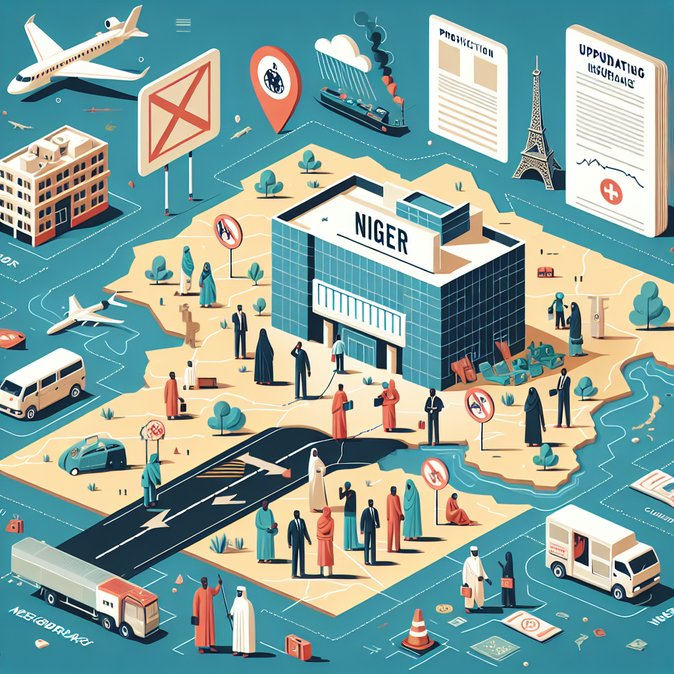
Barely a month after the military junta in Niamey voided a string of security- and migration-co-operation accords with European partners, Germany’s Federal Foreign Office (Auswärtiges Amt) has raised its travel advice for Niger to the highest level. Late on 31 January, the ministry replaced its long-standing “partial warning” with a full **Reisewarnung** and an explicit call for German nationals to depart the Sahel state “without delay.”
The updated advisory, published in the early hours of 1 February, cites a rapidly deteriorating security environment marked by jihadist attacks along the routes to Niamey’s Diori Hamani Airport, the breakdown of consular assistance after last July’s coup, and the absence of reliable medical care outside the capital. Commercial flights are still operating, but the embassy can no longer guarantee evacuation support once connections are suspended—an increasingly common scenario in the region.
In this context, VisaHQ’s Germany portal (https://www.visahq.com/germany/) can streamline emergency documentation, alternate visa routing and flight permissions, giving mobility teams a single dashboard to track requirements, submit applications and receive status alerts—services that become critical when consular channels in-country shut down.
![Germany Issues Red-Level Travel Warning for Niger, Urges All Citizens to Leave Immediately]()
For global-mobility managers the change triggers a cascade of duty-of-care obligations: Corporate travellers must be withdrawn or their assignments suspended; expatriate staff should activate evacuation cover in travel-risk insurance policies; and companies need to document how they informed employees of the new risk classification. Under Germany’s Employment--Social-Welfare Code (§ 618 BGB), firms are required to protect staff from “foreseeable hazards,” making failure to act a potential liability.
Logistically, the warning complicates freight and project work tied to Niger’s uranium and green-hydrogen sectors: Visa facilitation at the Nigerien embassy in Berlin has already been curtailed, while German development organisations now need case-by-case clearance to maintain skeleton teams. Airlines may refuse boarding to passengers without documented evacuation plans, and insurers could void medical-evacuation cover if travellers ignore the Foreign Office advice.
The Foreign Office recommendation is also a bellwether for the wider Sahel: The same update tightened wording for Ethiopia, Slovenia, South Africa and Eswatini, underscoring Berlin’s more proactive stance on crisis prevention. Mobility departments are therefore bracing for further snap warnings across West Africa, where coups in Mali, Burkina Faso and Guinea have similarly up-ended business travel in recent years.
The updated advisory, published in the early hours of 1 February, cites a rapidly deteriorating security environment marked by jihadist attacks along the routes to Niamey’s Diori Hamani Airport, the breakdown of consular assistance after last July’s coup, and the absence of reliable medical care outside the capital. Commercial flights are still operating, but the embassy can no longer guarantee evacuation support once connections are suspended—an increasingly common scenario in the region.
In this context, VisaHQ’s Germany portal (https://www.visahq.com/germany/) can streamline emergency documentation, alternate visa routing and flight permissions, giving mobility teams a single dashboard to track requirements, submit applications and receive status alerts—services that become critical when consular channels in-country shut down.

For global-mobility managers the change triggers a cascade of duty-of-care obligations: Corporate travellers must be withdrawn or their assignments suspended; expatriate staff should activate evacuation cover in travel-risk insurance policies; and companies need to document how they informed employees of the new risk classification. Under Germany’s Employment--Social-Welfare Code (§ 618 BGB), firms are required to protect staff from “foreseeable hazards,” making failure to act a potential liability.
Logistically, the warning complicates freight and project work tied to Niger’s uranium and green-hydrogen sectors: Visa facilitation at the Nigerien embassy in Berlin has already been curtailed, while German development organisations now need case-by-case clearance to maintain skeleton teams. Airlines may refuse boarding to passengers without documented evacuation plans, and insurers could void medical-evacuation cover if travellers ignore the Foreign Office advice.
The Foreign Office recommendation is also a bellwether for the wider Sahel: The same update tightened wording for Ethiopia, Slovenia, South Africa and Eswatini, underscoring Berlin’s more proactive stance on crisis prevention. Mobility departments are therefore bracing for further snap warnings across West Africa, where coups in Mali, Burkina Faso and Guinea have similarly up-ended business travel in recent years.