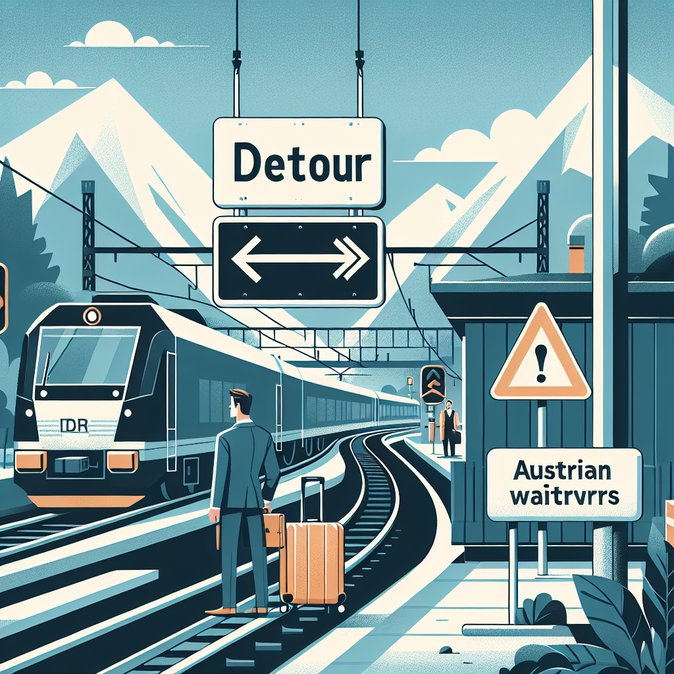
Just two days before a rolling programme of track closures begins on the strategic Passau–Nürnberg rail axis, Austrian logistics specialists are warning of cascading knock-on effects for exporters and north-bound supply chains. In an article published late on 30 January by the business portal UnternehmerWeb, analysts explain that Deutsche Bahn’s six-month “Generalsanierung” will force both passenger and freight services onto longer diversionary routes via Linz–Salzburg or the Prague corridor.
For Österreichische Bundesbahnen (ÖBB) Rail Cargo Group the timing is awkward. January steel and automotive volumes traditionally spike as manufacturers restock after winter shutdowns. With the direct line restricted from February to July, Austrian wagons heading to North Sea ports will face an extra 90–120 kilometres per consignment, adding an estimated €60–€80 in traction and path charges for a standard 1,000-tonne load. Slot scarcity on the German detours is already acute: DB Netz has pre-allocated only 60 percent of the paths requested by ÖBB for February.
Passenger services are also hit. The popular ICE and Railjet day services between Vienna and Frankfurt will be partially replaced by buses between Regensburg and Nürnberg for at least eight weeks. Corporate-travel managers are advising staff to budget an extra 50 minutes and to keep paper copies of itineraries in case split-ticket refunds are required.
![German Track Closures on Passau–Nürnberg Corridor Poised to Disrupt ÖBB Freight From February]()
Travellers re-routing through Germany or the Czech Republic should also double-check documentary requirements. VisaHQ’s Austrian portal (https://www.visahq.com/austria/) can fast-track visas, passport renewals and transit permits, giving corporate mobility teams a single dashboard to monitor applications and receive real-time status alerts—even when routes change at short notice.
ÖBB says it is negotiating reciprocal haulage deals with Czech operator ČD Cargo and private German carrier TX Logistik to secure capacity on alternative corridors. Meanwhile, the Austrian Economic Chambers (WKÖ) has urged the German government to grant temporary toll rebates on designated freight diversions, similar to measures adopted during the Rhine valley blockade in 2017.
The episode underscores how infrastructure works outside Austria’s borders can ripple through the country’s export economy. Mobility professionals should flag the dates in assignment trackers, re-sequence just-in-time deliveries, and remind travellers that any compensation claims must be filed with the original carrier—regardless of which replacement bus or train actually completes the journey.
For Österreichische Bundesbahnen (ÖBB) Rail Cargo Group the timing is awkward. January steel and automotive volumes traditionally spike as manufacturers restock after winter shutdowns. With the direct line restricted from February to July, Austrian wagons heading to North Sea ports will face an extra 90–120 kilometres per consignment, adding an estimated €60–€80 in traction and path charges for a standard 1,000-tonne load. Slot scarcity on the German detours is already acute: DB Netz has pre-allocated only 60 percent of the paths requested by ÖBB for February.
Passenger services are also hit. The popular ICE and Railjet day services between Vienna and Frankfurt will be partially replaced by buses between Regensburg and Nürnberg for at least eight weeks. Corporate-travel managers are advising staff to budget an extra 50 minutes and to keep paper copies of itineraries in case split-ticket refunds are required.

Travellers re-routing through Germany or the Czech Republic should also double-check documentary requirements. VisaHQ’s Austrian portal (https://www.visahq.com/austria/) can fast-track visas, passport renewals and transit permits, giving corporate mobility teams a single dashboard to monitor applications and receive real-time status alerts—even when routes change at short notice.
ÖBB says it is negotiating reciprocal haulage deals with Czech operator ČD Cargo and private German carrier TX Logistik to secure capacity on alternative corridors. Meanwhile, the Austrian Economic Chambers (WKÖ) has urged the German government to grant temporary toll rebates on designated freight diversions, similar to measures adopted during the Rhine valley blockade in 2017.
The episode underscores how infrastructure works outside Austria’s borders can ripple through the country’s export economy. Mobility professionals should flag the dates in assignment trackers, re-sequence just-in-time deliveries, and remind travellers that any compensation claims must be filed with the original carrier—regardless of which replacement bus or train actually completes the journey.