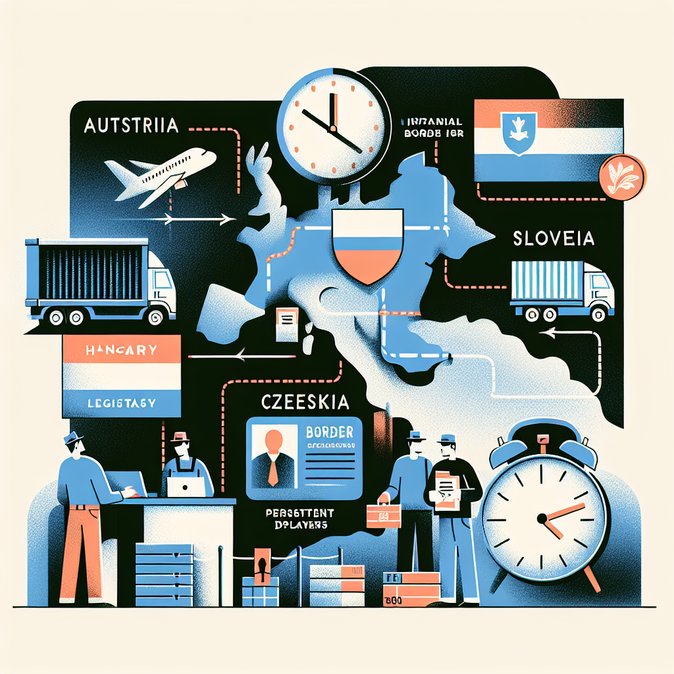
The European Commission quietly updated its public register of Schengen border notifications on 31 January, confirming that Austria will prolong controls at all land and river crossings with Hungary, Slovenia, Czechia and Slovakia until 15 June 2026. The notice cites persistent irregular-migration pressure along the Balkan route, capacity strains in Austria’s asylum system and heightened terrorism concerns linked to Middle-East tensions.
For global-mobility teams the extension means that spot checks—including passport scans and vehicle searches—remain a fact of life on routes that used to be paper-free. Although EU-based assignees can still transit without visas, companies must remind posted workers to carry proof of social-security coverage (A1 forms) and assignments letters; failure to show documents at pop-up checkpoints can trigger on-the-spot fines of up to €500.
Organizations that need help pulling together the right paperwork can streamline the process by using VisaHQ’s digital platform. Whether it’s Austrian short-term work permits, A1 certificates or other travel documents, VisaHQ (https://www.visahq.com/austria/) offers step-by-step guidance and courier options that keep mobile staff compliant and moving smoothly through any renewed border checks.
![EU List Confirms Austria’s Internal Border Checks Extended to 15 June 2026]()
Logistics firms running just-in-time flows through Burgenland and Niederösterreich note average border dwell times of 15–25 minutes since controls were re-introduced in late 2023. The Interior Ministry plans to scale down military assistance, but business groups caution that any reduction in staffing could lengthen queues during the Easter travel peak.
Austria’s decision aligns with measures in neighbouring Slovenia, Denmark, Germany and others, signalling that temporary controls—once an exception—are becoming semi-permanent in Schengen. Legal advisers recommend adding six-month “sunset” diary entries, because companies must update Posted-Worker Notifications whenever a host state extends its control period.
While Brussels has proposed a revised Schengen Borders Code that would formalise such long-term reintroductions, agreement remains elusive. Until then, Austrian mobility managers should assume that checks will be renewed again in June and build the extra buffer time into travel policies.
For global-mobility teams the extension means that spot checks—including passport scans and vehicle searches—remain a fact of life on routes that used to be paper-free. Although EU-based assignees can still transit without visas, companies must remind posted workers to carry proof of social-security coverage (A1 forms) and assignments letters; failure to show documents at pop-up checkpoints can trigger on-the-spot fines of up to €500.
Organizations that need help pulling together the right paperwork can streamline the process by using VisaHQ’s digital platform. Whether it’s Austrian short-term work permits, A1 certificates or other travel documents, VisaHQ (https://www.visahq.com/austria/) offers step-by-step guidance and courier options that keep mobile staff compliant and moving smoothly through any renewed border checks.

Logistics firms running just-in-time flows through Burgenland and Niederösterreich note average border dwell times of 15–25 minutes since controls were re-introduced in late 2023. The Interior Ministry plans to scale down military assistance, but business groups caution that any reduction in staffing could lengthen queues during the Easter travel peak.
Austria’s decision aligns with measures in neighbouring Slovenia, Denmark, Germany and others, signalling that temporary controls—once an exception—are becoming semi-permanent in Schengen. Legal advisers recommend adding six-month “sunset” diary entries, because companies must update Posted-Worker Notifications whenever a host state extends its control period.
While Brussels has proposed a revised Schengen Borders Code that would formalise such long-term reintroductions, agreement remains elusive. Until then, Austrian mobility managers should assume that checks will be renewed again in June and build the extra buffer time into travel policies.