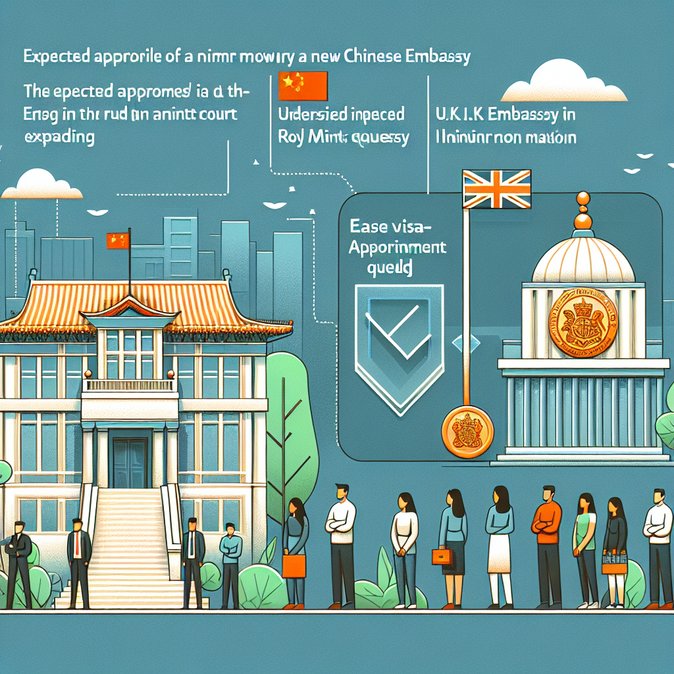
London’s Royal Mint Court saga may finally end this week, with ministers tipped to approve China’s £255 million embassy redevelopment near the Tower of London. The decade-long planning stand-off has seen Beijing stall British embassy renovation plans in return, creating bottlenecks for visa-issuance capacity in the Chinese capital.(theguardian.com)
Chinese diplomats argue that the 700-staff compound is essential to process growing U.K. student and business-travel demand. Officials in Beijing privately link the project to reciprocal approval for a modernised U.K. chancery, including expanded visa sections. British companies complain that limited biometric-capture booths at the current, ageing embassy mean peak-season appointment slots vanish within minutes.
![‘Mega-embassy’ planning decision for China expected this week, could unblock UK visas in Beijing]()
In the meantime, travellers and companies keen to sidestep last-minute scrambles can lean on VisaHQ’s London-based specialists. The firm monitors embassy scheduling changes daily, prepares documentation packs and arranges courier submission, offering a streamlined route for U.K. citizens and residents heading to China or elsewhere – full details are at https://www.visahq.com/united-kingdom/.
Security services had raised concerns about the site’s proximity to sensitive data centres, but a compromise—additional shielding and CCTV ‘dark zones’—appears to have satisfied the National Cyber Security Centre. Planning approval would trigger a two-year build; interim arrangements could see a pop-up visa-application centre in east-Beijing as early as September 2026.
For corporates, smoother visa logistics could shorten lead times for project deployments into China from the present four-week average to under ten days by 2027. Conversely, community groups around Tower Bridge worry about protest-buffer zones and traffic, issues the Greater London Authority says will be addressed via a revised travel plan.
Chinese diplomats argue that the 700-staff compound is essential to process growing U.K. student and business-travel demand. Officials in Beijing privately link the project to reciprocal approval for a modernised U.K. chancery, including expanded visa sections. British companies complain that limited biometric-capture booths at the current, ageing embassy mean peak-season appointment slots vanish within minutes.

In the meantime, travellers and companies keen to sidestep last-minute scrambles can lean on VisaHQ’s London-based specialists. The firm monitors embassy scheduling changes daily, prepares documentation packs and arranges courier submission, offering a streamlined route for U.K. citizens and residents heading to China or elsewhere – full details are at https://www.visahq.com/united-kingdom/.
Security services had raised concerns about the site’s proximity to sensitive data centres, but a compromise—additional shielding and CCTV ‘dark zones’—appears to have satisfied the National Cyber Security Centre. Planning approval would trigger a two-year build; interim arrangements could see a pop-up visa-application centre in east-Beijing as early as September 2026.
For corporates, smoother visa logistics could shorten lead times for project deployments into China from the present four-week average to under ten days by 2027. Conversely, community groups around Tower Bridge worry about protest-buffer zones and traffic, issues the Greater London Authority says will be addressed via a revised travel plan.