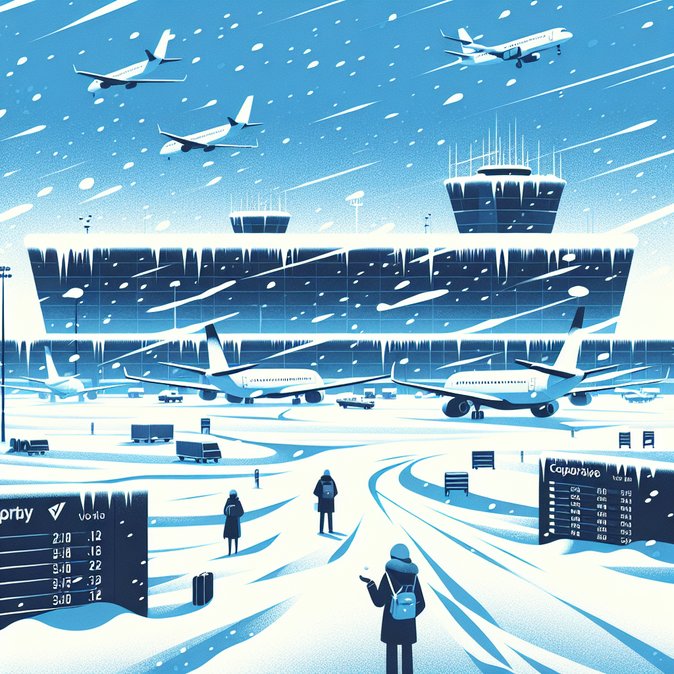
A fierce Arctic front barrelled across the country on 2 January 2026, plunging temperatures below –40 °C from the Prairies to Atlantic Canada and dumping heavy snow on every major hub. By dawn on 3 January, airlines had logged 598 delays and 98 cancellations, with Toronto Pearson alone accounting for 229 delayed movements and 34 outright cancellations.
The severity of the storm combined three operational nightmares: blizzard-force winds, freezing fog that limited visibility to less than 400 metres, and relentless de-icing demand that backed aircraft up for more than 90 minutes per cycle. Ground-handling crews worked in rotating 15-minute intervals to avoid frostbite, slowing baggage and catering operations and leaving planes out of sequence for tightly-banked morning departure waves.
Corporate travel managers scrambled to reroute employees flying to client kick-offs and Q1 planning meetings. Some firms moved entire agendas online, while others re-protected travellers over U.S. gateways such as Chicago and New York despite the extra immigration formalities that entails. For mobility teams the message was clear: build winter buffer time into Canadian itineraries and review duty-of-care protocols to cover hotel shortages, meal vouchers and mental-health support during prolonged disruptions.
![Winter Storm Grounds Nearly 600 Flights Across Canada, Snarls First Week of 2026 Business Travel]()
Amid the scramble, some passengers discovered their alternate routings now required additional transit authorizations—particularly when itineraries were re-ticketed over U.S. or European hubs. Online service VisaHQ (https://www.visahq.com/canada/) can fast-track electronic travel authorizations, visas and passport renewals, guiding Canadian residents and foreign nationals through shifting documentation rules so that paperwork, at least, doesn’t add to the weather-induced chaos.
Air Canada and WestJet issued flexible change policies through 11 January, signalling that knock-on delays could linger for days as aircraft and crews reposition. Analysts warn that the backlog will test already-strained staffing levels—pilot and mechanic contracts at both carriers enter negotiation later this year—which could push operating costs higher as airlines rely on overtime and sub-charters.
Practically, business travellers should check flight status every few hours, use airline apps to re-book proactively, and travel with digital copies of passports and employment letters. Employers may also need to revisit expense-policy caps as last-minute hotel rates around Pearson and Montréal-Trudeau exceeded CA$450 a night during the peak of the storm.
The severity of the storm combined three operational nightmares: blizzard-force winds, freezing fog that limited visibility to less than 400 metres, and relentless de-icing demand that backed aircraft up for more than 90 minutes per cycle. Ground-handling crews worked in rotating 15-minute intervals to avoid frostbite, slowing baggage and catering operations and leaving planes out of sequence for tightly-banked morning departure waves.
Corporate travel managers scrambled to reroute employees flying to client kick-offs and Q1 planning meetings. Some firms moved entire agendas online, while others re-protected travellers over U.S. gateways such as Chicago and New York despite the extra immigration formalities that entails. For mobility teams the message was clear: build winter buffer time into Canadian itineraries and review duty-of-care protocols to cover hotel shortages, meal vouchers and mental-health support during prolonged disruptions.

Amid the scramble, some passengers discovered their alternate routings now required additional transit authorizations—particularly when itineraries were re-ticketed over U.S. or European hubs. Online service VisaHQ (https://www.visahq.com/canada/) can fast-track electronic travel authorizations, visas and passport renewals, guiding Canadian residents and foreign nationals through shifting documentation rules so that paperwork, at least, doesn’t add to the weather-induced chaos.
Air Canada and WestJet issued flexible change policies through 11 January, signalling that knock-on delays could linger for days as aircraft and crews reposition. Analysts warn that the backlog will test already-strained staffing levels—pilot and mechanic contracts at both carriers enter negotiation later this year—which could push operating costs higher as airlines rely on overtime and sub-charters.
Practically, business travellers should check flight status every few hours, use airline apps to re-book proactively, and travel with digital copies of passports and employment letters. Employers may also need to revisit expense-policy caps as last-minute hotel rates around Pearson and Montréal-Trudeau exceeded CA$450 a night during the peak of the storm.