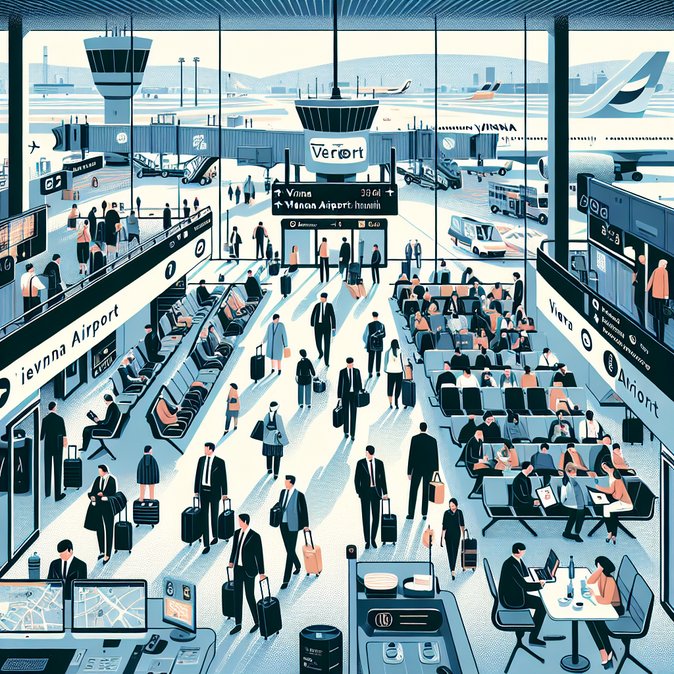
Vienna International Airport (VIE) closed 2025 on a historic high, greeting its 32-millionth traveller on 31 December. City finance councillor Barbara Novak and airport co-CEO Julian Jäger personally welcomed two Romanian sisters arriving from Bucharest, symbolically underscoring the hub’s growing pull for Central-Eastern European traffic .
The milestone crowns a year in which passenger numbers between January and November already rose 2.4 % versus 2024, driven by the steady return of long-haul links and the resurgence of intra-EU business travel. Transfer volumes slipped 2.9 %, but management stresses this is temporary as airlines rebalance schedules after the Middle-East capacity cuts earlier in the year .
For travellers wondering whether they need a visa to enter Austria—or how the EU’s new biometric Entry/Exit System might affect their paperwork—VisaHQ offers an easy online tool to check requirements, submit applications and track approvals. By visiting https://www.visahq.com/austria/ passengers can sort out documentation well before departure and avoid last-minute surprises at the gate.
![Vienna Airport Welcomes 32-Millionth Passenger, Capping Record-Breaking Year]()
Vienna’s next strategic leap is the €500 million southern terminal expansion, slated for 2027. The project will add larger lounges, automated border-control lanes and 50 % more Schengen gates—critical for handling the EU’s forthcoming biometric Entry/Exit System without lengthening minimum connection times. Construction contracts were finalised in Q4 2025, and ground works start next spring.
For corporate mobility managers the record matters: more traffic means denser frequencies on key routes such as Vienna-Frankfurt and Vienna-Zurich, allowing same-day meetings again. Yet the success also raises congestion risks. VIE is urging companies to remind travellers to pre-register passports in the airport app so that e-gate facial capture can be completed in advance, shaving several minutes at peak times.
Air-cargo stakeholders also benefit. A larger belly-hold network reduces reliance on trucking to German hubs for time-critical pharma exports from Upper Austria. Jäger confirmed the airport will publish a slot-relief programme in January to encourage airlines to up-gauge rather than add new movements, keeping noise within legal night-curfews.
The milestone crowns a year in which passenger numbers between January and November already rose 2.4 % versus 2024, driven by the steady return of long-haul links and the resurgence of intra-EU business travel. Transfer volumes slipped 2.9 %, but management stresses this is temporary as airlines rebalance schedules after the Middle-East capacity cuts earlier in the year .
For travellers wondering whether they need a visa to enter Austria—or how the EU’s new biometric Entry/Exit System might affect their paperwork—VisaHQ offers an easy online tool to check requirements, submit applications and track approvals. By visiting https://www.visahq.com/austria/ passengers can sort out documentation well before departure and avoid last-minute surprises at the gate.

Vienna’s next strategic leap is the €500 million southern terminal expansion, slated for 2027. The project will add larger lounges, automated border-control lanes and 50 % more Schengen gates—critical for handling the EU’s forthcoming biometric Entry/Exit System without lengthening minimum connection times. Construction contracts were finalised in Q4 2025, and ground works start next spring.
For corporate mobility managers the record matters: more traffic means denser frequencies on key routes such as Vienna-Frankfurt and Vienna-Zurich, allowing same-day meetings again. Yet the success also raises congestion risks. VIE is urging companies to remind travellers to pre-register passports in the airport app so that e-gate facial capture can be completed in advance, shaving several minutes at peak times.
Air-cargo stakeholders also benefit. A larger belly-hold network reduces reliance on trucking to German hubs for time-critical pharma exports from Upper Austria. Jäger confirmed the airport will publish a slot-relief programme in January to encourage airlines to up-gauge rather than add new movements, keeping noise within legal night-curfews.