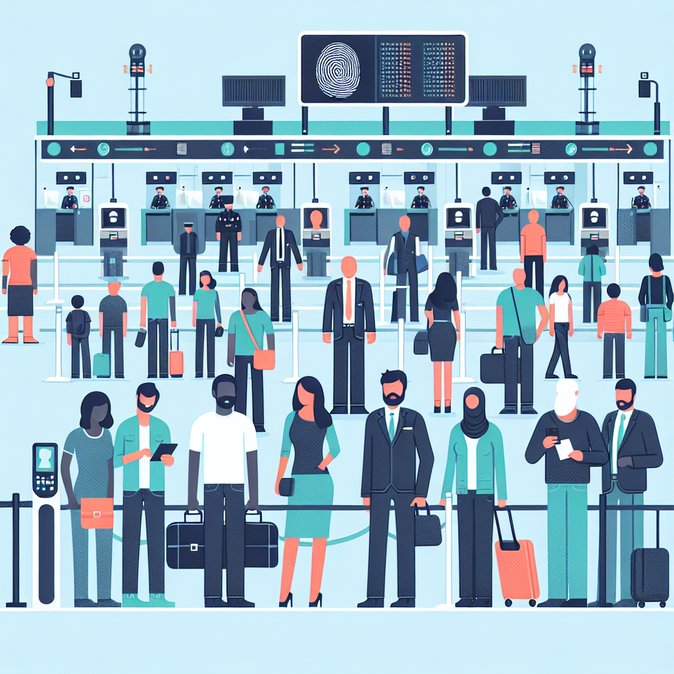
Canadians heading to the United States for business meetings, winter holidays or same-day shopping trips will face an additional set of border formalities after U.S. Customs and Border Protection (CBP) activated its long-planned Biometric Entry-Exit Rule on December 26 (coming into full effect December 27, 2025). The regulation extends mandatory facial images, fingerprints and—at some ports—iris scans to every non-U.S. citizen, including Canadian passport-holders and Canadian permanent residents. Until now, Canadians were largely exempt from routine biometric capture at U.S. land borders and most airports.
Under the new rule, biometrics will be taken at airports, land crossings and seaports each time a traveller both enters and departs the United States. CBP says the policy will close long-standing data gaps, tighten identity management and speed future vetting because officers can compare a live image against a gallery in seconds. Critics point out, however, that the rollout could slow border throughput during the first few months—particularly at high-volume land crossings like Windsor-Detroit and Pacific Highway—while booths are retro-fitted and travellers learn the drill.
From a corporate-mobility perspective, companies with frequent cross-border commuters or crews must budget extra transit time and update travel policies. Inter-company transfers under NAFTA/USMCA (C-20) and global project teams may have to re-sequence meeting agendas or build in contingency windows for biometric processing. Organizations moving equipment or perishables across the border should monitor wait-time dashboards and consider Commercial Vehicle lanes where biometrics can be pre-enrolled.
![U.S. Rolls Out Mandatory Biometric Entry-Exit Checks, Bringing New Border Formalities for Canadians]()
VisaHQ’s Canadian portal (https://www.visahq.com/canada/) can help travelers and mobility managers stay ahead of these changes by offering real-time updates on U.S. entry requirements, personalized document checklists, and expedited processing for visas or travel authorizations. By consolidating paperwork and guidance in one place, the service helps reduce last-minute surprises and keeps business trips on schedule despite the new biometric layer.
Privacy concerns also loom large. Under Department of Homeland Security retention rules, non-U.S. citizen biometric data may be stored for up to 75 years in the IDENT/HART system. Canadian labour-mobility groups have urged Ottawa to press Washington for clearer deletion protocols and public transparency. In the interim, Canadian travellers are being advised to arrive earlier, ensure passports are machine-readable and enroll in NEXUS where possible—although even trusted-traveller members will provide live facial images at e-gates.
Ultimately, CBP argues that an end-to-end biometric perimeter will reduce document fraud and overstay risk, paving the way for seamless, token-based travel in the future. For now, the immediate takeaway for global-mobility managers is operational: longer queues are likely through early 2026 and Canadian employees should be briefed on the new procedures before their next U.S. trip.
Under the new rule, biometrics will be taken at airports, land crossings and seaports each time a traveller both enters and departs the United States. CBP says the policy will close long-standing data gaps, tighten identity management and speed future vetting because officers can compare a live image against a gallery in seconds. Critics point out, however, that the rollout could slow border throughput during the first few months—particularly at high-volume land crossings like Windsor-Detroit and Pacific Highway—while booths are retro-fitted and travellers learn the drill.
From a corporate-mobility perspective, companies with frequent cross-border commuters or crews must budget extra transit time and update travel policies. Inter-company transfers under NAFTA/USMCA (C-20) and global project teams may have to re-sequence meeting agendas or build in contingency windows for biometric processing. Organizations moving equipment or perishables across the border should monitor wait-time dashboards and consider Commercial Vehicle lanes where biometrics can be pre-enrolled.

VisaHQ’s Canadian portal (https://www.visahq.com/canada/) can help travelers and mobility managers stay ahead of these changes by offering real-time updates on U.S. entry requirements, personalized document checklists, and expedited processing for visas or travel authorizations. By consolidating paperwork and guidance in one place, the service helps reduce last-minute surprises and keeps business trips on schedule despite the new biometric layer.
Privacy concerns also loom large. Under Department of Homeland Security retention rules, non-U.S. citizen biometric data may be stored for up to 75 years in the IDENT/HART system. Canadian labour-mobility groups have urged Ottawa to press Washington for clearer deletion protocols and public transparency. In the interim, Canadian travellers are being advised to arrive earlier, ensure passports are machine-readable and enroll in NEXUS where possible—although even trusted-traveller members will provide live facial images at e-gates.
Ultimately, CBP argues that an end-to-end biometric perimeter will reduce document fraud and overstay risk, paving the way for seamless, token-based travel in the future. For now, the immediate takeaway for global-mobility managers is operational: longer queues are likely through early 2026 and Canadian employees should be briefed on the new procedures before their next U.S. trip.