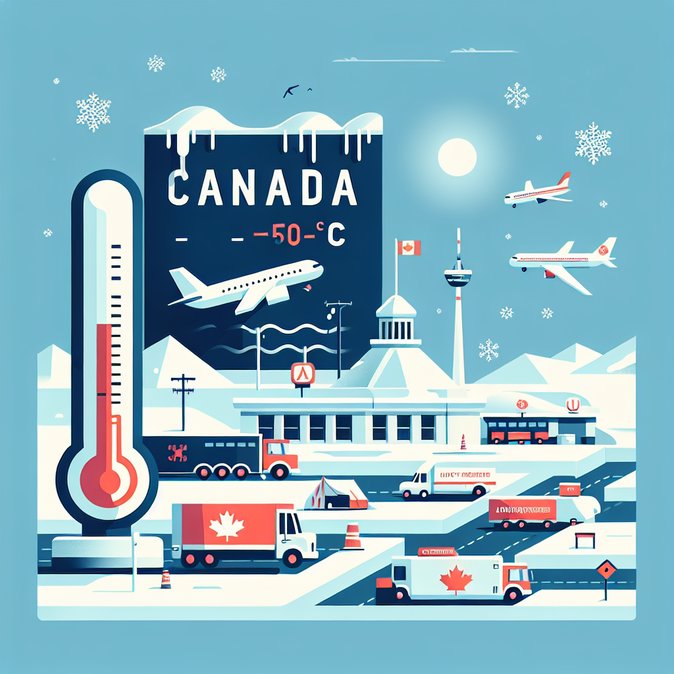
A stationary polar vortex parked over northern Yukon has unleashed some of the coldest December temperatures in half a century, with Braeburn recording –55.7 °C—Canada’s lowest December reading since 1975. Communities such as Mayo and Dawson endured 16 consecutive nights below –40 °C, while the chill extended south to Edmonton and Montréal, prompting Environment Canada to issue widespread extreme-cold warnings.
The frigid air has ripple effects on mobility. Airlines reduced allowable fuel loads to compensate for denser air, causing extra technical stops on certain transcontinental flights. Intercity bus operators cancelled overnight services across Prairie and Atlantic routes, and Via Rail warned of mechanical risks to rolling stock. Provincial transport ministries deployed ‘tow-plow’ convoys and mobile warming shelters along Highway 1 and other arterial corridors.
For travellers whose rerouted itineraries suddenly include unfamiliar transit points, staying on top of entry requirements is vital. VisaHQ’s Canada platform (https://www.visahq.com/canada/) lets you check visa rules in minutes, submit applications online and even arrange courier pickup for urgent passport renewals, ensuring paperwork doesn’t become another casualty of the deep freeze.
![Polar Vortex Plunges Much of Canada Into Deep Freeze, Forcing Travel Advisories and Infrastructure Strain]()
Employers with rotational workforces in energy, mining and construction sectors have invoked cold-weather shutdown protocols. At remote sites, fly-in/fly-out rotations were staggered to avoid exposing travellers to sub-Arctic apron conditions, and some firms activated charter aircraft to bypass congested hubs. Health authorities urged travellers to carry emergency kits, as stalled vehicles can become life-threatening within minutes at –40 °C wind chills.
Insurance underwriters are reminding relocation managers that household-goods shipments are at higher risk of freeze damage; supplemental coverage for temperature-sensitive items may be necessary. Meanwhile, utility providers in Yukon and northern B.C. issued conservation advisories, warning that surging demand could trigger rolling outages if generators fail.
Meteorologists predict the vortex will retreat northward after December 29, allowing milder Pacific air to reach southern Canada. Until then, travellers should verify airline cold-weather minimums, check highway closures and restrict non-essential outdoor movement.
The frigid air has ripple effects on mobility. Airlines reduced allowable fuel loads to compensate for denser air, causing extra technical stops on certain transcontinental flights. Intercity bus operators cancelled overnight services across Prairie and Atlantic routes, and Via Rail warned of mechanical risks to rolling stock. Provincial transport ministries deployed ‘tow-plow’ convoys and mobile warming shelters along Highway 1 and other arterial corridors.
For travellers whose rerouted itineraries suddenly include unfamiliar transit points, staying on top of entry requirements is vital. VisaHQ’s Canada platform (https://www.visahq.com/canada/) lets you check visa rules in minutes, submit applications online and even arrange courier pickup for urgent passport renewals, ensuring paperwork doesn’t become another casualty of the deep freeze.
Employers with rotational workforces in energy, mining and construction sectors have invoked cold-weather shutdown protocols. At remote sites, fly-in/fly-out rotations were staggered to avoid exposing travellers to sub-Arctic apron conditions, and some firms activated charter aircraft to bypass congested hubs. Health authorities urged travellers to carry emergency kits, as stalled vehicles can become life-threatening within minutes at –40 °C wind chills.
Insurance underwriters are reminding relocation managers that household-goods shipments are at higher risk of freeze damage; supplemental coverage for temperature-sensitive items may be necessary. Meanwhile, utility providers in Yukon and northern B.C. issued conservation advisories, warning that surging demand could trigger rolling outages if generators fail.
Meteorologists predict the vortex will retreat northward after December 29, allowing milder Pacific air to reach southern Canada. Until then, travellers should verify airline cold-weather minimums, check highway closures and restrict non-essential outdoor movement.