Germany’s Federal Ministry of the Interior quietly used the Christmas holiday lull to publish a notice in the Bundesanzeiger on 26 December confirming that the “temporary” controls it re-introduced at all nine of Germany’s land borders in September will remain in force until at least 15 March 2026.
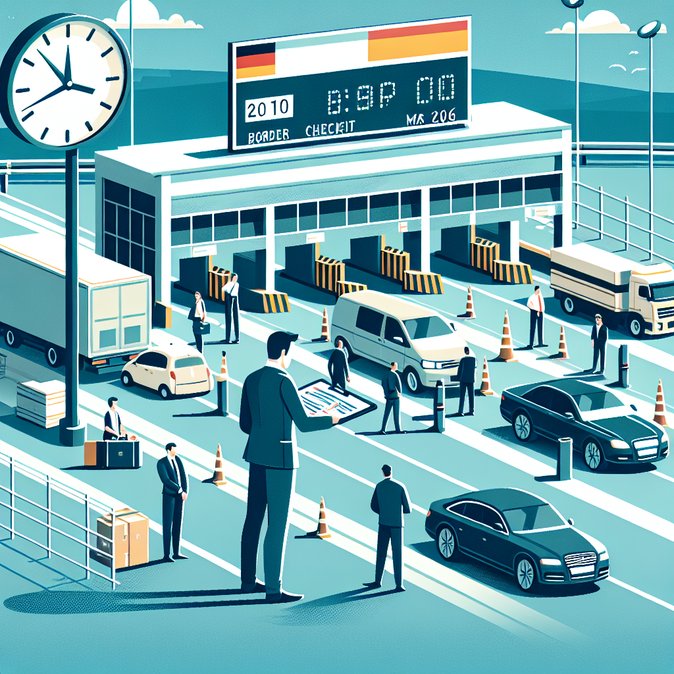
The controls—conducted by Bundespolizei officers on motorways, secondary roads and rail lines from Austria, Czechia, Poland, Denmark, the Netherlands, Luxembourg, France and Switzerland—were brought back three months ago after a spike in irregular arrivals along the Balkan route and the dismantling of several people-smuggling rings. Although the Schengen Borders Code normally guarantees passport-free travel within the bloc, Article 25 allows member states to re-establish checks for renewable six-month periods “in the event of a serious threat to public policy or internal security.” Berlin’s latest extension pushes Germany right up against that current maximum.
For corporate mobility managers the decision has immediate practical implications. Travellers arriving by car or train—even on short hops from Amsterdam or Salzburg—should now expect spot ID checks, questions about accommodation, and in some cases requests for proof of sufficient funds. Non-EU assignees who normally rely on residence cards in lieu of passports are advised to carry both documents; officers have broad discretion to deny entry if identity cannot be verified on the spot. Rail operators Deutsche Bahn and ÖBB have already issued schedule warnings, noting that spot inspections can add 15–30 minutes to cross-border journeys.
![Germany Extends Land-Border Checks Through 15 March 2026]()
If you need help navigating these tightened procedures, VisaHQ’s Germany portal (https://www.visahq.com/germany/) offers real-time updates on entry formalities, visa options and passport requirements. Their specialists can arrange fast-track Schengen visa processing, review residence-card validity and provide tailored compliance checklists—services that can save both travellers and mobility teams valuable time when every minute at the border counts.
The continuation of internal borders also complicates freight logistics. Supply-chain analysts warn that the controls coincide with the rollout of the EU Entry/Exit System (EES) and a busy post-holiday shipping season, increasing the likelihood of motorway bottlenecks at key crossings such as the A3 (Passau) and A12 (Kiefersfelden). Export-oriented firms in Bavaria and Baden-Württemberg are being encouraged to pad delivery timetables by at least 24 hours and to alert just-in-time suppliers.
Politically, the move underscores Germany’s harder line on migration heading into 2026. Interior Minister Alexander Dobrindt defended the extension, arguing that “organised smuggling networks quickly adapt to seasonal patterns; suspending controls now would be irresponsible.” Civil-liberty groups and several neighbouring governments, however, accuse Berlin of undermining Schengen’s core principle and warn that long-term internal checks could normalise fragmentation of the single market. The European Commission has so far tolerated Germany’s measures but is expected to review their proportionality again in March, setting up another potential flash-point for businesses already coping with layered compliance obligations at the EU’s external and now internal borders.
The controls—conducted by Bundespolizei officers on motorways, secondary roads and rail lines from Austria, Czechia, Poland, Denmark, the Netherlands, Luxembourg, France and Switzerland—were brought back three months ago after a spike in irregular arrivals along the Balkan route and the dismantling of several people-smuggling rings. Although the Schengen Borders Code normally guarantees passport-free travel within the bloc, Article 25 allows member states to re-establish checks for renewable six-month periods “in the event of a serious threat to public policy or internal security.” Berlin’s latest extension pushes Germany right up against that current maximum.
For corporate mobility managers the decision has immediate practical implications. Travellers arriving by car or train—even on short hops from Amsterdam or Salzburg—should now expect spot ID checks, questions about accommodation, and in some cases requests for proof of sufficient funds. Non-EU assignees who normally rely on residence cards in lieu of passports are advised to carry both documents; officers have broad discretion to deny entry if identity cannot be verified on the spot. Rail operators Deutsche Bahn and ÖBB have already issued schedule warnings, noting that spot inspections can add 15–30 minutes to cross-border journeys.

If you need help navigating these tightened procedures, VisaHQ’s Germany portal (https://www.visahq.com/germany/) offers real-time updates on entry formalities, visa options and passport requirements. Their specialists can arrange fast-track Schengen visa processing, review residence-card validity and provide tailored compliance checklists—services that can save both travellers and mobility teams valuable time when every minute at the border counts.
The continuation of internal borders also complicates freight logistics. Supply-chain analysts warn that the controls coincide with the rollout of the EU Entry/Exit System (EES) and a busy post-holiday shipping season, increasing the likelihood of motorway bottlenecks at key crossings such as the A3 (Passau) and A12 (Kiefersfelden). Export-oriented firms in Bavaria and Baden-Württemberg are being encouraged to pad delivery timetables by at least 24 hours and to alert just-in-time suppliers.
Politically, the move underscores Germany’s harder line on migration heading into 2026. Interior Minister Alexander Dobrindt defended the extension, arguing that “organised smuggling networks quickly adapt to seasonal patterns; suspending controls now would be irresponsible.” Civil-liberty groups and several neighbouring governments, however, accuse Berlin of undermining Schengen’s core principle and warn that long-term internal checks could normalise fragmentation of the single market. The European Commission has so far tolerated Germany’s measures but is expected to review their proportionality again in March, setting up another potential flash-point for businesses already coping with layered compliance obligations at the EU’s external and now internal borders.