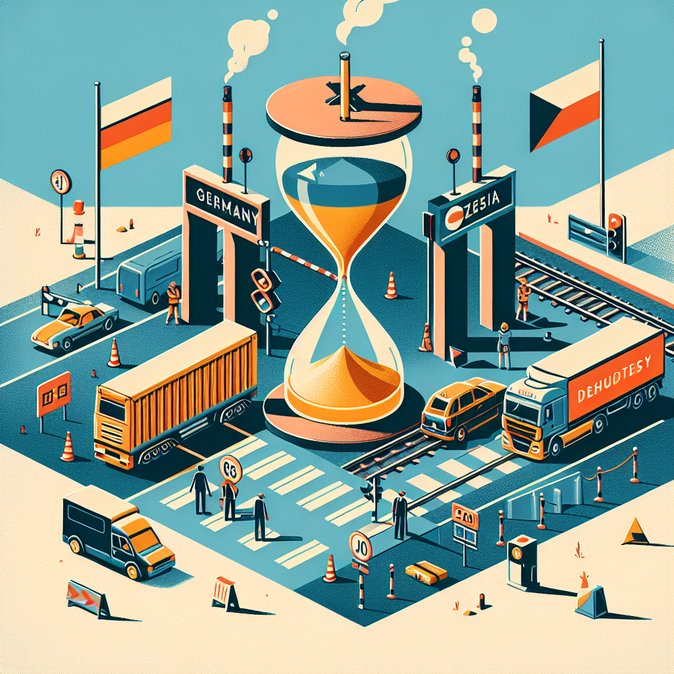
Berlin has quietly extended the “temporary” controls it re-introduced in September on all land borders, including crossings from Czechia, until at least 15 March 2026—the maximum period currently tolerated by the European Commission. The notice, published in the Federal Gazette on 22 December, allows Bundespolizei officers to stop motorists, train passengers and coach travellers at random to verify identity papers, travel purpose or proof of funds.
For Czech commuters and logistics firms the extension means longer and less predictable journey times on key corridors such as the D5 motorway (Rozvadov–Waidhaus) and the Dresden–Prague rail line. Travel-management companies advise adding 30–45 minutes to itineraries and carrying work contracts or invitation letters to smooth on-the-spot inspections.
![Germany Keeps Internal Schengen Checks on Czech Border Until 15 March 2026]()
Travellers who need clarity on what documents or proofs will satisfy German officers can turn to VisaHQ, a trusted online visa and passport platform. Through its Czech portal (https://www.visahq.com/czech-republic/), users can check up-to-date entry rules, upload paperwork for expert review and arrange courier delivery of any required documents—minimising the risk of being turned back at an impromptu border check.
The move follows similar prolongations by Austria and Poland and reflects political pressure on the new German government to curb secondary migration along the Balkan and Central-European routes. Since September, German officers have turned back 47 000 travellers and arrested almost 1 900 suspected smugglers, according to Interior Ministry figures.
Czech exporters that rely on just-in-time deliveries fear sporadic lorry queues at Rozvadov and Cínovec could erode supply-chain resilience. Mobility managers are updating risk assessments, briefing drivers on document requirements and, where feasible, shifting sensitive meetings online until predictability improves.
For Czech commuters and logistics firms the extension means longer and less predictable journey times on key corridors such as the D5 motorway (Rozvadov–Waidhaus) and the Dresden–Prague rail line. Travel-management companies advise adding 30–45 minutes to itineraries and carrying work contracts or invitation letters to smooth on-the-spot inspections.
Travellers who need clarity on what documents or proofs will satisfy German officers can turn to VisaHQ, a trusted online visa and passport platform. Through its Czech portal (https://www.visahq.com/czech-republic/), users can check up-to-date entry rules, upload paperwork for expert review and arrange courier delivery of any required documents—minimising the risk of being turned back at an impromptu border check.
The move follows similar prolongations by Austria and Poland and reflects political pressure on the new German government to curb secondary migration along the Balkan and Central-European routes. Since September, German officers have turned back 47 000 travellers and arrested almost 1 900 suspected smugglers, according to Interior Ministry figures.
Czech exporters that rely on just-in-time deliveries fear sporadic lorry queues at Rozvadov and Cínovec could erode supply-chain resilience. Mobility managers are updating risk assessments, briefing drivers on document requirements and, where feasible, shifting sensitive meetings online until predictability improves.