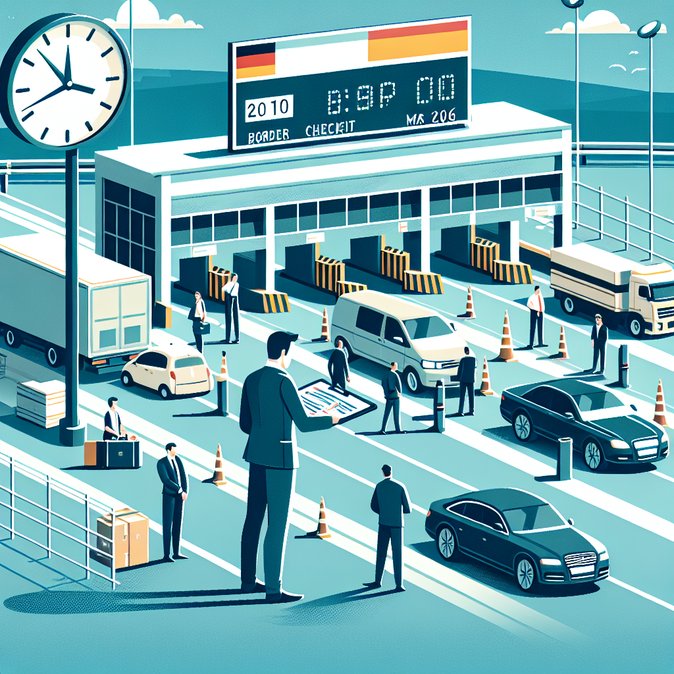
Germany’s Federal Ministry of the Interior used the quiet holiday period to publish a notice in the Bundesanzeiger confirming that the “temporary” controls re-introduced at Germany’s land borders in September will be prolonged until at least 15 March 2026. The step pushes the country right up against the six-month maximum currently tolerated by the European Commission for internal-Schengen checks. Spot controls will therefore continue on roads and rail lines from Austria, Czechia, Poland, Denmark, the Netherlands, Luxembourg, France and Switzerland.
Berlin first revived fixed checks three months ago after irregular arrivals along the Balkan route spiked and federal police broke up several high-profile people-smuggling rings. According to the Interior Ministry, officers have turned back 47,000 travellers since mid-September and arrested almost 1,900 suspected smugglers. While the move has proved popular with a public increasingly anxious about migration, it has angered haulage and tourism lobbies that rely on friction-free cross-border traffic.
![Germany Extends Land-Border Checks Through 15 March 2026]()
In this evolving environment, VisaHQ can help travellers and corporate mobility teams stay on top of Germany’s shifting entry requirements. Its dedicated Germany page (https://www.visahq.com/germany/) consolidates real-time updates on ID and visa rules, offers expedited document procurement services, and provides employer dashboards to track employee compliance—reducing the risk of delays or fines at the revived frontier checks.
For mobility managers the extension poses practical headaches. Coach operators must continue to pre-upload passenger manifests to the police gateway, while companies sending staff on same-day trips are being told to budget at least 30 extra minutes for possible stops. HR teams arranging cross-border commuter contracts in the densely populated “DACH-BENELUX” triangle are reminding employees to carry residence cards or EU ID cards even for short hops; failure to present them can trigger fines or refusals of entry.
Looking ahead, the Interior Ministry will review the measure in early March. If irregular entries fall below the 2023 monthly average, controls could be lifted or limited to high-risk crossings. Otherwise Berlin will have to seek another authorisation from Brussels—an option that may face political headwinds in the run-up to the June 2026 European Parliament elections. Companies with large commuter populations should therefore scenario-plan for both an early removal and a further extension.
Berlin first revived fixed checks three months ago after irregular arrivals along the Balkan route spiked and federal police broke up several high-profile people-smuggling rings. According to the Interior Ministry, officers have turned back 47,000 travellers since mid-September and arrested almost 1,900 suspected smugglers. While the move has proved popular with a public increasingly anxious about migration, it has angered haulage and tourism lobbies that rely on friction-free cross-border traffic.
In this evolving environment, VisaHQ can help travellers and corporate mobility teams stay on top of Germany’s shifting entry requirements. Its dedicated Germany page (https://www.visahq.com/germany/) consolidates real-time updates on ID and visa rules, offers expedited document procurement services, and provides employer dashboards to track employee compliance—reducing the risk of delays or fines at the revived frontier checks.
For mobility managers the extension poses practical headaches. Coach operators must continue to pre-upload passenger manifests to the police gateway, while companies sending staff on same-day trips are being told to budget at least 30 extra minutes for possible stops. HR teams arranging cross-border commuter contracts in the densely populated “DACH-BENELUX” triangle are reminding employees to carry residence cards or EU ID cards even for short hops; failure to present them can trigger fines or refusals of entry.
Looking ahead, the Interior Ministry will review the measure in early March. If irregular entries fall below the 2023 monthly average, controls could be lifted or limited to high-risk crossings. Otherwise Berlin will have to seek another authorisation from Brussels—an option that may face political headwinds in the run-up to the June 2026 European Parliament elections. Companies with large commuter populations should therefore scenario-plan for both an early removal and a further extension.