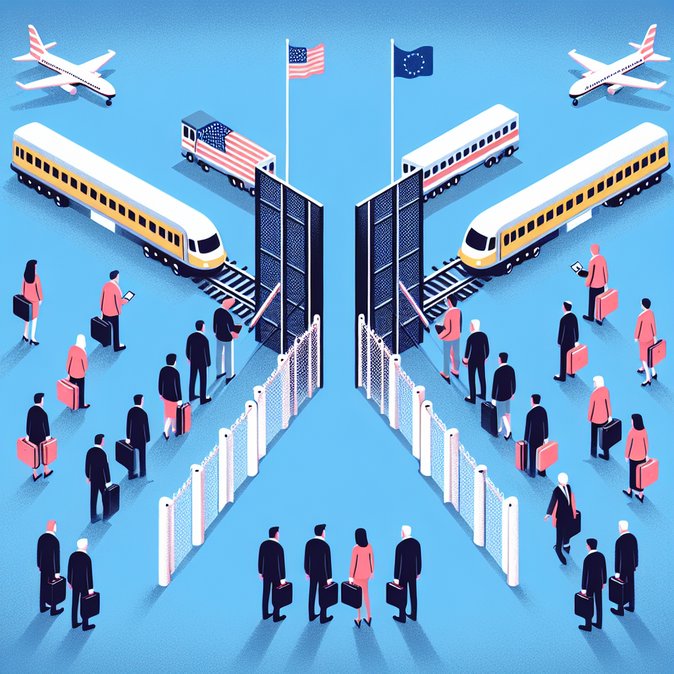
Trans-Atlantic relations took another knock on Christmas Eve when Washington announced visa bans on five high-profile European officials, including former Internal-Market Commissioner Thierry Breton, widely regarded as the father of the EU’s Digital Services Act (DSA). Berlin quickly aligned itself with Paris and Brussels, calling the step “unjustified political retaliation that undermines decades-old visa-waiver understandings.”
A spokesperson for Germany’s Federal Foreign Office warned that counter-measures—ranging from reciprocal entry restrictions on U.S. lobbyists to the suspension of ‘fast-track’ lanes at German airports—were already being mapped out with EU partners. While the bans are largely symbolic (few of the named officials travel often to the United States), German corporates fear collateral damage. Mobility managers at two DAX groups told Global Mobility News they are bracing for longer secondary screening of employees involved in EU tech-regulation projects when entering the U.S.
![Berlin Joins EU Outcry Over New U.S. Visa Bans on Digital-Regulation Architects]()
Amid such uncertainty, many companies are turning to specialised visa and travel-documentation services to minimise disruption. VisaHQ, for instance, tracks the latest diplomatic developments and can expedite the paperwork for German travellers who suddenly find themselves subject to new restrictions; details are available at https://www.visahq.com/germany/
The episode crystallises a bigger question: how politicised can mobility become before it starts to erode commercial ties? Lufthansa Cargo executives note that any tit-for-tat row could spill into over-flight approvals or air-freight tariffs. Travel-risk consultants advise senior staff working on digital-policy files to keep itineraries low key and carry letters clarifying the apolitical nature of their work.
For now the ball sits in Washington’s court. If the State Department does not clarify the legal basis of the bans, Berlin says it will push for a coordinated EU response when foreign ministers meet on 8 January. Companies with frequent U.S. travel should maintain a watching brief and update contingency plans.
A spokesperson for Germany’s Federal Foreign Office warned that counter-measures—ranging from reciprocal entry restrictions on U.S. lobbyists to the suspension of ‘fast-track’ lanes at German airports—were already being mapped out with EU partners. While the bans are largely symbolic (few of the named officials travel often to the United States), German corporates fear collateral damage. Mobility managers at two DAX groups told Global Mobility News they are bracing for longer secondary screening of employees involved in EU tech-regulation projects when entering the U.S.

Amid such uncertainty, many companies are turning to specialised visa and travel-documentation services to minimise disruption. VisaHQ, for instance, tracks the latest diplomatic developments and can expedite the paperwork for German travellers who suddenly find themselves subject to new restrictions; details are available at https://www.visahq.com/germany/
The episode crystallises a bigger question: how politicised can mobility become before it starts to erode commercial ties? Lufthansa Cargo executives note that any tit-for-tat row could spill into over-flight approvals or air-freight tariffs. Travel-risk consultants advise senior staff working on digital-policy files to keep itineraries low key and carry letters clarifying the apolitical nature of their work.
For now the ball sits in Washington’s court. If the State Department does not clarify the legal basis of the bans, Berlin says it will push for a coordinated EU response when foreign ministers meet on 8 January. Companies with frequent U.S. travel should maintain a watching brief and update contingency plans.