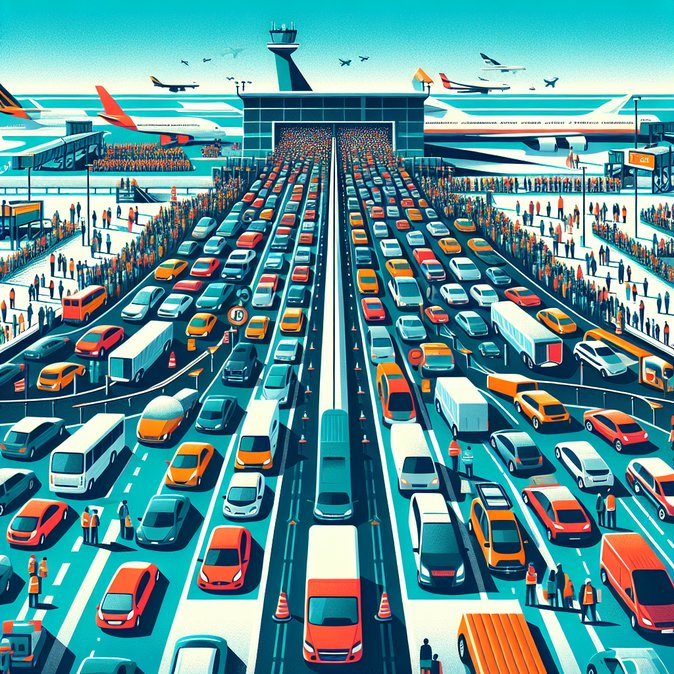
Britain’s transport network is under extraordinary pressure this Christmas Eve as millions of people attempt to reach friends, family and holiday destinations before services wind down for the festive break. The RAC forecasts 4.2 million individual car journeys today—the highest Christmas-Eve total since it began collecting comparable data in 2013—while the AA estimates overall traffic volumes could top 22 million vehicles. Motorways circling major cities are the worst affected: clockwise stretches of the M25 from Heathrow to Watford and long west-to-north sections of the M60 around Manchester are reporting average speeds below 20 mph.
Air travel is equally intense. Heathrow, Birmingham and Manchester airports all predict their busiest Christmas on record, with the Civil Aviation Authority expecting roughly 3 million departing passengers in the week leading up to 25 December. Airlines have added larger-gauge aircraft and supplementary “positioning” flights to cope with surging demand for Mediterranean winter-sun and New York shopping breaks, but take-off slots remain scarce—particularly in the 06:00-09:00 and 17:00-20:00 peaks.
Amid the rush, travellers bound for foreign destinations should also double-check entry requirements. VisaHQ’s online platform (https://www.visahq.com/united-kingdom/) lets UK residents quickly verify visa rules for hundreds of countries, complete applications and even arrange expedited processing—saving precious hours that might otherwise be lost in airport queues. Its customer-service team can advise on complex or multi-city itineraries, so last-minute holidaymakers spend less time on paperwork and more time enjoying the festivities.
![Busiest Christmas Eve on record strains UK roads, railways and airports]()
Rail capacity is limited because the traditional Christmas engineering blockade begins overnight. The final London–Edinburgh service left King’s Cross at 16:30, and most operators will run no trains at all on 25 December. Industry body Rail Delivery Group warns passengers that Boxing-Day timetables are “heavily reduced”, with only a handful of limited-stop services on Chiltern Railways, London Overground, Southern and ScotRail. Eurostar will not run any trains on Christmas Day and will operate 60 per cent of its normal schedule on 26 December.
For business travellers, the squeeze means leaving far greater buffers between land-side arrivals and flight departures, allowing for road congestion, potential rail replacement buses and longer airport dwell-times. Ground-handlers at several major airports have asked passengers to arrive three hours early for long-haul flights and two hours early for European services to mitigate bottlenecks at security.
Looking ahead, aviation analysts expect December 2025 to end with passenger numbers about 5 per cent higher than the pre-pandemic benchmark of December 2019—a sign that corporate travel budgets have largely normalised. The Department for Transport will use the Christmas Eve data to stress-test its real-time traffic-flow modelling ahead of next April’s rollout of emergency-digital corridors on the M25 and other strategic roads.
Air travel is equally intense. Heathrow, Birmingham and Manchester airports all predict their busiest Christmas on record, with the Civil Aviation Authority expecting roughly 3 million departing passengers in the week leading up to 25 December. Airlines have added larger-gauge aircraft and supplementary “positioning” flights to cope with surging demand for Mediterranean winter-sun and New York shopping breaks, but take-off slots remain scarce—particularly in the 06:00-09:00 and 17:00-20:00 peaks.
Amid the rush, travellers bound for foreign destinations should also double-check entry requirements. VisaHQ’s online platform (https://www.visahq.com/united-kingdom/) lets UK residents quickly verify visa rules for hundreds of countries, complete applications and even arrange expedited processing—saving precious hours that might otherwise be lost in airport queues. Its customer-service team can advise on complex or multi-city itineraries, so last-minute holidaymakers spend less time on paperwork and more time enjoying the festivities.
Rail capacity is limited because the traditional Christmas engineering blockade begins overnight. The final London–Edinburgh service left King’s Cross at 16:30, and most operators will run no trains at all on 25 December. Industry body Rail Delivery Group warns passengers that Boxing-Day timetables are “heavily reduced”, with only a handful of limited-stop services on Chiltern Railways, London Overground, Southern and ScotRail. Eurostar will not run any trains on Christmas Day and will operate 60 per cent of its normal schedule on 26 December.
For business travellers, the squeeze means leaving far greater buffers between land-side arrivals and flight departures, allowing for road congestion, potential rail replacement buses and longer airport dwell-times. Ground-handlers at several major airports have asked passengers to arrive three hours early for long-haul flights and two hours early for European services to mitigate bottlenecks at security.
Looking ahead, aviation analysts expect December 2025 to end with passenger numbers about 5 per cent higher than the pre-pandemic benchmark of December 2019—a sign that corporate travel budgets have largely normalised. The Department for Transport will use the Christmas Eve data to stress-test its real-time traffic-flow modelling ahead of next April’s rollout of emergency-digital corridors on the M25 and other strategic roads.