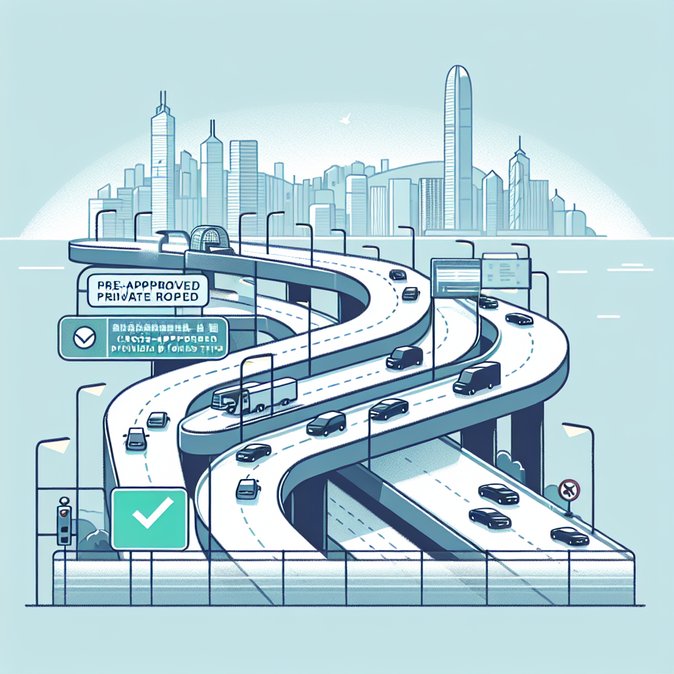
Hong Kong’s long-anticipated Southbound Travel for Guangdong Vehicles Scheme went live at midnight on December 23, allowing approved private cars from four Guangdong cities—Guangzhou, Zhuhai, Zhongshan and Jiangmen—to drive beyond the Hong Kong-Zhuhai-Macao Bridge port and enter the SAR’s urban road network for the first time.
The pilot is deliberately modest: a daily quota of 100 vehicles, each permitted to stay up to three days, and limited initially to drivers who secured a place in a computer ballot earlier this month. Before receiving an electronic permit, motorists had to pass a 15-point road-worthiness inspection on the mainland, install an HKSAR licence plate bearing the “FT” prefix, buy Hong Kong third-party insurance and register an HKeToll account to pay tunnel charges automatically. Border officials on both sides are using fully digital document checks, which greatly reduces processing time at the bridge crossing.
Business groups have welcomed the breakthrough. Guangdong executives visiting Hong Kong for meetings or trade fairs previously relied on chauffeurs, cross-boundary coaches or the airport “Park-and-Fly” facility added in November. The ability to self-drive directly to meetings in Central or Kowloon saves hours in transfers and allows passengers to carry product samples that would be awkward on public transport. Retailers in the New Territories are also eyeing new spending: government economists estimate each car party could inject HK $6,000–HK $9,000 per visit—equivalent to HK $15 million a week during the pilot phase.
![Hong Kong opens its roads to Guangdong-registered private cars under new Southbound Travel Scheme]()
For mainland motorists unsure about the paperwork, VisaHQ’s Hong Kong team (https://www.visahq.com/hong-kong/) can simplify the process. The agency offers end-to-end assistance with everything from cross-border insurance and licence-plate applications to last-minute visa or passport renewals, letting travellers focus on the business purpose of their trip rather than the red tape.
For now, the strict quota and three-day cap limit pure commuter usage. Chambers of commerce are already lobbying for a larger second-phase quota once authorities have analysed congestion, safety and insurance data collected during the first three months. Officials from both sides say an expansion to the rest of Guangdong’s Greater Bay Area cities is planned for mid-2026 if the launch proceeds smoothly.
Practical tips for corporates: ensure travellers’ travel documents match the vehicle permit, book tunnel slots early via the dedicated portal, and remind staff that mainland mobile-phone e-permits must be shown—even if a paper print-out is carried as back-up. Companies moving equipment should note that the usual customs declarations still apply, and hazardous goods remain prohibited.
The pilot is deliberately modest: a daily quota of 100 vehicles, each permitted to stay up to three days, and limited initially to drivers who secured a place in a computer ballot earlier this month. Before receiving an electronic permit, motorists had to pass a 15-point road-worthiness inspection on the mainland, install an HKSAR licence plate bearing the “FT” prefix, buy Hong Kong third-party insurance and register an HKeToll account to pay tunnel charges automatically. Border officials on both sides are using fully digital document checks, which greatly reduces processing time at the bridge crossing.
Business groups have welcomed the breakthrough. Guangdong executives visiting Hong Kong for meetings or trade fairs previously relied on chauffeurs, cross-boundary coaches or the airport “Park-and-Fly” facility added in November. The ability to self-drive directly to meetings in Central or Kowloon saves hours in transfers and allows passengers to carry product samples that would be awkward on public transport. Retailers in the New Territories are also eyeing new spending: government economists estimate each car party could inject HK $6,000–HK $9,000 per visit—equivalent to HK $15 million a week during the pilot phase.
For mainland motorists unsure about the paperwork, VisaHQ’s Hong Kong team (https://www.visahq.com/hong-kong/) can simplify the process. The agency offers end-to-end assistance with everything from cross-border insurance and licence-plate applications to last-minute visa or passport renewals, letting travellers focus on the business purpose of their trip rather than the red tape.
For now, the strict quota and three-day cap limit pure commuter usage. Chambers of commerce are already lobbying for a larger second-phase quota once authorities have analysed congestion, safety and insurance data collected during the first three months. Officials from both sides say an expansion to the rest of Guangdong’s Greater Bay Area cities is planned for mid-2026 if the launch proceeds smoothly.
Practical tips for corporates: ensure travellers’ travel documents match the vehicle permit, book tunnel slots early via the dedicated portal, and remind staff that mainland mobile-phone e-permits must be shown—even if a paper print-out is carried as back-up. Companies moving equipment should note that the usual customs declarations still apply, and hazardous goods remain prohibited.
More From Hong Kong
View all
Immigration Department forecasts 11.5 million border crossings over Christmas and New Year, expands e-Channel capacity

Christmas road closures and overnight transport boost to keep Hong Kong moving on 24-25 December