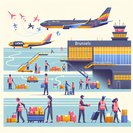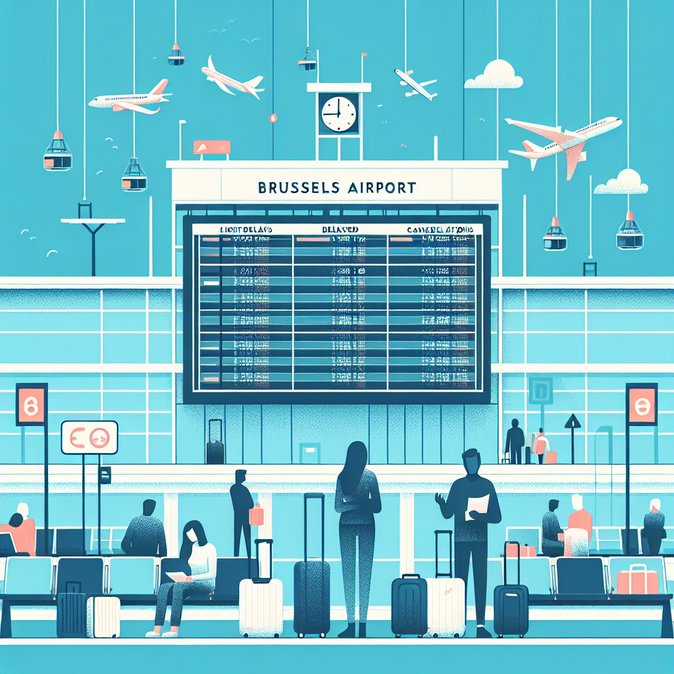
Brussels Airport woke up to a grim holiday rush on 23 December as the hub confirmed 110 flight delays and three outright cancellations in the space of a few morning hours. The figures come from real-time data collated by FlightAware and compiled by industry portal Travel and Tour World, which recorded 1,507 delayed and 25 cancelled flights across Europe’s five busiest markets – the UK, France, Portugal, Spain and Belgium.
Although Britain’s Heathrow and France’s Charles-de-Gaulle suffered the largest absolute numbers, Brussels Airport’s network tightness magnified the knock-on effect for Belgian travellers and transfer passengers alike. Business travellers heading for the United States or Africa on Brussels Airlines reported missed connections, while inbound expatriate workers found themselves queuing for rebooking assistance instead of making it to end-of-year assignment briefings. With staffing still below 2019 levels, airlines blamed a cocktail of winter weather, air-traffic-control stretch, and crewing shortfalls for the chaos.
From a corporate-mobility standpoint, the disruption illustrates how thin seasonal operating margins still are. Employers repatriating staff for Christmas or rotating project teams onto Belgian sites now face extra hotel, per-diem and productivity costs. Immigration lawyers warn that Schengen visa over-stays caused by flight cancellations technically remain the traveller’s responsibility; companies should therefore prepare written justifications and keep boarding-pass evidence in case of future audits.
![Holiday Air-Travel Chaos: 110 Delays and 3 Cancellations Hit Brussels Airport in Europe-Wide Disruption]()
During such visa-related uncertainties, VisaHQ can step in to streamline emergency Schengen extensions or alternative travel-document applications; its digital platform (https://www.visahq.com/belgium/) lets stranded passengers and corporate travel coordinators upload paperwork, track status in real time and receive expert guidance without leaving the airport lounge.
Travel managers are advising assignees to build 24-hour buffers into itineraries through Brussels, to use airline apps for re-routing before airport queues form, and to familiarise themselves with EU261 compensation rules. Analysts at Belfius expect a one-day disruption of this scale to shave up to €4 million off airport-area retail takings and could push December passenger-experience scores to their lowest level since early-2024 strikes.
Looking ahead, Brussels Airport’s capacity-planning team has called an emergency meeting with airlines and ground handlers to create contingency staffing rosters through New Year’s week. Whether that will be enough to avoid a repeat over the coming weekend remains to be seen – but for now, corporate mobility managers are bracing for another bruising holiday peak.
Although Britain’s Heathrow and France’s Charles-de-Gaulle suffered the largest absolute numbers, Brussels Airport’s network tightness magnified the knock-on effect for Belgian travellers and transfer passengers alike. Business travellers heading for the United States or Africa on Brussels Airlines reported missed connections, while inbound expatriate workers found themselves queuing for rebooking assistance instead of making it to end-of-year assignment briefings. With staffing still below 2019 levels, airlines blamed a cocktail of winter weather, air-traffic-control stretch, and crewing shortfalls for the chaos.
From a corporate-mobility standpoint, the disruption illustrates how thin seasonal operating margins still are. Employers repatriating staff for Christmas or rotating project teams onto Belgian sites now face extra hotel, per-diem and productivity costs. Immigration lawyers warn that Schengen visa over-stays caused by flight cancellations technically remain the traveller’s responsibility; companies should therefore prepare written justifications and keep boarding-pass evidence in case of future audits.

During such visa-related uncertainties, VisaHQ can step in to streamline emergency Schengen extensions or alternative travel-document applications; its digital platform (https://www.visahq.com/belgium/) lets stranded passengers and corporate travel coordinators upload paperwork, track status in real time and receive expert guidance without leaving the airport lounge.
Travel managers are advising assignees to build 24-hour buffers into itineraries through Brussels, to use airline apps for re-routing before airport queues form, and to familiarise themselves with EU261 compensation rules. Analysts at Belfius expect a one-day disruption of this scale to shave up to €4 million off airport-area retail takings and could push December passenger-experience scores to their lowest level since early-2024 strikes.
Looking ahead, Brussels Airport’s capacity-planning team has called an emergency meeting with airlines and ground handlers to create contingency staffing rosters through New Year’s week. Whether that will be enough to avoid a repeat over the coming weekend remains to be seen – but for now, corporate mobility managers are bracing for another bruising holiday peak.