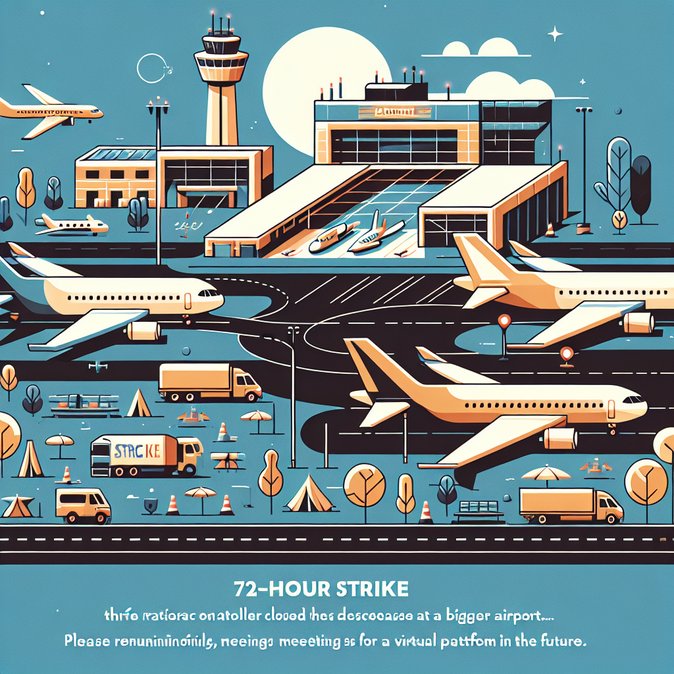
France’s volatile labour relations have erupted again just days before the peak holiday exodus. At 04:00 on 20 December, members of the powerful SNCTA union walked off the job over roster-reform talks, forcing the civil-aviation regulator (DGAC) to close Montpellier-Méditerranée, Nîmes-Garons and Perpignan-Rivesaltes outright and to cap movements at Lyon Saint-Exupéry by 60 percent. Although the strike technically began on Saturday, the DGAC confirmed it would continue through Monday, 22 December, meaning the entire 24-hour news cycle has been dominated by images of blank departure boards and diverted aircraft.
The immediate operational impact is severe. Montpellier lost every commercial departure on Sunday, while inbound flights were rerouted to Toulouse and Marseille. Business travellers hoping to shuttle between regional production sites and Parisian headquarters have scrambled for alternatives; TGV services are sold out and rental-car availability has collapsed. Several multinationals told VisaHQ they moved board meetings online and activated duty-of-care protocols to house stranded staff near open hubs.
Beyond the airport closures, NOTAMs issued by the DGAC have knocked-on consequences for the entire French Flight Information Region. Overflights that would normally cross the Mediterranean seaboard are being rerouted far out to sea, burning extra fuel and triggering EU emissions-trading costs. Cargo operators warn that perishable goods arriving via Catalonia now face last-mile road journeys of up to six hours to reach Occitanie distribution centres.
![Snap 72-Hour Air-Traffic Controller Strike Grounds Southern France Airports Ahead of Christmas]()
At this juncture, travellers unsure about documentation requirements—especially if rerouted through non-Schengen gateways—can lean on VisaHQ’s France portal (https://www.visahq.com/france/) for real-time visa checks, digital applications and passport-renewal support. The platform’s alert service tracks strike-related NOTAMs alongside consular updates, giving mobility managers a single dashboard to keep itineraries compliant even as routes change hour by hour.
Negotiations between the Ministry of Transport and SNCTA collapsed after an all-night session in Paris, with the union refusing to compromise on mandatory rest-period calculations. Officials admit privately that further stoppages could hit the early-January business-travel peak unless a new fatigue-management framework is tabled. Mobility managers should therefore: 1) block extra buffer time into January itineraries; 2) pre-book hotel rooms at alternative airports such as Toulouse or Girona; and 3) obtain written proof of cancellations to support insurance and expense claims.
For corporate travellers still determined to move staff, one option is to transit via Barcelona or Toulouse and then enter France by rail or road—provided vehicles avoid farmer blockades currently disrupting the A7 Rhône corridor (see separate story). Companies should also verify that any last-minute detours through non-Schengen hubs do not trigger unexpected visa or biometric obligations under the new Entry/Exit System (EES).
The immediate operational impact is severe. Montpellier lost every commercial departure on Sunday, while inbound flights were rerouted to Toulouse and Marseille. Business travellers hoping to shuttle between regional production sites and Parisian headquarters have scrambled for alternatives; TGV services are sold out and rental-car availability has collapsed. Several multinationals told VisaHQ they moved board meetings online and activated duty-of-care protocols to house stranded staff near open hubs.
Beyond the airport closures, NOTAMs issued by the DGAC have knocked-on consequences for the entire French Flight Information Region. Overflights that would normally cross the Mediterranean seaboard are being rerouted far out to sea, burning extra fuel and triggering EU emissions-trading costs. Cargo operators warn that perishable goods arriving via Catalonia now face last-mile road journeys of up to six hours to reach Occitanie distribution centres.

At this juncture, travellers unsure about documentation requirements—especially if rerouted through non-Schengen gateways—can lean on VisaHQ’s France portal (https://www.visahq.com/france/) for real-time visa checks, digital applications and passport-renewal support. The platform’s alert service tracks strike-related NOTAMs alongside consular updates, giving mobility managers a single dashboard to keep itineraries compliant even as routes change hour by hour.
Negotiations between the Ministry of Transport and SNCTA collapsed after an all-night session in Paris, with the union refusing to compromise on mandatory rest-period calculations. Officials admit privately that further stoppages could hit the early-January business-travel peak unless a new fatigue-management framework is tabled. Mobility managers should therefore: 1) block extra buffer time into January itineraries; 2) pre-book hotel rooms at alternative airports such as Toulouse or Girona; and 3) obtain written proof of cancellations to support insurance and expense claims.
For corporate travellers still determined to move staff, one option is to transit via Barcelona or Toulouse and then enter France by rail or road—provided vehicles avoid farmer blockades currently disrupting the A7 Rhône corridor (see separate story). Companies should also verify that any last-minute detours through non-Schengen hubs do not trigger unexpected visa or biometric obligations under the new Entry/Exit System (EES).