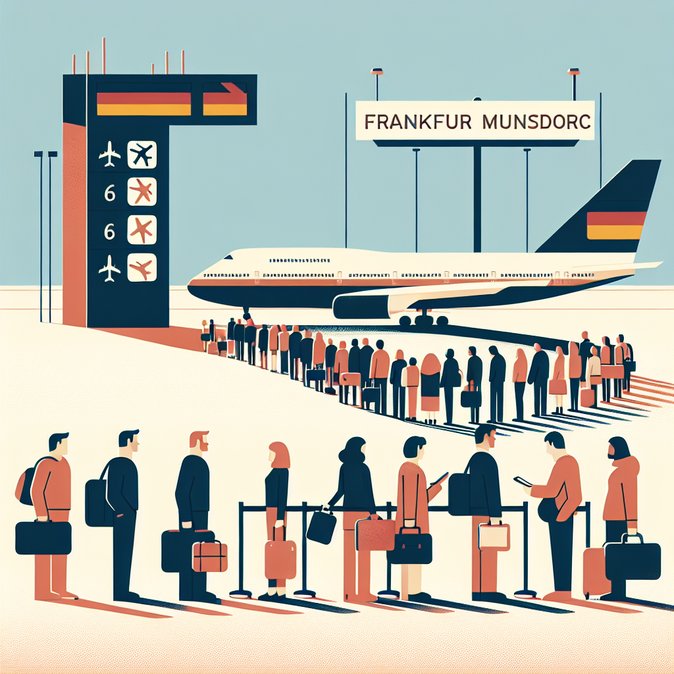
German travellers hoping to leave for the Christmas break faced a double shock over the weekend: airport ground-handling strikes coincided with the first large-scale use of the EU’s Entry/Exit System (EES), producing queues that at times stretched through terminal concourses. According to data compiled by flight-tracker OAG and confirmed by German aviation officials, Frankfurt, Munich and Düsseldorf recorded average departure delays of 55 minutes on Saturday, 21 December.
Under the EES, all third-country nationals must register four fingerprints and a facial image the first time they enter the Schengen Area, replacing the manual passport stamp. German hubs have installed more than 300 self-service kiosks, but union representatives argue that staffing levels are insufficient to manage unfamiliar passengers, especially when experienced ground staff are on strike for higher Christmas bonuses. The Verdi union says up to 2,000 baggage handlers and check-in agents walked out for 12 hours, demanding a €500 one-off payment to offset inflation.
![Holiday Strikes and New Biometric Checks Snarl Traffic at German Airports]()
For travellers who want to minimise surprises, VisaHQ can step in as a one-stop resource for EES information and Schengen documentation. Its Germany portal (https://www.visahq.com/germany/) keeps requirements up to date, offers digital application tools, and connects users with experts who can fast-track visas or passports—services that can prove critical when strikes or long biometric queues threaten a carefully planned trip.
For business travellers the disruption is more than a one-day nuisance. Airlines warn that residual backlogs may persist until 24 December. Lufthansa has already issued a “book-with-confidence” waiver allowing ticket changes free of charge. Mobility managers are advising executives from the US and UK to arrive at least four hours early, complete the pre-registration on the EU’s “EES Mobile” app and use priority security lanes where available.
The situation offers a glimpse of what may await after the EES becomes fully mandatory in May 2026. Companies relying on frequent short-notice trips into Germany should budget extra lead time and consider obtaining Registered Traveller status once the programme opens to corporate applicants. Employers should also update travel policies to reflect the biometric capture requirement and clarify who pays if missed flights lead to rebooking fees.
Under the EES, all third-country nationals must register four fingerprints and a facial image the first time they enter the Schengen Area, replacing the manual passport stamp. German hubs have installed more than 300 self-service kiosks, but union representatives argue that staffing levels are insufficient to manage unfamiliar passengers, especially when experienced ground staff are on strike for higher Christmas bonuses. The Verdi union says up to 2,000 baggage handlers and check-in agents walked out for 12 hours, demanding a €500 one-off payment to offset inflation.

For travellers who want to minimise surprises, VisaHQ can step in as a one-stop resource for EES information and Schengen documentation. Its Germany portal (https://www.visahq.com/germany/) keeps requirements up to date, offers digital application tools, and connects users with experts who can fast-track visas or passports—services that can prove critical when strikes or long biometric queues threaten a carefully planned trip.
For business travellers the disruption is more than a one-day nuisance. Airlines warn that residual backlogs may persist until 24 December. Lufthansa has already issued a “book-with-confidence” waiver allowing ticket changes free of charge. Mobility managers are advising executives from the US and UK to arrive at least four hours early, complete the pre-registration on the EU’s “EES Mobile” app and use priority security lanes where available.
The situation offers a glimpse of what may await after the EES becomes fully mandatory in May 2026. Companies relying on frequent short-notice trips into Germany should budget extra lead time and consider obtaining Registered Traveller status once the programme opens to corporate applicants. Employers should also update travel policies to reflect the biometric capture requirement and clarify who pays if missed flights lead to rebooking fees.