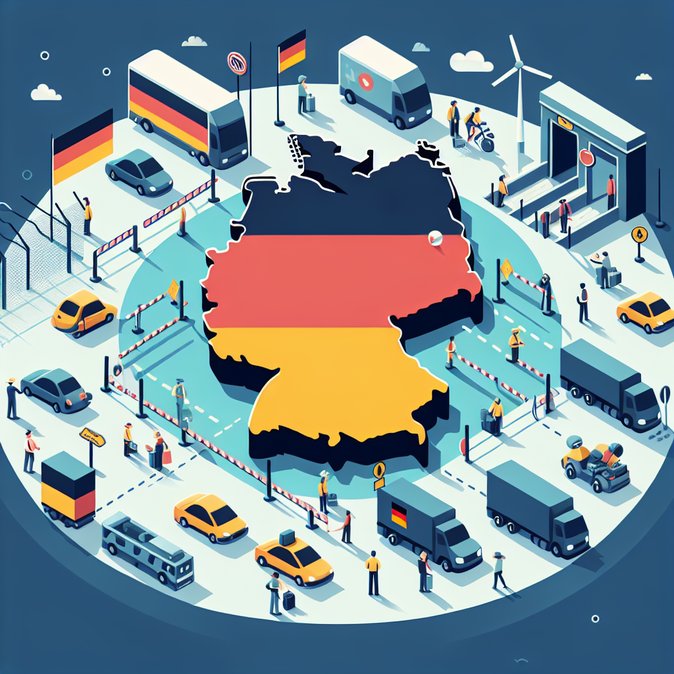
Germany’s Federal Ministry of the Interior has confirmed that the temporary checks it re-introduced on 16 September 2025 at almost all of the country’s land borders will remain in force until at least 15 March 2026 – the maximum period currently authorised by the European Commission. The decision, published on 22 December, means that motorists and train passengers entering Germany from Austria, Czechia, Poland, Denmark, the Netherlands, Luxembourg, France and Switzerland will continue to encounter spot controls by the Bundespolizei. Officers do not stamp EU passports, but may ask travellers to present identity documents, proof of accommodation or funds, and have the authority to refuse entry to anyone suspected of irregular migration or security threats.
Interior Minister Alexander Dobrindt justified the move as a response to “continued secondary movements and people-smuggling along the Balkan and Central European routes”, pointing to a 35 % decline in irregular entries since the checks were reinstated. The ministry claims that the extension is proportionate and coordinated with neighbouring states, noting similar measures in Austria, Slovenia and Denmark.
![Germany Extends Land-Border Checks Until March 2026]()
Travellers or mobility teams who need clarity on document requirements—or assistance securing business, work or long-term stays—can simplify the process through VisaHQ’s Germany portal (https://www.visahq.com/germany/). The platform consolidates the latest rules, supplies step-by-step checklists, and offers courier and concierge services that help ensure every passport or visa application is correct before travellers reach the border.
For corporate mobility managers the renewal translates into at least three more months of administrative friction. Although average inspection times at the busiest crossings (A3 Passau and A12 Frankfurt (Oder)) are under ten minutes, freight forwarders and commuter coaches report peak-hour tailbacks of up to six kilometres. Employee shuttles moving between German and Polish plants now plan buffer time and carry letters explaining the business purpose of travel. Logistics associations have warned that just a five-minute delay per truck adds roughly €4 million in costs to cross-border supply chains each month.
Practical advice for travellers remains straightforward: carry a valid passport or EU ID card, allow extra travel time, and keep work contracts, hotel bookings or invitation letters handy. Employers should remind posted workers that overstaying the Schengen 90/180-day rule can still trigger fines even though passports are not stamped. Multinationals with high volumes of cross-border traffic may consider applying for Federal Police “Frequent Traveller” cards that allow streamlined checks at designated lanes.
Interior Minister Alexander Dobrindt justified the move as a response to “continued secondary movements and people-smuggling along the Balkan and Central European routes”, pointing to a 35 % decline in irregular entries since the checks were reinstated. The ministry claims that the extension is proportionate and coordinated with neighbouring states, noting similar measures in Austria, Slovenia and Denmark.

Travellers or mobility teams who need clarity on document requirements—or assistance securing business, work or long-term stays—can simplify the process through VisaHQ’s Germany portal (https://www.visahq.com/germany/). The platform consolidates the latest rules, supplies step-by-step checklists, and offers courier and concierge services that help ensure every passport or visa application is correct before travellers reach the border.
For corporate mobility managers the renewal translates into at least three more months of administrative friction. Although average inspection times at the busiest crossings (A3 Passau and A12 Frankfurt (Oder)) are under ten minutes, freight forwarders and commuter coaches report peak-hour tailbacks of up to six kilometres. Employee shuttles moving between German and Polish plants now plan buffer time and carry letters explaining the business purpose of travel. Logistics associations have warned that just a five-minute delay per truck adds roughly €4 million in costs to cross-border supply chains each month.
Practical advice for travellers remains straightforward: carry a valid passport or EU ID card, allow extra travel time, and keep work contracts, hotel bookings or invitation letters handy. Employers should remind posted workers that overstaying the Schengen 90/180-day rule can still trigger fines even though passports are not stamped. Multinationals with high volumes of cross-border traffic may consider applying for Federal Police “Frequent Traveller” cards that allow streamlined checks at designated lanes.