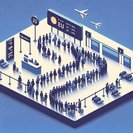
Two months into the EU-wide roll-out of the Biometric Entry/Exit System (EES), Airports Council International Europe is warning of wait times of up to three hours at several hubs. Austrian airports have so far avoided headline-grabbing chaos, but the share of third-country nationals that must be registered will jump from 10 % to 35 % on 9 January and to 100 % by April 2026.
Vienna International Airport (VIE) has redeployed 60 security officers to immigration booths and installed 24 new self-service kiosks; Salzburg and Innsbruck have set up overflow lanes and issued guidance advising non-EU passengers to arrive 45 minutes earlier. Airlines including Austrian and Ryanair are retiming early-morning banks to preserve minimum connections, while Qatar Airways has advanced its late-night Doha departure by 20 minutes.
Amid these changes, a one-stop service such as VisaHQ can help travellers stay ahead of new formalities. Through its Austria portal (https://www.visahq.com/austria/), VisaHQ offers real-time updates on visa rules, assists with electronic pre-enrolment and documentation, and provides alerts on biometric requirements—support that can save valuable minutes when every second counts at busy airports like Vienna and Salzburg.
![Biometric Entry/Exit System: Austrian Airports Warn of January Queue Surge]()
Business travellers are especially exposed: premium-lane capacity remains limited, and several relocation firms report missed residence-permit appointments after clients were stuck in immigration queues. HR teams are therefore building longer layover buffers into travel-booking tools and circulating quick-guide videos on kiosk navigation.
The Interior Ministry says it may request an EU derogation to keep January’s capture rate below 35 % if kiosk faults persist, but unanimity among member states would be required. Looking ahead, a mobile pre-enrolment app is promised for June 2026, but until then companies should advise travellers to allow at least an extra 45 minutes at Vienna and 30 minutes at secondary airports.
Failure to adapt could mean missed client meetings, missed train connections to Bratislava and Graz, and increased hotel costs. Embedding EES buffer times into corporate booking platforms now will pay dividends once 100 % capture becomes mandatory.
Vienna International Airport (VIE) has redeployed 60 security officers to immigration booths and installed 24 new self-service kiosks; Salzburg and Innsbruck have set up overflow lanes and issued guidance advising non-EU passengers to arrive 45 minutes earlier. Airlines including Austrian and Ryanair are retiming early-morning banks to preserve minimum connections, while Qatar Airways has advanced its late-night Doha departure by 20 minutes.
Amid these changes, a one-stop service such as VisaHQ can help travellers stay ahead of new formalities. Through its Austria portal (https://www.visahq.com/austria/), VisaHQ offers real-time updates on visa rules, assists with electronic pre-enrolment and documentation, and provides alerts on biometric requirements—support that can save valuable minutes when every second counts at busy airports like Vienna and Salzburg.

Business travellers are especially exposed: premium-lane capacity remains limited, and several relocation firms report missed residence-permit appointments after clients were stuck in immigration queues. HR teams are therefore building longer layover buffers into travel-booking tools and circulating quick-guide videos on kiosk navigation.
The Interior Ministry says it may request an EU derogation to keep January’s capture rate below 35 % if kiosk faults persist, but unanimity among member states would be required. Looking ahead, a mobile pre-enrolment app is promised for June 2026, but until then companies should advise travellers to allow at least an extra 45 minutes at Vienna and 30 minutes at secondary airports.
Failure to adapt could mean missed client meetings, missed train connections to Bratislava and Graz, and increased hotel costs. Embedding EES buffer times into corporate booking platforms now will pay dividends once 100 % capture becomes mandatory.