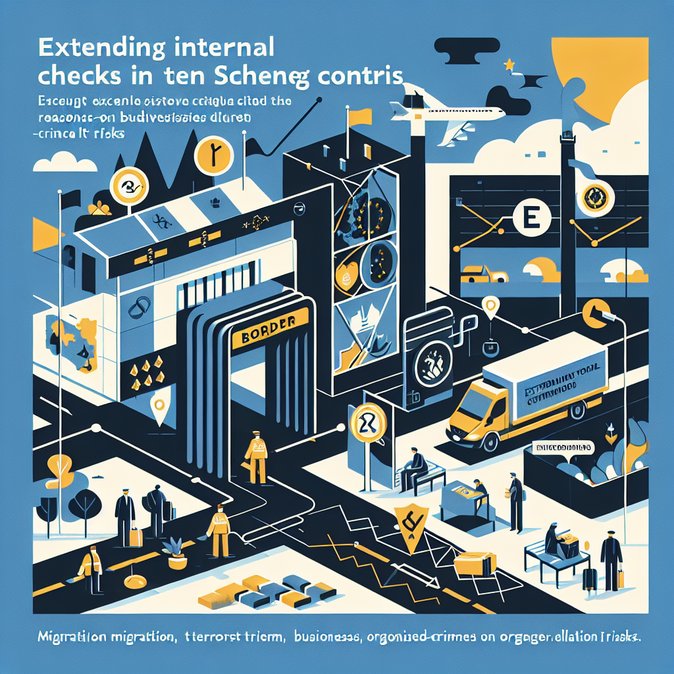
Belgian business travellers planning multi-country itineraries across continental Europe will need to dust off their passports again. On 21 December 2025, Israel Hayom reported that ten Schengen states—Austria, Slovenia, Italy, the Netherlands, Denmark, Norway, Sweden, France, Poland and Germany—have officially notified Brussels that they will prolong temporary controls at their internal borders until at least June 2026.
Although the Schengen Borders Code allows short-term re-introductions of checks in cases of ‘serious threats’, the patchwork of overlapping extensions has now become semi-permanent. For Belgians who routinely drive to the Netherlands for client meetings, ship goods by road through Germany, or fly via Paris Charles-de-Gaulle, the move means longer queues and a legal obligation to carry a national ID or passport at every crossing. Airports such as Brussels Zaventem already see sporadic spot-checks on flights to Amsterdam, Frankfurt and Copenhagen; these are expected to intensify.
If the extra paperwork feels daunting, VisaHQ can lighten the load. The company’s Belgian portal (https://www.visahq.com/belgium/) lets travellers and corporate travel managers arrange passport renewals, obtain second passports for frequent flyers, and secure visas for onward legs outside Schengen—all from one dashboard, with live status tracking and dedicated support.
![Schengen shake-up: Ten European countries extend internal border checks through mid-2026]()
Security rationales differ by country. Berlin cites unprecedented irregular migration pressure; Paris points to terrorism risks and rising antisemitic incidents; Rome links controls to preparations for the 2026 Jubilee Year and Milan–Cortina Olympics. The Netherlands explicitly names smuggling networks operating on its Belgian and German frontiers. Each state will review the measures every six months, but diplomats in Brussels concede that political appetite for a coordinated return to full free movement is “close to zero” until the 2026 European elections.
Practical implications for Belgian corporates are substantial. Cross-border commuters may have to factor in 20-45-minute delays at land crossings, especially at the E19 (Antwerp–Breda) and E40 (Liège–Aachen) corridors. Human-resources teams should remind staff to travel with compliant ID and residency permits. Logistics managers should update delivery schedules, while mobility-policy owners may need to adjust per-diem allowances to reflect unexpected overnight stays if drivers are held for secondary inspection.
On a strategic level, the creeping normalisation of internal controls could undermine the cost advantages that made Belgium—sandwiched between France, the Netherlands and Germany—an attractive hub for pan-European assignments. Multinationals are advised to monitor the European Commission’s February 2026 assessment, which will indicate whether Brussels is ready to push member states back toward the original Schengen norm—or accept a longer-term fragmentation of the zone.
Although the Schengen Borders Code allows short-term re-introductions of checks in cases of ‘serious threats’, the patchwork of overlapping extensions has now become semi-permanent. For Belgians who routinely drive to the Netherlands for client meetings, ship goods by road through Germany, or fly via Paris Charles-de-Gaulle, the move means longer queues and a legal obligation to carry a national ID or passport at every crossing. Airports such as Brussels Zaventem already see sporadic spot-checks on flights to Amsterdam, Frankfurt and Copenhagen; these are expected to intensify.
If the extra paperwork feels daunting, VisaHQ can lighten the load. The company’s Belgian portal (https://www.visahq.com/belgium/) lets travellers and corporate travel managers arrange passport renewals, obtain second passports for frequent flyers, and secure visas for onward legs outside Schengen—all from one dashboard, with live status tracking and dedicated support.

Security rationales differ by country. Berlin cites unprecedented irregular migration pressure; Paris points to terrorism risks and rising antisemitic incidents; Rome links controls to preparations for the 2026 Jubilee Year and Milan–Cortina Olympics. The Netherlands explicitly names smuggling networks operating on its Belgian and German frontiers. Each state will review the measures every six months, but diplomats in Brussels concede that political appetite for a coordinated return to full free movement is “close to zero” until the 2026 European elections.
Practical implications for Belgian corporates are substantial. Cross-border commuters may have to factor in 20-45-minute delays at land crossings, especially at the E19 (Antwerp–Breda) and E40 (Liège–Aachen) corridors. Human-resources teams should remind staff to travel with compliant ID and residency permits. Logistics managers should update delivery schedules, while mobility-policy owners may need to adjust per-diem allowances to reflect unexpected overnight stays if drivers are held for secondary inspection.
On a strategic level, the creeping normalisation of internal controls could undermine the cost advantages that made Belgium—sandwiched between France, the Netherlands and Germany—an attractive hub for pan-European assignments. Multinationals are advised to monitor the European Commission’s February 2026 assessment, which will indicate whether Brussels is ready to push member states back toward the original Schengen norm—or accept a longer-term fragmentation of the zone.