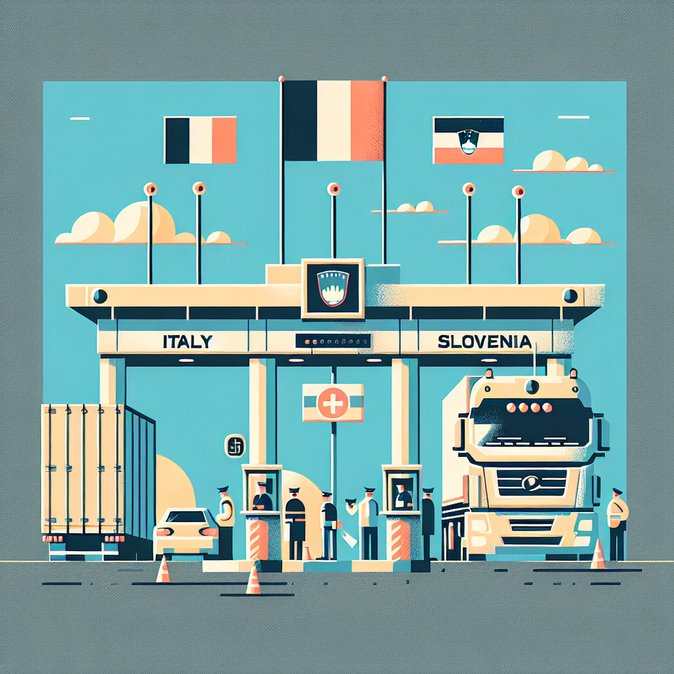
Travel between Italy’s Friuli-Venezia Giulia region and neighbouring Slovenia will remain subject to random passport inspections for at least another six months after Rome filed its fourth consecutive notification under Article 25 of the Schengen Borders Code. The extension, which formally runs from 19 December 2025 to 18 June 2026, is now listed on the European Commission’s public register of internal-border measures.
Businesses and individual travellers who need help ensuring their documents are in order can turn to VisaHQ, whose online platform (https://www.visahq.com/italy/) streamlines Italian passport renewals, visa applications, and residency paperwork. By offering pre-screening, courier pick-up, and real-time status tracking, VisaHQ helps minimise the risk of delays or refusals during these heightened border checks.
![Italy renews internal border checks with Slovenia until June 2026]()
The Italian Interior Ministry argues that continued checks are justified by terrorism-related security alerts ahead of the 2026 Universal Jubilee in Rome and by persistent irregular migration along the Balkan route. Companies shuttling staff or goods through the busy Trieste–Koper and Gorizia–Nova Gorica crossings should therefore plan for potential delays, especially at peak hours when police conduct vehicle-by-vehicle checks.
Although controls are selective rather than systematic, the renewal complicates Schengen-area predictability. Business travellers must carry passports or national ID cards; coach operators and corporate shuttle services are advised to brief passengers in advance to avoid refused boarding. Logistics managers moving time-sensitive freight through the Fernetti and Sežana commercial gates may want to build extra buffer time into schedules or reroute via Austria.
The policy also has HR implications: employees holding third-country residence permits issued by Italy or Slovenia still face spot checks and must present both passport and permit. Firms operating cross-border commuter programmes should audit documentation readiness and consider electronic storage of IDs to facilitate re-issue in case of loss during inspections.
Businesses and individual travellers who need help ensuring their documents are in order can turn to VisaHQ, whose online platform (https://www.visahq.com/italy/) streamlines Italian passport renewals, visa applications, and residency paperwork. By offering pre-screening, courier pick-up, and real-time status tracking, VisaHQ helps minimise the risk of delays or refusals during these heightened border checks.
The Italian Interior Ministry argues that continued checks are justified by terrorism-related security alerts ahead of the 2026 Universal Jubilee in Rome and by persistent irregular migration along the Balkan route. Companies shuttling staff or goods through the busy Trieste–Koper and Gorizia–Nova Gorica crossings should therefore plan for potential delays, especially at peak hours when police conduct vehicle-by-vehicle checks.
Although controls are selective rather than systematic, the renewal complicates Schengen-area predictability. Business travellers must carry passports or national ID cards; coach operators and corporate shuttle services are advised to brief passengers in advance to avoid refused boarding. Logistics managers moving time-sensitive freight through the Fernetti and Sežana commercial gates may want to build extra buffer time into schedules or reroute via Austria.
The policy also has HR implications: employees holding third-country residence permits issued by Italy or Slovenia still face spot checks and must present both passport and permit. Firms operating cross-border commuter programmes should audit documentation readiness and consider electronic storage of IDs to facilitate re-issue in case of loss during inspections.