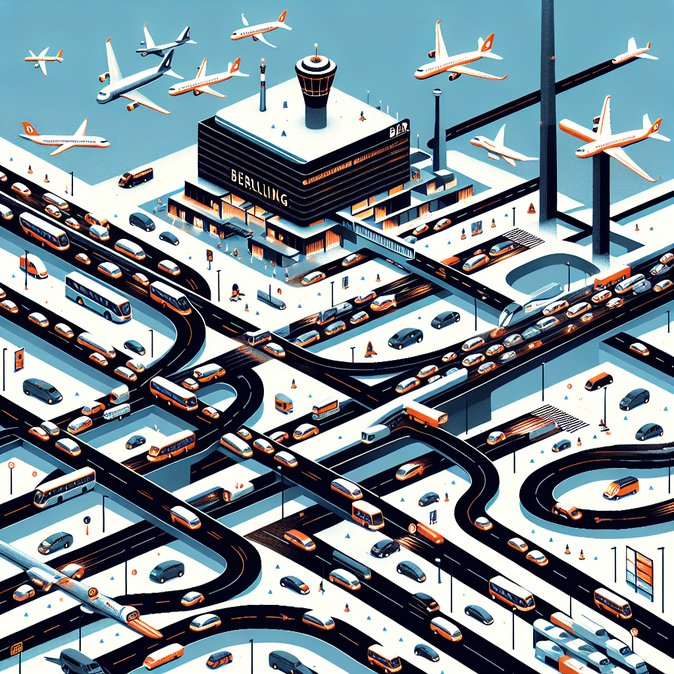
Berlin’s long-anticipated Christmas get-away has begun in earnest. According to the city’s Traffic Information Centre (VIZ), traffic on the capital’s ring roads and arterial motorways began to thicken late Friday evening and is expected to remain heavy throughout Saturday as families, international students and business travellers head for airports, rail stations and rental-car depots.
At Berlin-Brandenburg Airport (BER) alone, more than 1.1 million passengers are forecast to pass through the terminals between 20 December and 2 January—matching pre-pandemic levels for the first time. Airport operator FBB has scheduled roughly 7,300 flight movements over the two-week peak period and re-opened additional security lanes in Terminal 1 to keep wait times below 20 minutes. Lufthansa, easyJet and Eurowings have all deployed larger-gauge aircraft on key European city-pairs (London, Madrid, Milan) and on long-haul leisure routes such as Dubai and Singapore to absorb demand.
For international visitors who discover they still need a visa or transit permit before departure, VisaHQ can expedite the entire process online. The platform (https://www.visahq.com/germany/) offers step-by-step digital applications, real-time status tracking and optional courier pick-up—an efficient back-up for corporate mobility managers scrambling to keep holiday itineraries on track.
![Berlin-Brandenburg Faces Holiday Travel Surge: 1.1 Million Passengers Expected at BER]()
Road and rail networks are also under strain. Construction on the city motorway A100 near Detmolder Straße and on the A115 Dreilinden junction is already causing intermittent tailbacks; drivers are being urged to allow at least 45 minutes of extra journey time to reach BER. Deutsche Bahn has added 50,000 seats on ICE and InterCity services this weekend, but the train-drivers’ union GDL has warned it will “not rule out” further industrial action in the new year if wage negotiations stall—an uncertainty global-mobility managers should monitor closely.
For corporate travel programmes the immediate impact is two-fold: first, ticket prices have spiked by an average 18 per cent on domestic German routes originating in Berlin, according to forward-booking data from Amadeus. Second, last-minute seat availability is extremely limited on evening departures through Monday. Mobility teams are advising travellers to consider alternate gateways (Leipzig, Dresden, even Poznań in Poland) and to factor in potential road delays when booking airport transfers.
Looking ahead, FBB says it will publish a post-mortem operations report in January outlining lessons learned—a document mobility professionals should review. Early indicators suggest that permanent additional security staffing and the expansion of the BER Runway fast-track lane could become fixtures in 2026, potentially improving the employee-experience score for assignments into Germany’s capital region.
At Berlin-Brandenburg Airport (BER) alone, more than 1.1 million passengers are forecast to pass through the terminals between 20 December and 2 January—matching pre-pandemic levels for the first time. Airport operator FBB has scheduled roughly 7,300 flight movements over the two-week peak period and re-opened additional security lanes in Terminal 1 to keep wait times below 20 minutes. Lufthansa, easyJet and Eurowings have all deployed larger-gauge aircraft on key European city-pairs (London, Madrid, Milan) and on long-haul leisure routes such as Dubai and Singapore to absorb demand.
For international visitors who discover they still need a visa or transit permit before departure, VisaHQ can expedite the entire process online. The platform (https://www.visahq.com/germany/) offers step-by-step digital applications, real-time status tracking and optional courier pick-up—an efficient back-up for corporate mobility managers scrambling to keep holiday itineraries on track.
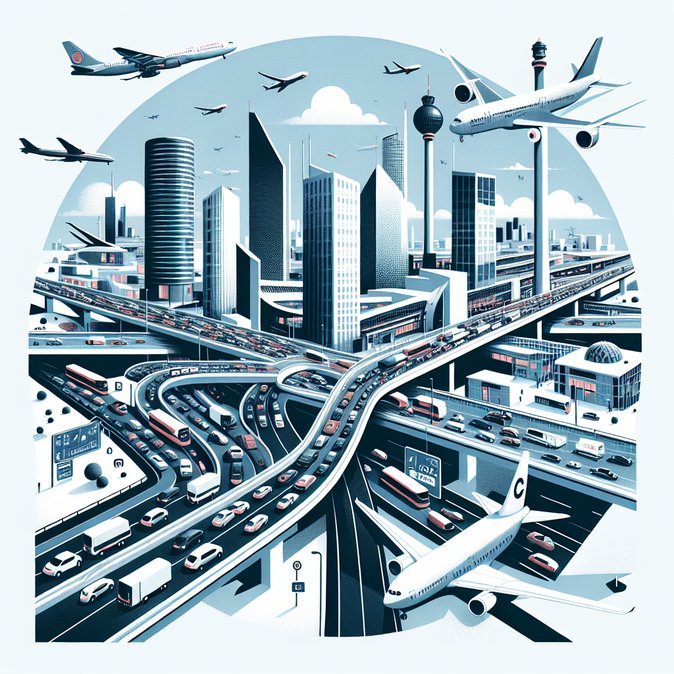
Road and rail networks are also under strain. Construction on the city motorway A100 near Detmolder Straße and on the A115 Dreilinden junction is already causing intermittent tailbacks; drivers are being urged to allow at least 45 minutes of extra journey time to reach BER. Deutsche Bahn has added 50,000 seats on ICE and InterCity services this weekend, but the train-drivers’ union GDL has warned it will “not rule out” further industrial action in the new year if wage negotiations stall—an uncertainty global-mobility managers should monitor closely.
For corporate travel programmes the immediate impact is two-fold: first, ticket prices have spiked by an average 18 per cent on domestic German routes originating in Berlin, according to forward-booking data from Amadeus. Second, last-minute seat availability is extremely limited on evening departures through Monday. Mobility teams are advising travellers to consider alternate gateways (Leipzig, Dresden, even Poznań in Poland) and to factor in potential road delays when booking airport transfers.
Looking ahead, FBB says it will publish a post-mortem operations report in January outlining lessons learned—a document mobility professionals should review. Early indicators suggest that permanent additional security staffing and the expansion of the BER Runway fast-track lane could become fixtures in 2026, potentially improving the employee-experience score for assignments into Germany’s capital region.


