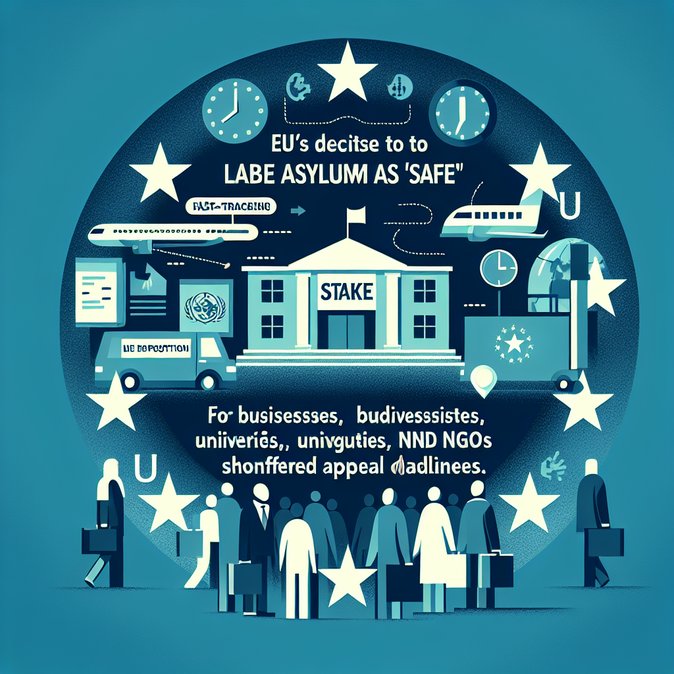
France’s asylum offices will have to apply a radically different screening logic from today after the European Union agreed to designate Bangladesh, Colombia, Egypt, Kosovo, India, Morocco and Tunisia as “safe countries of origin”. Under the revised Pact on Migration and Asylum, which EU institutions formally endorsed on 18 December, applications from nationals of those states will be channelled into accelerated border-procedure lanes. Claimants will now bear the burden of proving individual persecution, rather than benefiting from a presumption of risk.
For France, which registered almost 100,000 first-time asylum requests last year, the change is expected to reduce interview backlogs at OFPRA (the French Office for the Protection of Refugees and Stateless Persons) and free up accommodation places for more complex cases originating from conflict zones. Interior-ministry planners estimate that 12-15 percent of current applications fall under the new fast-track categories—resources that could now be redeployed to speed decisions on Ukrainian, Sudanese or Afghan files.
Corporate mobility managers and universities should nevertheless prepare for shorter appeal windows: rejected applicants from the seven countries will have only one week to contest decisions before removal orders are issued. Employers who sponsor talent from India or Morocco may need to switch to work-permit pathways sooner because humanitarian stay will become harder to secure.
![EU adds 7 “safe countries” to fast-track list, reshaping France’s asylum caseload]()
In this context, VisaHQ can be an invaluable ally. Through its France portal (https://www.visahq.com/france/), the service guides employers, students and individual travellers in selecting the right visa category, compiling supporting documents and securing consular appointments—help that becomes essential as humanitarian options narrow and administrative timelines tighten.
Politically, Paris sees the agreement as a rare convergence of security and solidarity goals. By aligning with the EU list, France can justify keeping six-month internal Schengen border checks in place while arguing that it still offers protection to those who genuinely need it. Human-rights NGOs, however, warn that rapid procedures risk overlooking LGBTQ+ or opposition activists whose persecution is less visible.
Looking ahead, the European Commission will review the safe-country list every year. French lawyers expect challenges: if security deteriorates in any of the seven states—or if French administrative courts find systemic flaws in the new procedure—claimants could still win status on appeal, keeping the legal landscape fluid.
For France, which registered almost 100,000 first-time asylum requests last year, the change is expected to reduce interview backlogs at OFPRA (the French Office for the Protection of Refugees and Stateless Persons) and free up accommodation places for more complex cases originating from conflict zones. Interior-ministry planners estimate that 12-15 percent of current applications fall under the new fast-track categories—resources that could now be redeployed to speed decisions on Ukrainian, Sudanese or Afghan files.
Corporate mobility managers and universities should nevertheless prepare for shorter appeal windows: rejected applicants from the seven countries will have only one week to contest decisions before removal orders are issued. Employers who sponsor talent from India or Morocco may need to switch to work-permit pathways sooner because humanitarian stay will become harder to secure.

In this context, VisaHQ can be an invaluable ally. Through its France portal (https://www.visahq.com/france/), the service guides employers, students and individual travellers in selecting the right visa category, compiling supporting documents and securing consular appointments—help that becomes essential as humanitarian options narrow and administrative timelines tighten.
Politically, Paris sees the agreement as a rare convergence of security and solidarity goals. By aligning with the EU list, France can justify keeping six-month internal Schengen border checks in place while arguing that it still offers protection to those who genuinely need it. Human-rights NGOs, however, warn that rapid procedures risk overlooking LGBTQ+ or opposition activists whose persecution is less visible.
Looking ahead, the European Commission will review the safe-country list every year. French lawyers expect challenges: if security deteriorates in any of the seven states—or if French administrative courts find systemic flaws in the new procedure—claimants could still win status on appeal, keeping the legal landscape fluid.