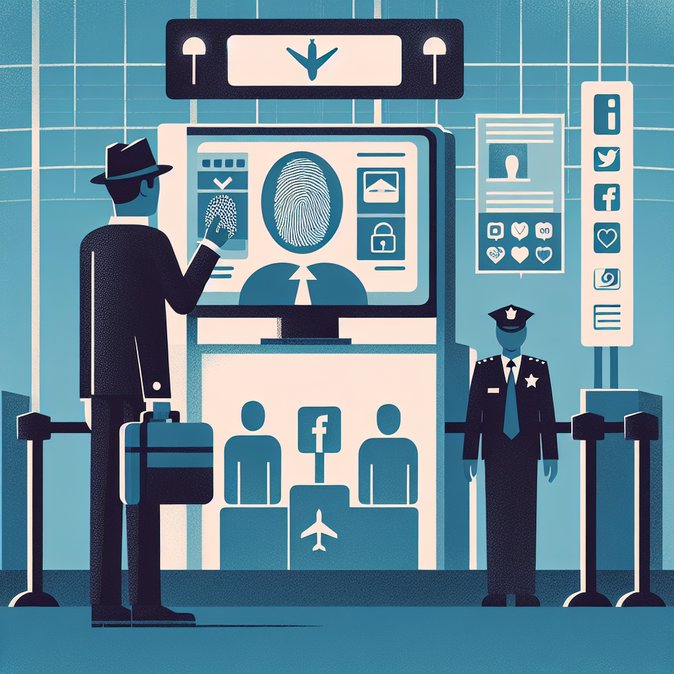
In Washington, the Department of Homeland Security has released a draft rule that would force nationals of all 42 Visa Waiver Program (VWP) countries—including Germany—to list every social-media handle they have used in the past five years when applying for an ESTA travel authorisation. The proposal, published on 16 December 2025, also envisages optional DNA collection for “risk-based secondary screening” and an expansion of biometric capture at U.S. pre-clearance sites such as Dublin and Abu Dhabi.
For Germany, the stakes are high: pre-pandemic, more than two million Germans visited the United States annually, and Lufthansa’s trans-Atlantic joint venture depends on friction-free ESTA approvals. German privacy regulator BfDI called the plan “disproportionate mass surveillance” and hinted it may advise citizens to minimise their digital footprint before applying. Data-protection lawyers warn that inconsistent profile names—or old satirical posts—could trigger refusals that are almost impossible to appeal.
Corporate mobility teams face new compliance chores. U.S. inbound assignees and frequent business travellers will need social-media audits to ensure that usernames declared on the ESTA match those on company devices. Travel-management companies anticipate longer lead times: the ESTA form, which once took ten minutes, could morph into a 40-minute exercise once all fields are mandatory.
![US plans mandatory social-media disclosure for German visa-waiver travelers]()
For travellers and employers navigating these looming complexities, VisaHQ can act as a one-stop platform. Its Germany-specific portal (https://www.visahq.com/germany/) monitors DHS rule changes in real time, offers pre-submission reviews of ESTA applications and alerts users to any inconsistencies—such as mismatched social-media handles—that might otherwise result in costly refusals.
Tourism bodies on both sides of the Atlantic fear a chill effect. The U.S. Travel Association already estimates a €12.5 billion loss in inbound revenue this year; German tour operator DER Touristik warns that additional digital scrutiny “could push price-sensitive holiday-makers toward Canada or Asia.”
The draft is open for public comment until 31 January 2026 and could take effect as early as summer 2026. German diplomats in Washington have signalled they will push for exemptions for minors and short stopovers, but insiders say the Biden administration is unlikely to dilute the security package in an election year.
For Germany, the stakes are high: pre-pandemic, more than two million Germans visited the United States annually, and Lufthansa’s trans-Atlantic joint venture depends on friction-free ESTA approvals. German privacy regulator BfDI called the plan “disproportionate mass surveillance” and hinted it may advise citizens to minimise their digital footprint before applying. Data-protection lawyers warn that inconsistent profile names—or old satirical posts—could trigger refusals that are almost impossible to appeal.
Corporate mobility teams face new compliance chores. U.S. inbound assignees and frequent business travellers will need social-media audits to ensure that usernames declared on the ESTA match those on company devices. Travel-management companies anticipate longer lead times: the ESTA form, which once took ten minutes, could morph into a 40-minute exercise once all fields are mandatory.

For travellers and employers navigating these looming complexities, VisaHQ can act as a one-stop platform. Its Germany-specific portal (https://www.visahq.com/germany/) monitors DHS rule changes in real time, offers pre-submission reviews of ESTA applications and alerts users to any inconsistencies—such as mismatched social-media handles—that might otherwise result in costly refusals.
Tourism bodies on both sides of the Atlantic fear a chill effect. The U.S. Travel Association already estimates a €12.5 billion loss in inbound revenue this year; German tour operator DER Touristik warns that additional digital scrutiny “could push price-sensitive holiday-makers toward Canada or Asia.”
The draft is open for public comment until 31 January 2026 and could take effect as early as summer 2026. German diplomats in Washington have signalled they will push for exemptions for minors and short stopovers, but insiders say the Biden administration is unlikely to dilute the security package in an election year.